When MIT bioengineer Linda Griffith set out to find a better treatment for a painful disease affecting 1 in 10 women—including her and her niece—she took a different path from most researchers. She didn’t use animals.
Instead, Griffith took cells from patients with endometriosis—a disease that causes tissue from the uterus to grow in other parts of the body—and used them to grow tiny versions of uterine tissue. She placed the tissue on lab “chips” designed to simulate the human body, with nutrient-rich liquid pumped through microscopic channels to keep it alive. Using these “organoids,” she could study exact replicas of what was happening in patients’ bodies and test what molecules might stop the growth of endometriosis lesions. Before her work, a drug had been discovered that stopped endometrial lesions in mice used as models. But the drug failed in human trials—as do 90% of drugs found safe and effective in animals. Her breakthrough approach created a path forward.
“We can’t make a lot of progress if we continue to study animals,” Griffith said in “Move over, mice!,” a 2025 MIT talk. “We really need to study the patients and replace animals with living patient avatars.”
David Keith Jones/
To the Rescue!
The annual To the Rescue! gala, benefiting Humane World for Animals and its mission to protect animals, will be held on November 6, 2026, at Cipriani 42nd Street in New York City.
Moving toward a kinder approach
Since the passage of the Federal Food, Drug and Cosmetic Act in the U.S. in 1938, billions of mice, rats, guinea pigs, rabbits, dogs, fish, monkeys, chimpanzees and other animals have been used to study human diseases and test chemicals, drugs and vaccines. Safer, cheaper and more effective methods have existed for decades, and are gradually replacing animal testing, especially in the cosmetics industry. Still, an estimated 190 million animals worldwide languish in barren cages, suffering through invasive tests and enduring experiments that often end in death for necropsy. Outdated government laws and rules require companies to use them for safety testing. For research laboratories there are no such legal requirements, but the practice continues.
Now, U.S. labs are finally ending animal testing after decades of advocacy by Humane World for Animals and others. Three of the federal agencies that provide funding and establish testing requirements are decisively moving away from animal methods. In 2025 and 2026, the National Institutes of Health, the world’s largest funder of biomedical research; the Food and Drug Administration; and the Environmental Protection Agency all announced they would encourage the development and use of human-based technologies, including lab-grown cells and organoid models, as well as computational models that use human data.
“It’s come to this really critical point,” says Kathleen Conlee, vice president of animal research issues for Humane World. “The animal tests aren’t giving us the information we need. We have to do something different. This is the moment we need to seize.”
Siqui Sanchez/Getty Images
A different kind of laboratory
Instead of another animal lab, NIH is establishing an organoid center at the Frederick National Laboratory for Cancer Research in Maryland, where scientists will develop small models of the liver, lung, heart and intestines grown from human cells. The aim is to create reproducible, scientifically reliable non-animal models that can be used around the world.
Humane World Action Fund is working to ensure that NIH, FDA and EPA carry out commitments to non-animal testing before the end of the Trump administration, says Tracie Letterman, vice president of federal affairs. The Humane World team is asking that the federal agencies direct their funding toward the development of non-animal approaches and make it clear that those can be used for safety testing.
Until now, almost half of the NIH budget—$20 to $25 billion—has been spent on research and testing that uses animals but only a small fraction has been used to support non-animal methods. “It’s critical that we maintain this pressure,” says Letterman.
Pakhnyushchyy/Getty Images
When Amanda Ulrey, president of the Institute for In Vitro Sciences, first arrived at the nonprofit in Gaithersburg, Maryland, 20 years ago, non-animal methods for toxicity testing developed there had already been proven effective. Today, those tests have been accepted by the federal government and adopted by private companies.
With the NIH, FDA and EPA announcements, Ulrey hopes for quicker progress. Scientists understand so much, she says—they can identify the events that lead to itchy skin at the molecular level. “There’s a lot of potential to make big moves now.”
Inside In Vitro Sciences’ labs, researchers are using new ways to test safety without animals. White-coated technicians work with precisely calibrated pipettes for handling human cells and cytometers that rapidly count them. Incubators provide just the right temperature, CO2 level and humidity for tissue shipped in weekly from Boston and abroad. Lab-grown human skin cells are exposed to a test material and UV light, then scanned. If the cells are still alive, they metabolize a dye that turns purple. There are human lung slices the size of a toothpick’s point, ready to be inserted into a machine that surrounds them with smoke.
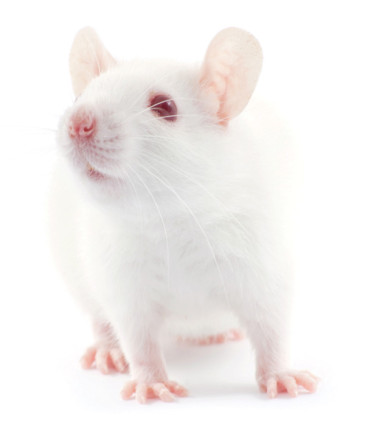
While rodent models have been useful, we are not 150-pound rats. And even though we are not balls of cells either, you can often get much better information from these balls of cells than from rodents.”
Thomas Hartung, Johns Hopkins researcher
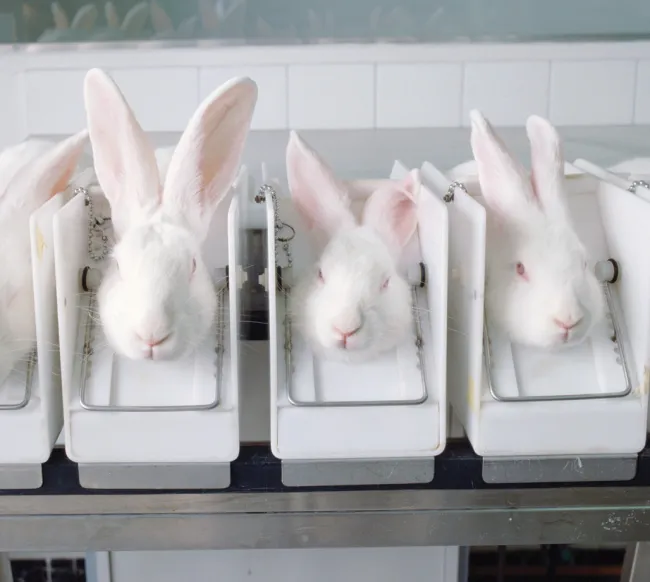
What’s missing: rows of animals. Not a single rabbit restrained so a corrosive substance can be dropped into their eyes or applied to their shaved skin. Not a single rat with a cup over their nose, forced to breathe in a toxic substance. Not a single cage.
This is a vision of the future, across the United States and around the world: better safety tests, revolutionary research. All without animal suffering.
The survivors
With the help of Humane World for Animals, chimpanzee research has ended in the U.S., but tests and experiments on primates continue, with 70,000 macaques still used in labs and tens of thousands more used for breeding. The same is true for rabbits and beagles, thousands of whom are still bred and used for testing and research. Below are the stories of four animals who survived.
Brandon Wade/AP Images for Humane World for Animals
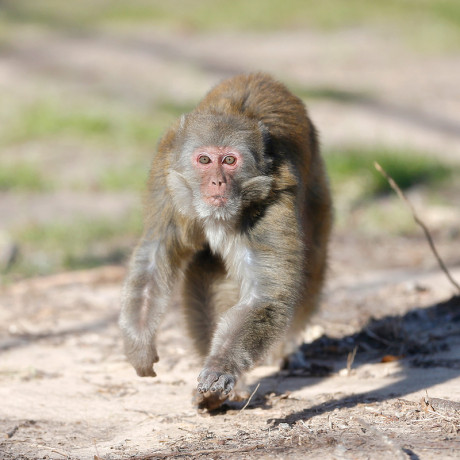
Big Bit, 38 years old
Black Beauty Ranch sanctuary, Texas
The oldest rhesus macaque at our Black Beauty Ranch sanctuary, Big Bit started her life as “RH-1266,” a subject in a long-shuttered lab doing HIV and hepatitis research on primates. She was listed as “on study” and likely lived in a row of sterile metal cages. Big Bit was trained to present her limbs for blood draws and injections, and to climb into a box for transport to experiments.
In 1997, after seven years in the lab without ever going outside, she arrived at the sanctuary, where she now roams a large, wooded yard open to the sky. As with other macaques, she is “reactive”—she may perceive eye contact or close proximity as a threat and respond by posturing, opening her mouth or giving a raspy bark, says Christi Gilbreth, the sanctuary’s senior specialist of outreach and development.
Big Bit, who has arthritis, spends much of the day napping and lounging. But she’s quick to vocally join disputes of her macaque neighbors. In the lab, she might once have spent hours in fear, hearing or smelling lab attendants and waiting for their approach—anticipating the needles, pain and restraints that followed. Now she has no need to worry. The humans bring only food.
Marci Smeltz
Donny, 8 years old
Adopter’s home near Research Triangle Park, N.C.
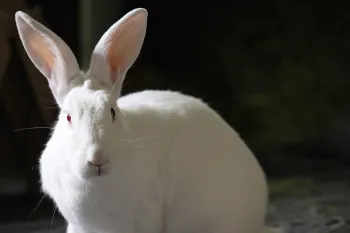
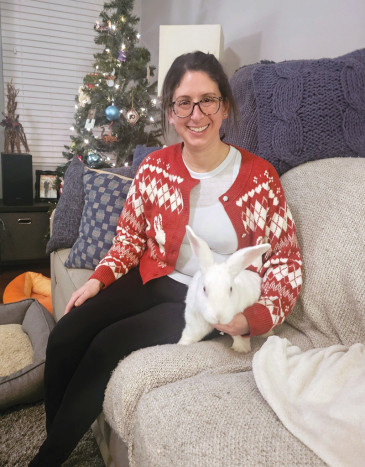
Donny, a New Zealand white rabbit, was the first of two animals adopted from the EPA lab in Research Triangle Park in June 2025. His adoption marked the agency’s renewed commitment to phasing out the use of mammals for chemical safety testing.
EPA scientist Marci Smeltz, who with her husband already had a rabbit, dogs and lizards, says she happily agreed to take Donny. At the end of one workday, Smeltz—who develops non-animal methods for testing the effects of inhaling chemicals—carried the big rabbit out of the EPA lab and into the sunshine for the first time.
She then drove him slowly home, radio off, so he could adjust.
When she is home, Donny roams the kitchen and living and dining rooms. (He never had much room to hop around in the lab.) Now he does binkies—joyous leaps and twists—and zooms around in the high-energy movement known as the “bunny 500.” If Smeltz and her husband are away, he’s in a pen with a dog bed, a king-size comforter, a crate and a litter box. “He’s a big splooter,” Smeltz says. “He’ll lay his back legs out and relax. He’ll do this big yawn. He’s super chill.” He likes bell peppers and being petted, and he gets along with Smeltz’s 14-year-old poodle mix. Donny doesn’t like to be held, but he’s curious and loves people. When Smeltz comes home from work, he’s excited to see her (she gives him a treat). When she comes downstairs in the morning, he greets her—happy for another day in a real home.
Chimp Haven
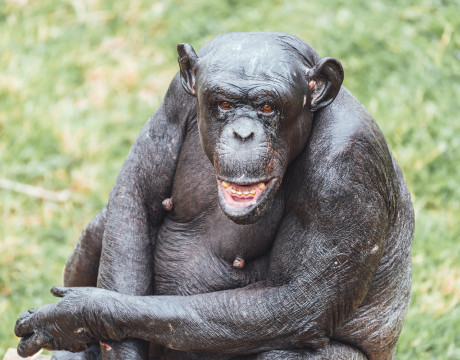
Hope, 29 years old
Chimp Haven sanctuary, Louisiana
Hope was born into a world in which she had no choices. The lab in New Mexico, then called the Coulston Foundation, exposed chimpanzees to infectious diseases such as hepatitis and HIV. Repeated violations of the federal Animal Welfare Act led to the deaths of 48 animals there in less than a decade.
In 2002, when Hope was five, the invasive experiments and poor conditions ended as research was halted. But she did not leave what became the Alamogordo Primate Facility for another 16 years, after persistent appeals by Humane World for Animals and other advocates finally made her release possible. Hope went to Chimp Haven, a sanctuary established by the NIH for federally owned chimpanzees.
Now she can choose.
When it’s time to clean her yard, trainers offer a flying disc or a tennis ball: If she chooses the flying disc, they’ll return later. If she chooses the tennis ball, she moves to her indoor “bedroom” for a treat while they clean the yard.
Hope doesn’t like to be locked inside, even for an hour, but she accepts it if she can choose when it happens, says Michelle Reininger, Chimp Haven colony director. Most of the time, when she’s free to move about, Hope is affectionate, often hugging other chimpanzees in her group. “She is one of the sweetest chimps I know. Very loving, very caring,” says Reininger. “She is the glue that holds them together.”

Anita Archambeau
Phoebe, 4 years old
Adopter’s home near Harrisburg, PA
Phoebe was among the last of more than 4,000 beagles rescued from the Envigo breeding site in Cumberland, Virginia, during the summer of 2022. The rescue was carried out by Humane World for Animals and our partners after the company agreed to shut down the facility following a U.S. Department of Justice investigation of Animal Welfare Act violations. At 13 pounds, she was emaciated—dogs there were fed too little poor-quality food. Of her litter of seven, only one other made it out alive.
When Anita Archambeau took her home to central Pennsylvania, she had to teach Phoebe how to use a bowl. After some weeks, Phoebe howled for the first time. Imitating Archambeau’s two other beagles, she did zoomies. She learned how to get a belly rub and how to stop when running on grass. She overcame her fear of men and felt comfortable around Archambeau’s husband.
“She started to develop her queen complex,” Archambeau says. “She dominated the house.”
Then, Archambeau saw a post from our Pennsylvania state director Kristen Tullo looking for Envigo beagles to visit the state capital. Phoebe became a lobbyist for a bill to protect dogs and other animals in Pennsylvania laboratories. The proposed legislation unanimously passed the Senate last year, and Phoebe was awarded the Pennsylvania Freedom Medal.
Still, she has her moments, says Archambeau. Unexpected noises, like a cell phone beep, make her shake. But medications help manage her anxiety. She’s loving and cuddly and makes Archambeau and her husband laugh, running across the top of the couch, carrying stuffed animals. “She’s an amazing little soul.”
Toward the end of animal testing
Humane World for Animals began pushing for an end to animal research and testing soon after our founding in 1954. In the following decades, scientific advances created humane alternatives until, finally, companies, governments and researchers began to adopt them in the ‘80s.
1980
Animal welfare advocate Henry Spira’s campaign persuades cosmetics giant Revlon to stop using the Draize test, which exposes animals’ eyes and skin to painful chemicals.
1981
The Johns Hopskins Center for Alternatives to Animal Testing opens.

1997
The Institute for In Vitro Sciences is founded in Gaithersburg, Maryland, to promote non-animal methods for testing and research.
2004
The European Union passes a law phasing out the production and sale of cosmetics tested on animals by 2013.
2008
The “Toxicology in the 21st century” initiative is launched by U.S. federal government agencies with our support to develop non-animal methods for testing whether chemicals can harm humans.

2014
The Humane Cosmetics Act, which would prohibit the testing of cosmetics on animals and the sale of animal-tested products in the U.S., is introduced with our help for the first time in Congress.
2015
The National Institutes of Health ends research on chimpanzees and starts retiring the surviving animals to sanctuaries after years of Humane World for Animals’ advocacy.

2016
The Lautenberg Chemical Safety for the 21st Century Act prioritizes the use of non-animal methods for testing industrial chemical safety in the United States.
2018-2019
Unilever, Proctor & Gamble, Estée Lauder and Avon join the Humane World for Animals-led #BeCrueltyFree campaign to end cosmetics testing on animals worldwide.
2023
Brazil bans cosmetics testing on animals.
2024
Washington becomes the 12th state to ban sales of animals-tested cosmetics, essentially ending the sale of such products in the United States.
2025
The National Institutes of Health closes its last beagle lab on the agency’s campus just outside Washington, D.C.
The Environmental Protection Agency begins offering animals at its Research Triangle Park, North Carolina, lab for adoption.
The Centers for Disease Control and Prevention looks to end studies on 200 macaques at its Atlanta lab.
2026
The Oregon Health and Science University board of directors and the NIH agree to discuss ending research at the Oregon National Primate Research Center—the biggest NIH-funded National Primate Research Center in the country, with 5,000 macaques and other monkeys.
Beyond 2026
The Food and Drug Administration plans to replace most animal tests in the drug approval process with non-animal tests during the next three to five years.
Health and Human Services Secretary Robert F. Kennedy has announced he wants to stop the importation of monkeys for scientific studies and supports retiring them to sanctuaries.
The Environmental Protection Agency has committed to phasing out the use of mammals for chemical and pesticide tests by 2035.
Related Stories
Meredith Lee/Humane World for Animals
After witnessing research rabbits' suffering firsthand, a former lab worker has launched a rescue to save rabbits used in testing. This is Mallory Cormier's story.
Chris Engel/Pixabay
Learn how horseshoe crabs are used in medical testing and why Humane World for Animals advocates for humane, modern alternatives.
Aaron Zellhoefer/Humane World for Animals
My rescued beagles reveal the lifelong trauma caused by animal testing. This is why we must end Category E experiments once and for all.