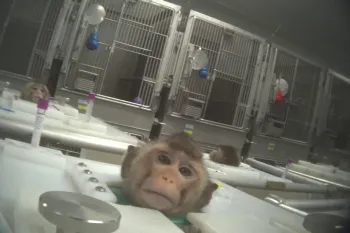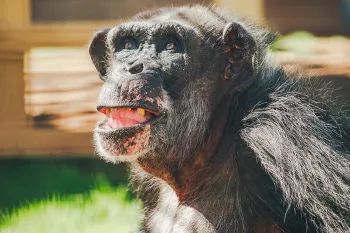
Montessa, a chimpanzee, spent 50 years in a barren laboratory, and for 30 of them, she endured harmful testing procedures. This year, however, her fortune changed. She, along with other chimpanzees from a federally owned facility in New Mexico, finally arrived at Chimp Haven in Louisiana—thanks in large part to our persistent advocacy for their sanctuary retirement.
She and her peers are now living their best lives there. Just recently, the chimps received holiday stockings stuffed with treats.
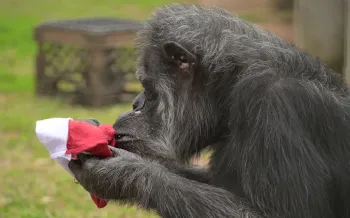
Chimp Haven
Montessa and the other chimpanzees at the sanctuary are a good reminder of what —or who—our work is really about. We’re not defined by the things we’re against. We’re defined by the vision of what we’re for: a better, more compassionate world that benefits everyone.
To create that world, we push hard for the adoption of non-animal methods and technologies in research and testing, not only sparing the lives of rats, mice, rabbits, fish, dogs, monkeys and other species, but also aiming for methods that can test more accurately for human biology. We pursue real relief for animals still languishing in laboratories. We advocate for proper lifetime care for animals fortunate enough to gain their freedom from such places. Finally, we forge the partnerships and initiatives that will help bring that vision of a better world to life.
In pursuit of a world without animals used in research and testing, we’re actively engaged in dozens of countries. Here are just some of 2025’s remarkable accomplishments for these animals:
Brazil
This year, in Brazil, the world’s fifth largest nation and South America’s largest beauty market, our decade-long campaign culminated in a prohibition on the sale of cosmetics tested on animals.
Brazil was also the host nation for the 13th World Congress on Alternatives and Animal Use in the Life Sciences, where we launched a global campaign to end lethal dose testing.
Canada
In Canada, we exposed the commercial import of wild-caught long-tailed macaque monkeys (Mauritius and Cambodia exported nearly 1,800 of them to Canada between 2021 and 2023), highlighting the fact that Canada is right up there with the United States as one of the world’s only importers of endangered wild macaques. We called on the government to ban the import, sale and use of all wild-caught primates (with a sanctuary exception), take meaningful action to improve the welfare of wild macaques in the country, strengthen standards for reporting and accountability for all protocols involving primates, and invest in technologies to replace animal use in research.
Canada also published a strategy to guide and promote the use of non-animal approaches that replace, reduce or refine the use of vertebrate animals in toxicity testing of chemicals whenever possible. Our continued input during consultations and meetings with the government contributed significantly to shaping this strategy, and thousands of our supporters who wrote in during the consultation period played a critical role in influencing its development. To advance this work, we convened the first-of-its-kind workshop bringing together government, academia, industry, trade organizations, and the Canadian Council on Animal Care to discuss practical steps for turning the strategy into action. Our focus now is sustaining momentum and collaboration, so this strategy moves from words on paper to meaningful change.
South Korea
In South Korea, construction began on a national animal-free testing facility, scheduled for completion in 2026. This government-funded center will provide shared infrastructure for nonanimal toxicity testing, training and international collaboration using human cells, 3D models and AI-based tools. It is directly tied to the Ministry of Climate, Energy and Environment’s aim for at least 60% of chemical safety data to come from non-animal methods rather than animal tests.
United Kingdom
Thanks to continued pressure from animal advocacy organizations such as ours and our partners, the UK government released plans to accelerate the phaseout of animal experiments in research and testing. These are the most extensive plans to date that aim to phase out animal use across all of discovery research and regulatory testing.
United States
Key agencies in the U.S. government made dramatic announcements this year that have major implications for animals used in research.
Scientists at the Centers for Disease Control have reportedly been instructed to end all current and future experimentation on monkeys.
The Food and Drug Administration shared its plan to make animal tests the exception and not the rule for testing medicines. Instead, it plans to prioritize non-animal methods that are “faster, cheaper and better at predicting human toxicity.” The FDA also announced that it will implement reforms to clarify that animal testing by pharmaceutical companies is not required and should be replaced by non-animal methods, which is in line with our various efforts, including a petition we submitted in 2024 and our work with Congress. As part of the annual federal funding bill for the FDA, Congress also directed the agency to revise its regulations to make it clear that testing performed on animals is not required for some kinds of testing. In December, the FDA took the first step under its plan by identifying unnecessary tests on monkeys that can be reduced or eliminated. Among other steps, the agency updated its website with a list of methods that companies could use as part of reducing or eliminating animal tests. The FDA also promised to create a guidance document on non-animal methods and take steps to underscore its acceptance of non-animal methods in relevant documents. This was one of our major requests of the FDA this year and marks a huge step to getting animals out of the lab.
The National Institutes of Health announced that it would “prioritize human-based research technologies.” As the world’s largest funder of biomedical research, with an annual budget of $48 billion, NIH has enormous influence on how science is conducted not only in the U.S. but around the world. Its announcement carried an implicit acknowledgment of the limited effectiveness of animal experimentation to advancing human health research.
NIH made good on its commitment to reduce animal use in research. It announced that it will no longer seek new grant proposals that rely solely on animal experiments, launched a new center for the development of human organoid technology that can reduce reliance on animal experiments and closed the last remaining dog laboratory on the NIH campus.
Other agencies also stepped up. The Environmental Protection Agency announced that it would resume its efforts to reduce animal tests, and the U.S. Navy shared its plan to end experiments on dogs and cats.
At the state level, we saw remarkable progress, too: More than 20 states introduced legislation supporting the replacement of animal experiments with non-animal methods, strengthening protections for animals in laboratories, or making it easier to adopt such animals after the experiments in which they were involved had ended. Colorado became the 17th state to give dogs and cats in laboratories a chance to find loving adoptive homes after the experiments have ended. In Virginia, one new law will give monkeys in state-operated laboratories a chance to move to accredited sanctuaries after their use. Another new Virginia law will require state-operated laboratories and public and private institutions of higher learning to post on their website additional documents concerning violations or suspected violations of the Animal Welfare Act in the interests of greater transparency. A new law in New York will prohibit the capture of horseshoe crabs for biomedical blood extraction as well as their use for bait, marking a significant victory for protecting this animal as over 1 million are harvested from the U.S. east coast each year for the biomedical industry.
--
These are just a few of the successes we achieved for animals used in research all over the world. And in every country where we operate, we’re working with interested parties to develop funding plans for non-animal methods, identify the most urgent investment and infrastructure priorities, stage workshops and set the course for further reforms in testing methods in a range of areas. Real change is coming, and we’re at the heart of creating a world in which animals won’t suffer in the name of science. We’re working in a host of ways to usher in a vision of medical and scientific progress that doesn’t rely on animals but rather on an elegant suite of non-animal technologies that can better meet the needs of a 21st century world and make it a kinder one at the same time.
Kitty Block is president and CEO of Humane World for Animals. Follow Kitty Block on X. Sara Amundson is president of Humane World Action Fund.