It started with a raspberry-flavored medicine called Elixir Sulfanilamide that contained antibiotics for strep throat. Unbeknownst to the doctors and pharmacists who prescribed it in 1937, the medicine also contained diethylene glycol, the sweet tasting but poisonous chemical in antifreeze. One hundred and seven people died across 15 states. The Food and Drug Administration spent months tracking down and disposing of every single remaining bottle of the deadly fluid. The incident and several others led Congress to pass the Federal Food, Drug and Cosmetic Act of 1938, and large-scale animal testing began in the United States.
Siqui Sanchez/Getty Images
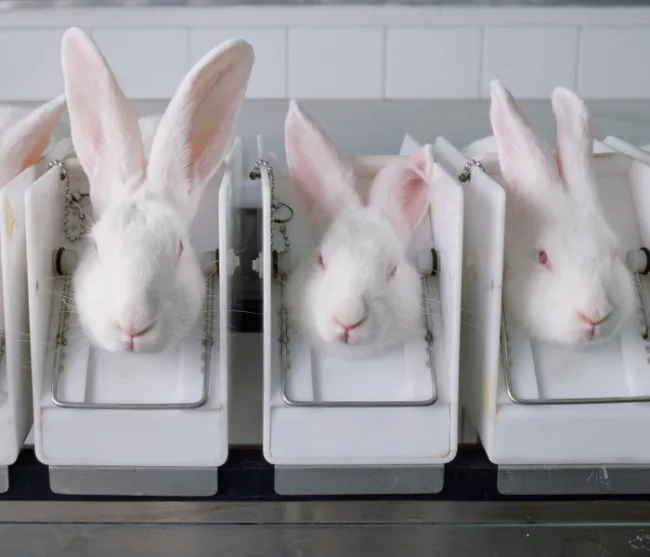
Over the decades that followed, billions of mice, rats, guinea pigs, rabbits, ferrets, dogs, fish, monkeys, chimpanzees and other animals have been used to test drugs, makeup and other products for safety and to research human diseases. Young scientists were trained to experiment on animals and government agencies issued rules that required animal tests. The system spread around the world and continues today. An estimated 192 million animals suffer each year in labs, most confined to barren cages, subjected to often painful tests or distressing experiments, and usually killed for necropsy. Large-scale animal testing continues, even though 90% of drugs found safe in animal tests later fail in clinical trials; too often causing life-threatening reactions and even death in human volunteers or patients. Animals continue to be experimented on to produce models of human disease like Alzheimer’s, cancer and other complex conditions, even though they fail to fully replicate human biology or deepen understanding of human illness—sometimes they set science back.
Humane World for Animals/The HSUS
Replace animal experiments with more advanced alternatives
Stand with us to demand that the federal government, state governments, companies and universities stop relying on outdated animal experiments.
The fight to end animal testing
Humane World for Animals and other animal welfare advocates have pushed for change since the 1950s. Humane World led efforts to end federal research on chimpanzees at the National Institutes of Health and greatly reduced cosmetic testing on animals worldwide. They’ve supported pioneering government, industry and university researchers who are developing non-animal testing and research methods based on human cells and biological systems and human data. And they’ve encouraged the adoption of advanced tools such as computational modeling and miniature organs on a chip for testing the toxicity of chemicals and pesticides and for evaluating the safety and effectiveness of drugs and vaccines.
Now their efforts are producing breakthrough results in the United States. Within the space of a few weeks in April 2025, the heads of the National Institutes of Health (the world’s largest funder of biomedical research) and the Food and Drug Administration (a global leader in protecting public health) issued statements that they are moving away from animal experiments. Consistent with Humane World requests, the two agencies have committed to promoting non-animal methods because they are more effective, quicker and less expensive. Thousands of animals, including dogs and monkeys, could eventually be spared each year, said FDA Commissioner Martin A. Makary.
This is unprecedented. It [feels] like, ‘Put on your running shoes. We need to get as much done as possible.’ This is the moment we need to seize.”
Kathleen Conlee, Humane World for Animals
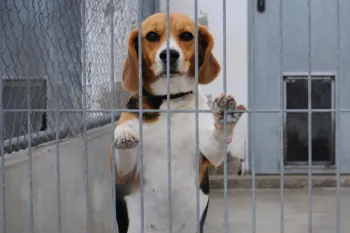
The NIH named Dr. Nicole Kleinstreuer, a champion of non-animal methods, to the top post of deputy director for program coordination, planning and strategic initiatives and announced that it was creating a new dedicated Office of Research Innovation, Validation and Application, while also closing the last beagle laboratory on its campus. At the same time, the Environmental Protection Agency began adopting out animals once used in its laboratories. The FDA made plans to replace animals with non-animal testing in the drug approval process within three to five years. It’s already working to phase out animal tests in the development of new drugs called monoclonal antibodies that can be used to treat cancers, autoimmune diseases and other conditions.
“This is unprecedented,” says Kathleen Conlee, vice president of Animal Research Issues for Humane World. “It [feels] like, ‘Put on your running shoes. We need to get as much done as possible.’ This is the moment we need to seize.”
David Poller/Zuma Press, Inc. ZUMA Press, Inc./Alamy Stock Photo
The shift to non-animal testing speeds up
Month by month, through the fall of 2025 and early this year, the NIH, FDA and EPA made good on their promises. What had been hopeful announcements became a foundation for sweeping change.
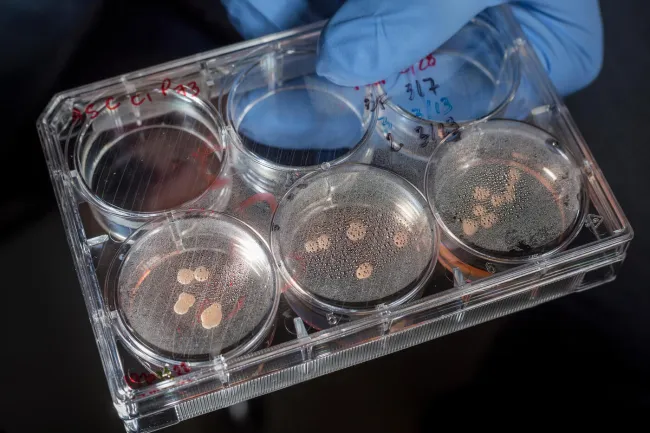
In September, Kleinstreuer and NIH Director Jay Bhattacharya announced the agency was establishing a “first of its kind” center for developing organoids—small models of organs grown in labs from human cells. The center at the Frederick National Laboratory for Cancer Research in Maryland will focus on models of the liver, lung, heart and intestine. The aim is to replace animal tests with reproducible and scientifically reliable non-animal methods, and to make these available to scientists across the country and the world.
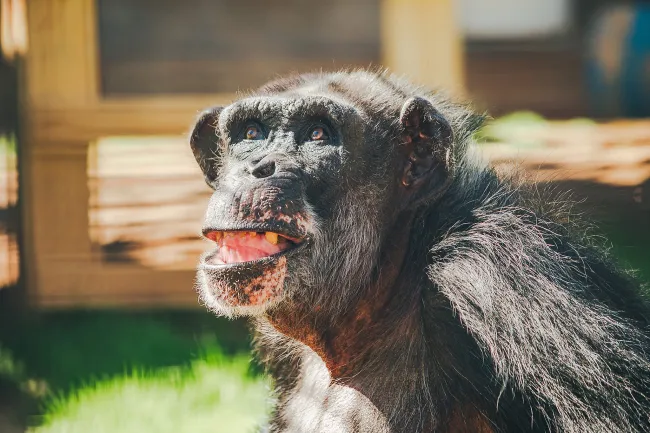
In November, Science, the journal of the American Association for the Advancement of Science, broke the news that the Centers for Disease Control and Prevention would end its infectious disease research on 200 macaques. In December, Health and Human Services Secretary Robert F. Kennedy Jr., speaking on “My View with Lara Trump,” said he no longer wanted NIH to fund primate research and was thinking about moving monkeys in the National Primate Research Centers to sanctuaries.
Kierstin Luckett & Lauren Rager/Chimp Haven
In February, the board of directors of the Oregon Health and Science University voted to enter negotiations to end research at the Oregon National Primate Research Center, the biggest NIH-funded National Primate Research Center in the country, with 5,000 macaques and other monkeys (there are also other NIH-funded primate labs beyond the centers). The February decision followed a legislative effort, which Humane World and other advocates supported, to phase out the primate research center. Ultimately, Oregon state Rep. David Gomberg (D-Otis) included a reconciliation note in the budget that bars state money from being spent on the facility. The measure also requires OHSU to develop a plan to close the center should federal funding fall more than 25% from its 2024 level (the center receives 84% of its funding from NIH, or around $60 million a year). Discussions are underway for the center to become a sanctuary.
Science called this “a seismic change that would affect biomedical research across the country.”
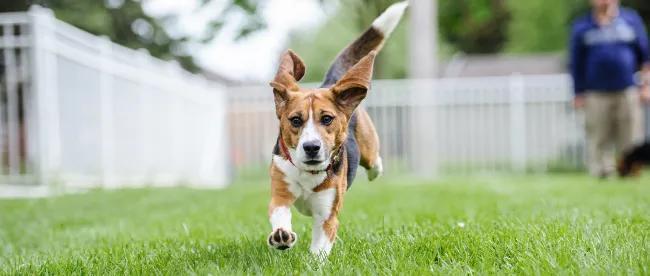
At around the same time, EPA administrator, Lee Zeldin, recommitted the agency to a plan that will phase out chemical and pesticide tests on mammals by 2035. He made the announcement in January flanked by Oliver, one of more than 4,000 beagles Humane World helped rescue from a laboratory breeding facility in 2022 after violations of the Animal Welfare Act. Zeldin thanked the advocates he had invited to be there, including PETA, and Humane World Action Fund.
Bryan Mitchell/AP Images for The HSUS
Humane non-animal alternatives
Already, certain non-animal methods have proven more effective than their animal counterparts: A“human Liver-Chip” produced by a company called Emulate was found to accurately predict toxicity for human livers 87% of the time.
Amanda Ulrey, president of the nonprofit Institute for In Vitro Sciences, in Gaithersburg, Maryland, which has been developing and promoting non-animal methods for nearly three decades, says private companies are abandoning animal tests in favor of cutting-edge science.
“Companies are going right to in vitro (testing on human cells and tissues),” she says. “What happens when there are big announcements [from the government] is that it redirects the ship. I’m hopeful there will be continued momentum.”
Even when promising non-animal alternatives exist, they can take years to be accepted by regulatory agencies, which may still compel the use of animal the use of animals for some research on drugs, such as whether drugs taken over a long period of time become toxic, say Conlee and other experts. But as more money flows to non-animal methods, that will change. Half of the NIH budget, or $20 to $25 billion, has been spent on animal experiments and less than 1% on non-animal methods. In March, the FDA issued guidelines for validating non-animal methods for in drug development and the NIH announced $150 million to develop and validate non-animal methods for biomedical research.
“If we actually, in a meaningful way, shifted the money, what would happen? It would be incredible,” Conlee says. “We save the animals and the people.”
What happens when there are big announcements [from the government] is that it redirects the ship. I’m hopeful there will be continued momentum.”
Amanda Ulrey, president of Institute for In Vitro Sciences
What’s next
Humane World Action Fund is focused on ensuring the NIH, FDA and EPA carry out their commitments to transition to non-animal methods before the end of the current administration, says Tracie Letterman, vice president of federal affairs. To do so, the agencies need to direct their funding toward the development of non-animal approaches and clarify their regulations to make it clear that non-animal methods can be used in safety testing, she says. We are working with the agencies and Congress. “We have to channel our energy here. It’s critical that we maintain this pressure.”

Marci Smeltz
The big change is made up of many small ones, including the retirement of individual animals in laboratories who are no longer used in experiments.
The first to go home from the EPA’s lab in Research Triangle Park, North Carolina, were two white rabbits. Marci Smeltz, an EPA chemist who already had a pet rabbit, adopted one of the two at the request of a coworker. As it happens, Smeltz does her research without using animals: She uses cell cultures to assess the risk of breathing in certain chemicals.
Smeltz picked up 6-year-old “Donny” one evening in June 2025 and took him out of the lab building into the sun for the first time in his life. Then she placed him in her car—his first time in a motor vehicle. Smeltz drove home slowly, trying to avoid any bumps. She kept the radio off, so it would be quiet.
Donny came home on a Thursday. By Saturday, Smeltz says, he was completely settled in, with the other rabbit, a little dog, several more animals and Smeltz’s husband. “I feel very humbled to have him as part of our family,” she says. “He brings a lot of joy to us. I’m just glad that he’s with me now.”
Related stories
Aaron Zellhoefer/Humane World for Animals
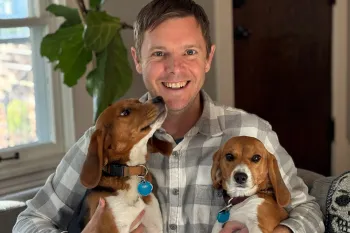
My rescued beagles, Bertie and Ernie, reveal the lifelong trauma caused by animal testing. This is why we must end Category E experiments once and for all.
Kevin Wolf/AP Images for the HSUS
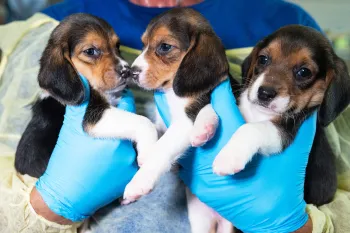
Here's how the historic surrender of 4,145 beagles from Envigo's breeding facility ignited nationwide reform in animal testing and inspired thousands of adoptions.
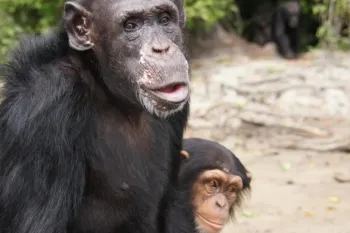
Chikondi Kaona/Humane World for Animals
Every animal has a story. And the dozens of chimps at Second Chance Chimpanzee Refuge, our sanctuary located on a set of estuarine islands near Monrovia, Liberia, have lived stories of epic proportions.