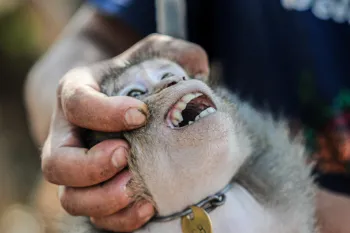
The writing is on the wall at the Oregon National Primate Research Center. A new day is dawning, and with the U.S. government dramatically shifting its funding and strategic emphasis to human-based research, the ONPRC wants to move in the same direction.
In July, Oregon Health & Science University, which provides administrative, academic and institutional support for the primate center, passed a resolution to develop a plan to turn it into a national center for non-animal research while substantially reducing the breeding of monkeys as well as experiments on monkeys there.
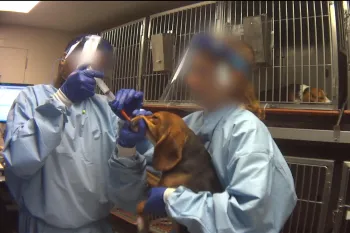
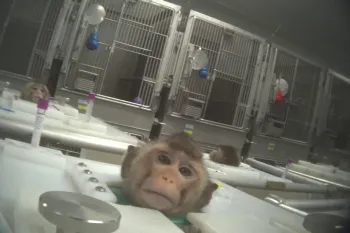
That’s great news, because this center alone has been experimenting on and killing more than 1,000 monkeys per year. But the breeding, use in experiments and death of these and other monkeys there and in other facilities are part of a larger challenge.
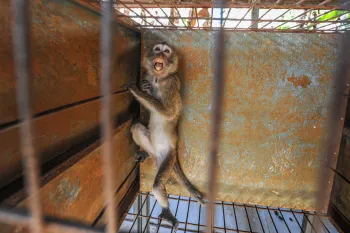
More than 60,000 monkeys are still subjected to experiments in the U.S. every year. Approximately 45,000 more are used as breeders, giving birth to thousands of baby monkeys in the U.S. facilities annually. Others are imported from countries like Cambodia and Vietnam, some captured from the wild, with recent data showing that more than 100,000 were imported into the U.S. between 2001 and 2024.
Jo-Anne McArthur/We Animals
End cruel animal testing
Every day animals endure a life of misery in laboratories around the world. Sign the petition to replace painful animal experiments with sophisticated alternatives.
A crossroads for primate experiments
We first advocated for the conversion of U.S primate centers to centers of excellence for non-animal methods in the mid-1980s, and in recent years, we’ve worked with Oregon state representative David Gomberg and others to advocate for the monkeys at the ONPRC in particular.
In 2023, in an effort led by Rep. Gomberg, Oregon passed a law mandating more transparency about what was happening at the laboratory. In 2025, Rep. Gomberg then introduced a bill that would have required the center to phase out experiments on monkeys. His leadership, along with increasing public pressure on the use of animals at the center, helped to bring us to this remarkable juncture.
The ONPRC is one of seven national primate centers funded by the federal government, beginning in the early 1960s, and this is a landmark event in their long and controversial history as facilities dedicated to carrying out biomedical experiments on multiple nonhuman primate species. As part of the resolution, the ONPRC anticipates it will no longer be designated as a National Primate Research Center, therefore decreasing the number of such facilities to six.
Three new realities for primates in research and testing
- Experimenting on monkeys is increasingly unpopular with the public.
- The federal government is less enthusiastic about funding such facilities.
- Scientists and others are deepening in their conviction that human medicine and health needs are better served by new research based on human biology.
OSHU’s acknowledgment of these three realities will have consequential implications for the mission and focus of the other centers in the future. Given our strong global commitment to non-animal methods that can replace experiments on monkeys and other animals, and our role in helping to shape the adoption of such methods at the National Institutes of Health, the Environmental Protection Agency and the Food and Drug Administration, we’re certainly pleased at the prospect that OHSU will now redirect its focus on building out infrastructure for cutting-edge, human-based research methods.
Some big questions remain, however, and most of them focus on the fate of the primates at the ONPRC, which is currently home to an estimated 5,000 monkeys, making it the largest of the seven U.S. federal primate centers. Together, the seven centers have between 18,000 and 20,000 primates, including baboons, three species of macaque and marmosets.
The thwarted sanctuary and remaining questions
In February, OSHU announced it was in discussion with the NIH to convert the Hillsboro, Oregon, facility into a sanctuary. Ultimately, it abandoned that course, citing prohibitive costs.
Now, instead, it seems that OHSU will move some primates to other institutions, reduce the center’s breeding programs, evaluate opportunities to transfer animals to sanctuaries and refocus what remaining primate research it conducts.
Understanding that a resolution for a situation like this must begin somewhere, we certainly don’t want to see the center start by sending monkeys to other laboratories or breeding facilities, where they might be used and die in experiments or supply their offspring for that same fate. That’s a game of musical chairs, not a genuine reduction in the use of animals in research.
We’re calling on OHSU to transfer its first cohorts of monkeys to sanctuaries, not to other laboratories or breeding facilities.
The danger is real.
Dozens of primate breeding and testing facilities are currently doing business in the U.S. Alpha Genesis, a South Carolina company with more than 10,000 monkeys at two sites, is indicative of the systematic cruelty of this industry. The facility, which receives millions in taxpayer dollars every year, has been cited for multiple violations of the Animal Welfare Act in recent years, but is openly calling for any facilities looking to decrease their primate populations to send the animals their way.
Kathleen Conlee, our vice president of animal research issues at Humane World for Animals, started her career at Alpha Genesis, when it had a different name and owner. What she saw there opened her eyes to how animals in laboratories and breeding facilities are treated and convinced her that experiments on animals were not the way to improve human health.
“The youngsters, who the day before were bonding with their family, would be put in a small cage and prepped for shipping,” she wrote in a guest blog about her experience at the monkey breeding facility. “Mothers would wake up looking for them, crying out. You could hear the youngsters from a building across the property returning their calls. I can still hear their mournful cries—those will haunt me forever.”
The path to primate-free science
Today, Kathleen and her team are working to reduce the use of monkeys in experiments, end their importation and block the construction of new monkey breeding and research facilities nationally, and they’ve shown that public advocacy works. In 2024, we helped halt the construction of a massive monkey breeding facility in Bainbridge, Georgia, in an effort supported by town residents who were only made aware of after it had been approved by county authorities.
“I can still hear their mournful cries—those will haunt me forever.”
— Kathleen Conlee, vice president of animal research issues at Humane World for Animals
When it comes to the larger challenge of phasing out monkey experiments and creating sanctuary opportunities for animals relinquished by laboratories and breeding facilities, we face a challenge at great scale, and one that will require commitment, funding and discipline from interested parties in government, industry, academia, and other sectors. Most of these institutions have long been willing to spend government dollars on the infrastructure required to keep and use monkeys and other primates in experiments.
Now, they must do more than develop a strategy for replacing those animals in experiments. They must also advance the conversation about how to ensure a swift pathway to retirement for the tens of thousands of animals currently languishing in the primate centers and other facilities. We owe them that as part of a just outcome for all that they have been forced to sacrifice and all that they have lost. We simply can’t justify their continued suffering with human-based test methods already proving to be more accurate.
Stand with us to support a switch from animal experiments to advanced non-animal technologies.
Kitty Block is president and CEO of Humane World for Animals. Follow Kitty Block on X. Sara Amundson is president of Humane World Action Fund.