Mallory Cormier started working at the rabbit lab because the position promised career growth and financial independence—she hadn’t been able to afford her own place on a vet tech’s salary. She loved animals and thought she could do what was best for them at the biopharmaceutical facility. An interviewer told her she might have to euthanize rabbits, but as a vet tech she was used to euthanizing animals who were dying or suffering.
Only after she started the job in 2015 did she learn she would have to regularly euthanize young and healthy animals. The people who ran the lab told technicians their work was for the good of humankind.
The hidden horrors of animal testing
The rabbits in the lab had been genetically altered so the females, called does, produced a protein in their milk that could be used to develop a drug to treat hemophilia. Technicians had to artificially inseminate does at the lab so they gave birth.
Each morning, lab workers took away the lactating mothers to milk them. In the afternoon, the mothers were allowed into nest boxes to nurse their 10 to 12 babies. The afternoon milk was not enough for the kits, who grew skinnier and skinnier.
At three weeks, Cormier and her fellow lab workers would remove the nest box from the cage, leaving a metal plate over what had been the door to the box. Some of the mothers scratched their paws bloody on the metal plate trying to nurse their babies. Mallory and the other technicians had to take the kits away to euthanize them.
“The babies—they’re bopping around; they’re adorable. It’s heartbreaking,” says Cormier. “You’re bringing these animals into the world to take them out three weeks later. Again and again and again. I wanted to just slip a baby bunny in my pocket and walk out of there.”
End cruel animal testing
Every day animals endure a life of misery in laboratories around the world. Sign the petition to replace painful animal experiments with sophisticated alternatives.
But Cormier remained, trying to make things better. When she spoke up about rabbits self-mutilating, she was promoted—but given no real power to change their conditions. After two years at the lab, she learned that another lab produced the same protein without using animals.
Cormier became severely depressed. She would drive to work in tears and continue to cry after she arrived. She suffered panic attacks. “Compassion fatigue training” provided by her employer only made her feel worse. When she realized she could no longer fulfill most of her assigned duties, she desperately searched for another job.
In 2017, she left for a veterinary pathology lab, but feelings of shame, regret and sadness stayed with her. They drove her to found the lab rabbit rescue Save the Buns.
From research to rescue
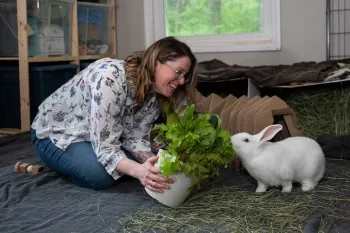
An ad for a rabbit being sold for meat led Cormier to take in her first bunny. She bought and adopted Crumpet, who now lives in her house. Chickpea was the first lab rabbit Cormier was able to rescue. She watched as, freed from life in a cage, he leapt with joy from one side of a pen to another. She thought: “I want to do this for more rabbits.”
Meredith Lee/Humane World for Animals
In 2020, Cormier filed the nonprofit paperwork establishing Save the Buns as a rescue that places rabbits released from labs for adoption. In August 2024, a rescue facilitator emailed that a lab had six rabbits to release who weren’t right for a cardiology study. Cormier wasn’t entirely ready, but she set up pens in a friends’ basement and accepted them.
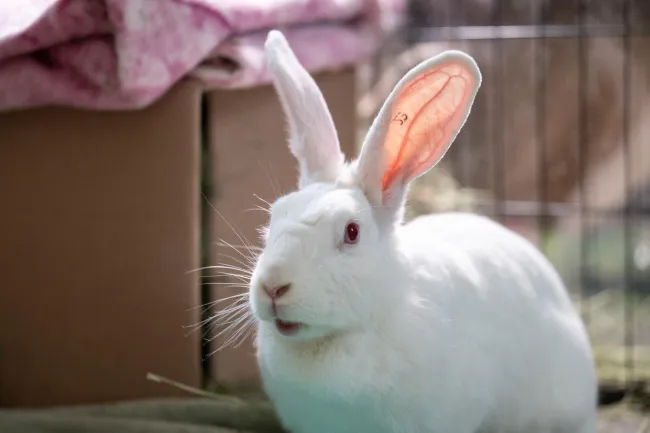
A year later, Cormier got two more rabbits from the same lab and ended up adopting one of those, who she named “Crouton.” She keeps him in her home with Crumpet and Chickpea. When Crouton arrived, he stood out to Cormier because he would extend his head to be touched. Cormier figures he was petted in the lab. “He literally just melts and he’s like, ‘Please, rub my head.’”
As she got to know Crouton, she discovered he is silly, sassy and outgoing. He reminded her of a spirited rabbit she had known while working at the lab. Like Cormier, that rabbit suffered so much that she became a shell of herself. Cormier says Crouton helped her to finally heal. She has his lab tattoo—the number 953—tattooed on her own skin.
Meredith Lee/Humane World for Animals
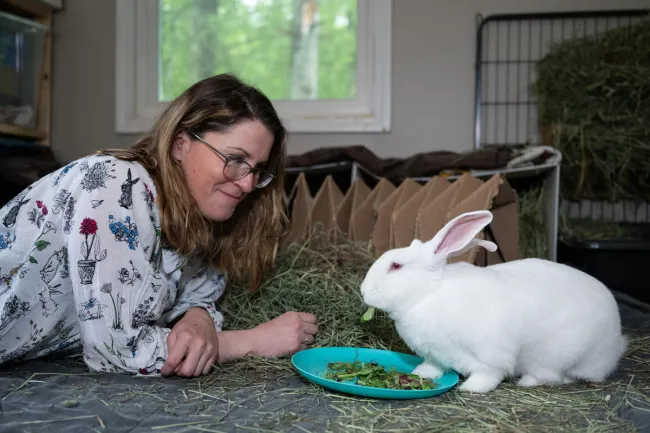
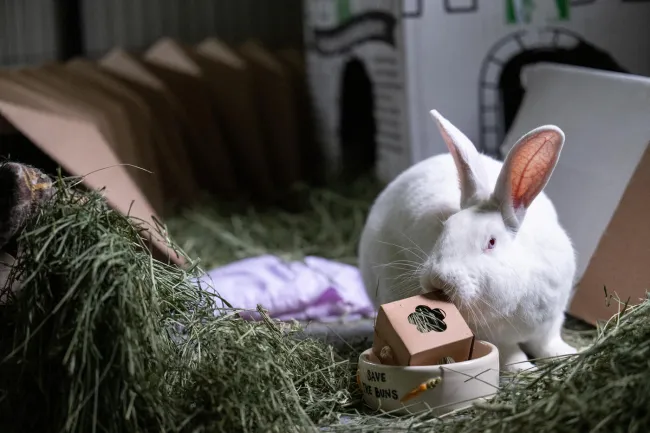
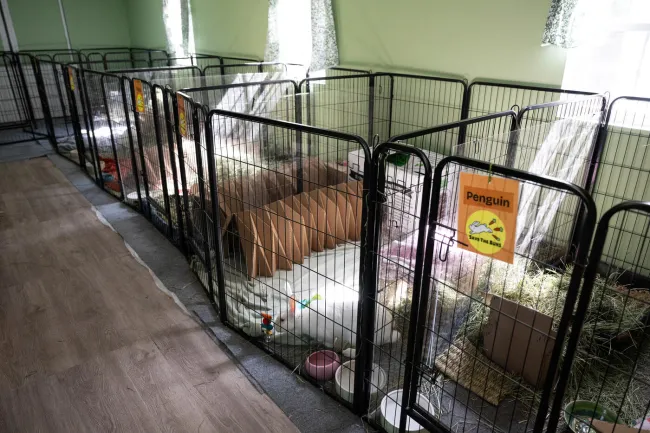
As Save the Buns began to expand, Cormier built a barn near her house with insulation, electricity, heat and cooling to hold more rabbits. She gave the “buns” everything she couldn’t in the lab: plenty of hay, treats and toys; pens with space to move in; lots of light from big windows.
Most of the rabbits released to Save the Buns are spayed, neutered and healthy. However, the first 24 to 48 hours in their transition to life outside the lab are challenging, says Cormier.
After being kept in windowless labs, rabbits are not used to daylight, the noise of traffic or even the sound of rain. Rabbits must also eat continuously for their gastrointestinal tracts to function properly. They can die if they do not. During their first days, Cormier keeps the lights down in the barn, plays calm music and makes sure they have hiding spots. She introduces fresh greens slowly.
Every morning, she gives the rabbits fresh hay, greens and water and cleans their litterboxes. She leaves midday for work, then comes home to give the rabbits their evening salad with a treat and maybe fruit.
Meredith Lee/Humane World for Animals
As of June, Cormier had rescued 21 buns. She is hoping to rescue many more. An estimated 111,000 rabbits, New Zealand whites, and black and white Dutch rabbits, remain in labs in the United States.
There are not enough rescues focused on rabbits like Save the Buns to take in the thousands of rabbits that labs might release, says Kathleen Conlee, vice president for animal research issues at Humane World for Animals. At the same time, too few labs have developed protocols for adopting out animals they will no longer use to homes or even local shelters rather than euthanizing them.
For Cormier, rescuing more rabbits depends on fostering trust and relationships with labs. She is careful not to identify the labs she works with or the people involved in releases. She approaches people in labs with empathy and respect. Not only does her work require their cooperation, but she understands all too well what it is like to work in a lab.
Life after the lab
Cormier invites labs to contact her if they have rabbits they don’t need. She attends veterinary conferences, veg fests and Humane World’s Taking Action for Animals conference. She has found the people who work with rabbits in labs to be receptive. They want better lives for the animals.
She has established a Save the Bun’s Bun Club through which research labs can commit to releasing eligible rabbits to the rescue and reach out whenever rabbits are at risk of euthanasia. This year, she secured the first Bun Club partnerships with two research labs.
Katrina Letourneau once worked at the rabbit lab Cormier left and now serves on the board of Save the Buns, and she credits Cormier with helping her realize she too had to get another job. Like Cormier, Letourneau was having a hard time just showing up for work.
When Cormier resigned, “it gave me the motivation to realize what was going on, to say, ‘This is not right,’” Letourneau says. “It was a dark circumstance, and she was the light that brought me to the light.”
Meredith Lee/Humane World for Animals
Now Letourneau takes care of the Save the Buns rabbits if Cormier has to be away. She delights at the rabbits’ freedom from poking or prodding and their lives in the barn, unrestricted by small cages. “To me, it’s a palace. I’ve never seen so much for a rabbit.”
Mark Hawthorne, author of The Way of the Rabbit and another board member of Save the Buns, describes Cormier as dedicated and tenacious and creative. This year, Cormier joined with Humane World for Animals Connecticut state director Annie Hornish to oppose legislation that would allow large-scale slaughter and processing of rabbits for meat. When Hawthorne identified a newspaper where she might place an op-ed, he said she wrote an 800-word piece within two hours.
After all those days in the lab, Cormier says she wants to make things right where she used to work. “Those bunnies do not have to be euthanized. My ultimate goal is to get some of those bunnies out.”
She has reached out several times to people who still work at that lab and has not heard back. She won’t stop trying.
Related stories
Chris Engel/Pixabay
After receiving strong public feedback, Massachusetts scraps proposal that would harm additional horseshoe crabs.
Jo-Anne McArthur/We Animals
The NIH, FDA and EPA say they want to move away from animal experiments in the U.S. and toward modern alternatives.
Aaron Zellhoefer/Humane World for Animals
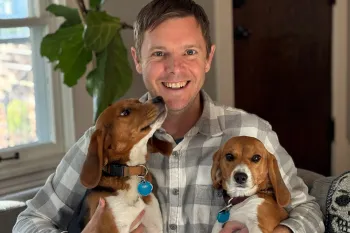
My beagles reveal the lifelong trauma caused by animal testing. This is why we must end Category E experiments once and for all.