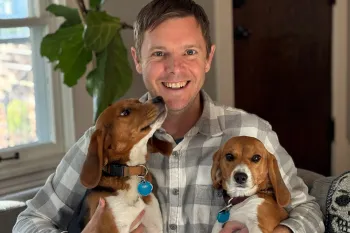
Junior and Raymond were my fur babies. But before my husband and I adopted them, they were known only by numbers tattooed on their ears. They were former research dogs, used in animal testing. One came from Spain, the other from an unnamed U.S. state. When we got them from a rescue group that helps research animals over a decade ago, they had already spent years in a laboratory—five for Junior and two for Raymond.
The hidden trauma of research dogs
Junior had severe confinement issues. For the first month we had him, he refused to leave the living room. Even the short hallway leading to the kitchen terrified him. He’d pause, trembling, too afraid to pass through the 3-foot stretch of open space. Over time, he learned to walk through it—but some fears never left him. Junior was always terrified of anything that muzzled his mouth. He could only eat from shallow dishes, never bowls. Even after 10 years of freedom, he wouldn’t put his face inside one, no matter how many treats it contained. I often wondered if he had been used in inhalation studies, forced to wear a mask and inhale substances.
Aaron Zellhoefer/Humane World for Animals
Junior also never fully learned how to love. He trusted me a little, but he could never quite trust people entirely. He never let anyone get close to him. Snuggles and tight hugs were a no-go. If your face got too close to Junior's, he might growl at you. I couldn’t blame him. The only humans he’d known for most of his life most likely caused him pain.
Raymond, our other boy, had severe separation anxiety and was prone to inappropriate chewing. If I went to the bathroom, he would panic on the other side of the door. Once, he chewed through my husband’s briefcase handle, and Raymond’s injuries required emergency surgery. Another time, he swallowed a phone cord. Over time, he healed, but thunder still terrified him—only Xanax could help. Despite their trauma, Junior and Raymond brought joy into our lives. Our dogs traveled with us across the country—from the Hollywood Hills to the Mississippi River to Central Park; they were a well-traveled pair.
When Junior turned 17 in 2022, his health began to fail. We had to make the heartbreaking decision to let him cross the rainbow bridge. Four months later, Raymond fell ill. What started as a limp turned out to be cancer throughout his body. He passed soon after. Losing both of them within months broke us. I remember thinking, “Why have dogs if this is what I have to go through?” But the answer is love. The love, joy and companionship they gave outweighed any pain.
Aaron Zellhoefer/Humane World for Animals
After some time, I knew I would want dogs again. My husband wasn’t ready, and I respected that. When he finally said yes, it was November 2024, and I shared the news with my peers at Humane World for Animals. As the Minnesota state director for Humane World, I told them I wanted to adopt more beagles—dogs like Junior and Raymond who had known only suffering and deserved to know love.
That’s when my colleague Preston Moore from Iowa connected me with a rescue. Iowa had passed a similar bill to the one I’d helped pass in Minnesota years earlier—a law requiring laboratories offer dogs and cats for adoption once they were no longer used for research. Thanks to Preston’s work, shelters in Iowa had started partnering with research labs to rehome beagles.
Through one of those rescues, I met Shelly Schossow, who runs Calhoun County Caine Shelter and told me she could get a pair of beagles soon. A few weeks later, she sent pictures. I was instantly in love. Their faces were so full of innocence that I wanted to scoop them up and never let them go.
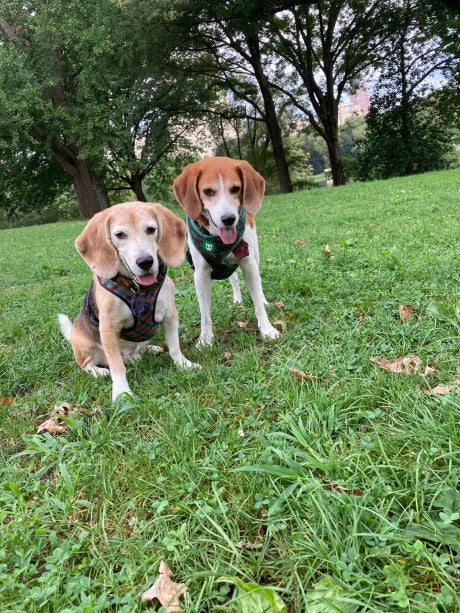
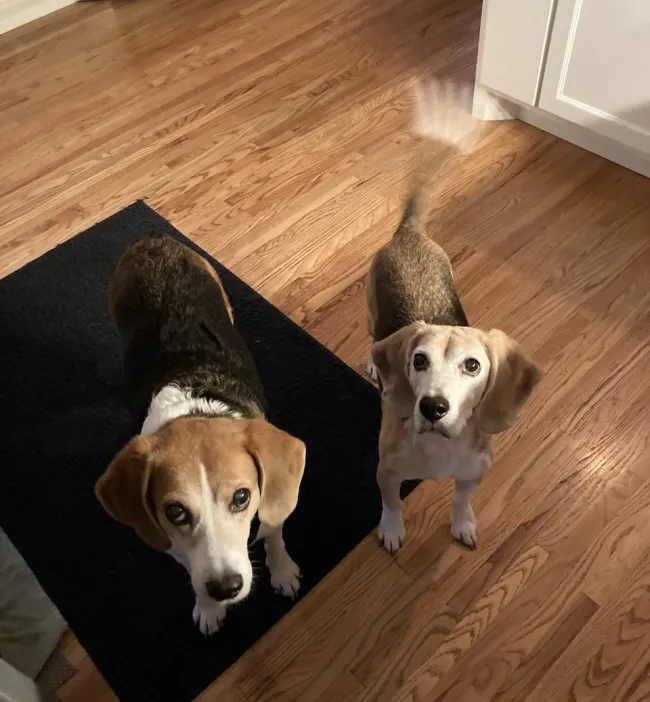
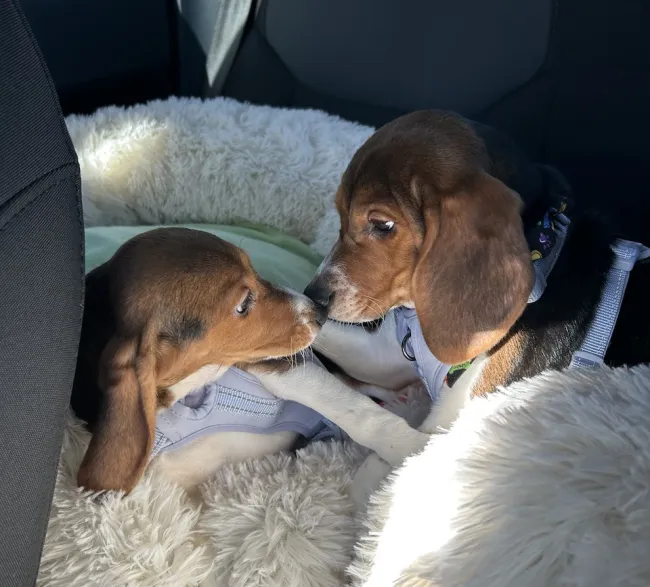
When we drove to Iowa to meet them, it felt like Christmas Eve. I couldn’t sleep from excitement. The little boy came out first, wagging his tail, pure joy in motion. We named him Ernie. His sister, who we would name Bertie, was tiny—barely the size of a cat. When they reunited in our car, they immediately started to play. Unlike Junior and Raymond, who had years of trauma to unlearn, Bertie and Ernie had only spent a few months in the lab. They were happy, sociable and full of life.
But not all dogs are as lucky as Bertie and Ernie.
Aaron Zellhoefer/Humane World for Animals
The horrors of animal testing
Across the country, thousands of animals—especially beagles—are still being used in painful and unnecessary experiments. Many of these fall into what’s known as Category E research under the U.S. Department of Agriculture’s Animal Welfare Act reporting system. Category E is the most severe classification of research; it means animals are subjected to procedures that cause pain and distress without any pain or distress relief.
Essentially, Category E experiments are designed to cause suffering. And this isn’t rare. In Minnesota alone, NAMSA in 2020 used 25 beagles in a Category E experiment. The dogs underwent unilateral injections of kaolin suspensions to create an artificial model of inflammatory pain. In the company’s own words, it stated that “dogs are a defined model for the assessment of pain and inflammation.” According to USDA inspection reports, that same facility was cited in 2022 after a beagle was found dead in their cage.
Think about that. Dogs like Junior, Raymond, Bertie and Ernie, all capable of feeling love, fear and pain, are being used as “models for pain.” Their purpose, in the eyes of researchers, is to suffer. My colleague Mitchell Nelson, the Michigan state director for Humane World, has been supporting efforts to ban painful experimentation using state funding on dogs. This year the Michigan Legislature took an important step by introducing Queenie’s Law (H.B. 4254, S.B. 127). It would prohibit Michigan’s publicly funded institutions from conducting painful dog experiments. The House bill passed the Regulatory Reform Committee in October, bringing the state closer to ending this form of cruelty. These experiments don’t just cause pain—they normalize it. They perpetuate the idea that animal suffering is an acceptable byproduct of human progress. But it’s not.
Other states are starting to take notice. In Iowa, Preston is working with lawmakers to demand additional disclosure from the state’s research institutions to ensure that no unnecessary and cruel testing takes place. These efforts matter, because transparency is the first step toward accountability—and ultimately, the end of animal experiments.
In Minnesota, we’re still fighting this battle. But the tide is turning. Public awareness is growing, and stories like Bertie’s and Ernie’s remind people that the animals behind research aren’t tools or data points. They’re living beings who want love, playtime and the chance to simply exist without fear.
/The HSUS
Stand with us to end experiments on dogs
Experiments on dogs are more common than most people realize. Please stand with us and call on governments in the U.S. and around the globe to end experiments on dogs and invest in science that doesn’t cause animal suffering.
Every year, countless animals suffer in research laboratories. Many endure Category E experiments where pain relief is deliberately withheld. These aren’t necessary for human medicine. Many of these tests could be replaced with modern non-animal-based methods, such as tissue cultures, computer modeling and organ-on-a-chip technologies. We can do better. We must do better.
When I remember Junior and Raymond, I recall the lifelong impacts of animal testing. When I look at Bertie and Ernie, I see what’s at stake. Their joy, their playfulness, their ability to love despite their pasts—it’s proof that animals have resilience, hope and the same desire to live free from harm that we all share.
The fight to end Category E research isn’t abstract. It’s about real animals—dogs such as Junior and Raymond, who never fully escaped their trauma, and Bertie and Ernie, who represent what’s possible when compassion wins.
We owe it to them to keep fighting. Because no animal should ever exist for the sole purpose of feeling pain.
Related stories
Kevin Wolf/AP Images for the HSUS
The historic surrender of 4,145 beagles from Envigo's closed breeding facility inspired thousands of adoptions. Now these pups continue to ignite nationwide reform in animal testing policies.

Bryan Mitchell/AP Images for Humane World for Animals
Once used for animal testing and research, Teddy has helped spark change for tens of thousands of dogs in the United States. Here's his story.
Molly Tamulevich/The HSUS
Here's how Humane World for Animals is fighting to end experiments on dogs and get these animals the homes they deserve.