Do your once-cherished childhood memories now make you wince? They might if they involve events and activities where animals, you now realize, were exploited and mistreated. Your adult self is more aware that animals are sentient creatures who deserve respect and kindness. Once that mindset takes hold, memories of those family trips to the petting zoo or the circus no longer produce the warm fuzzies.
The good news is that future generations might be less likely to have such guilt-tinged memories. Around the world, customs and traditional forms of entertainment are becoming more humane—sometimes in ways that surprise us. A few decades ago, it seemed inconceivable that Ringling Bros. and Barnum & Bailey Circus would abandon animal acts or that South Korea would ban the dog meat trade, but both those developments are now reality.
Bernard Unti, a senior communications specialist at Humane World for Animals, thinks the trend toward greater compassion is due in part to modern methods of communication.
“In the era of instantaneous transmission of information, virtually every use of animals is coming under moral scrutiny from somebody somewhere,” Unti says. “It’s hard for cruelty to hide. Cruelty has no safe quarter, really, when it comes to the scrutiny of billions of people with cameras on their phones.”
And Unti believes that values promoting compassion toward animals are continually spreading, forcing us to reexamine our practices. “The kindness-to-animals values are always getting into new areas of concern or shining new light on long-standing areas of concern,” he says.
Naturally, the news isn’t all good. Many inhumane traditions and forms of entertainment—from rodeos to live animal mascots at sporting events—stubbornly persist in the modern world.
The following sections, written by Humane World staff, explore how we’re helping transform long-standing traditions to create a better world for animals. These are snapshots rather than comprehensive reports. We’re highlighting progress in some countries, but recognize there’s room for improvement in others. Every small or large step can open the door for more humane alternatives that honor the spirit of these celebrations.
—James Hettinger

Mike Marsland/Alamy
The circus: Rethinking the big top
Featured attractions in the 2026 edition of Ringling Bros. and Barnum & Bailey Circus include the “Double Wheel of Destiny,” the “Criss-Cross Flying Trapeze,” “Bike-robatics” and the “World’s Craziest Unicycle.”
Notice anything missing?
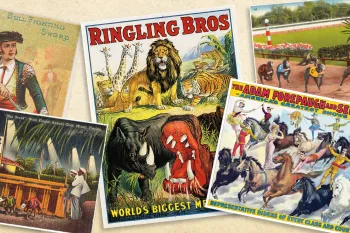
Animal advocates rejoiced in 2017 when the nearly 150-year-old circus—long associated with elephants, lions, tigers, camels and other animal acts—announced that it was closing shop, citing financial trouble and changing tastes in entertainment. It had been hounded for years by accusations of cruelty to animals. A new version of Ringling Bros. Circus emerged in 2023, with human performers replacing the animal acts.
Bernard Unti, communications specialist for Humane World, urges advocates to reflect on that remarkable feat: Animal welfare concerns helped transform an iconic circus. Ringling’s decision to abandon animal acts, Unti says, is a prime example of how the rise of humane values can “surround and zero in on certain activities once considered universally popular and unproblematic.”
Ringling Bros. followed the path of Cirque du Soleil, the enormously popular, animal-free circus featuring acrobatics, dance and theatrical spectacle. “Circus life is fundamentally at odds with the complex needs of wild animals,” says Jennifer Leon, program manager of wildlife protection at Humane World. “The success of animal-free circuses shows that talented performers deliver the spectacle and wonder audiences expect without compromising animal welfare.”
We’ve worked for years to shine a light on animal cruelty in circuses and to help pass laws to stop it. In 2017, our undercover investigation of Ryan Easley’s ShowMe Tigers act exposed the violent training of eight tigers for the Carden Circus and Shrine circuses. In the U.S., 12 states restrict the use of wild animals in shows, and at least 200 localities have passed similar measures. We’re making similar progress elsewhere: In Mexico, for example, we provided technical information that helped pass a 2025 ban on the use of marine mammals in entertainment, and we helped draft legislation in Guatemala that since 2018 has banned the use of animals in circuses.
The battle against circuses that still exploit animals continues. Sign the petition below and urge Shriners International to adopt an animal-free circus policy for local chapters.
—James Hettinger
Humane World for Animals/
Petition to Shriners International
Join us in urging Shriners International to stop using and abusing wild animals in circuses. Sign the petition for Shriners International to adopt an animal-free circus policy for local chapters.
Greyhound racing: The last lap
When nearly 70% of Florida voters in 2018 approved a ban on greyhound racing in the state, Kate MacFall, our Florida state director, felt gratified but not surprised.
Decades earlier, Florida had been the first state to legalize greyhound racing, and the Sunshine State once housed a dozen tracks. For much of the 20th century, racing was a popular entertainment.

Petegar/Getty Images
But in recent decades, public sentiment had shifted against the sport amid reports of dogs frequently dying on the tracks and the abysmal conditions they were kept in when not racing. Attendance at the races dwindled.
“It wasn’t surprising that we won with such an overwhelming number, because the people of Florida love dogs, and people care about protecting dogs,” says MacFall. “And when they realized they were kept in crates 22 hours a day, and a dog was dying every three days, and no one even goes anymore, it’s like, ‘Why are we doing this?’”
MacFall worked on the greyhound racing issue for 10-plus years alongside the nonprofit Grey2K USA Worldwide and says the campaign helped convince voters to support the ban. Animal welfare concerns have also helped spur a worldwide decline in greyhound racing, though races are still legal in Australia, Ireland, Mexico, Viet Nam and parts of the United Kingdom.
The decline of greyhound racing in the U.S. is stunning, from about 50 tracks in the 1980s to just two today (both in West Virginia). Now, 44 U.S. states have laws that ban greyhound racing.
“That’s a significant victory,” notes Jessica Simpson, a Humane World program manager for public and corporate policy, “and it really reflects a major shift in public values.”
—James Hettinger
Holiday adoptions: Little cause for concern
For years, two myths persisted in U.S. animal shelters.
One held that the tradition of adopting dogs and cats as gifts meant more animals would likely be returned to the shelter.
The other forbade adopting out black cats around Halloween for fear that they might be used in some nefarious ritual.
Thankfully, both myths have largely been debunked, paving the way for additional shelter animals to find new homes.
Lindsay Hamrick, our former director of shelter outreach and engagement, says she still hears from shelters that are nervous about pet adoptions as gifts. But most organizations, she adds, understand the need to question the myths that permeate the sheltering field and how they affect adoption decisions.
We don’t want people going out and purchasing puppy mill dogs. We want them to adopt.”
Lindsay Hamrick, Humane World for Animals
Hard numbers to dispel either myth are difficult to find, Hamrick says. But shelters that hold holiday adoption programs that deliver puppies or kittens to adopters on Christmas morning say the return rates for those animals are no higher than normal.
Hamrick applauds shelters for questioning Halloween policies that were making adoptions more difficult: “OK, we have all these black cats sitting in shelters. Why are we holding them back when they need adoptive homes?”
And during the holidays, she adds, “We don’t want people going out and purchasing puppy mill dogs. We want them to adopt.” By making that process easy and nonjudgmental, shelters can help ensure more families choose adoption—and that’s something to celebrate.
Humane World encourages shelters to remove barriers to adoption through the Adopters Welcome approach. Visit humaneworld.org/adopterswelcome to learn more.
—James Hettinger

Jean Chung/For Humane World for Animals
Bok Nal: Shifting tastes in South Korea
Bok Nal refers to the three hottest days of summer in South Korea, according to the traditional lunar calendar. For generations, these days have been marked by the custom of eating “restorative” foods believed to help the body endure the intense heat. One dish closely associated with Bok Nal was bosintang, a stew made with dog meat.
For centuries, some Koreans believed dog meat had medicinal qualities and could boost stamina during extreme heat. As a result, bosintang became a seasonal specialty, and even people who did not normally eat dog meat might have consumed it during Bok Nal.
Humane World for Animals, along with other animal welfare organizations in South Korea, has spent years exposing the conditions on dog meat farms, rescuing dogs, organizing protests during Bok Nal and promoting plant-based alternatives. At the same time, South Korea itself has changed rapidly. With millions of pet dogs now living in Korean homes, attitudes toward dogs have shifted, particularly among younger generations, who overwhelmingly reject the idea of eating their animal companions.
This major shift in attitudes led to South Korea passing a law to end the dog meat industry by February 2027. (Stay tuned for our Winter 2027 issue for more on this momentous ban.) While Bok Nal still exists as a summer tradition, the focus has now shifted toward health foods and plant-based dishes. Bok Nal shows that traditions don’t have to stand still—they can evolve in ways that respect both people and animals.
—Julie Sanders, principal, Ending Dog and Cat Meat Trade campaign
Anadolu/Getty Images
Diwali: Brighter, safer nights
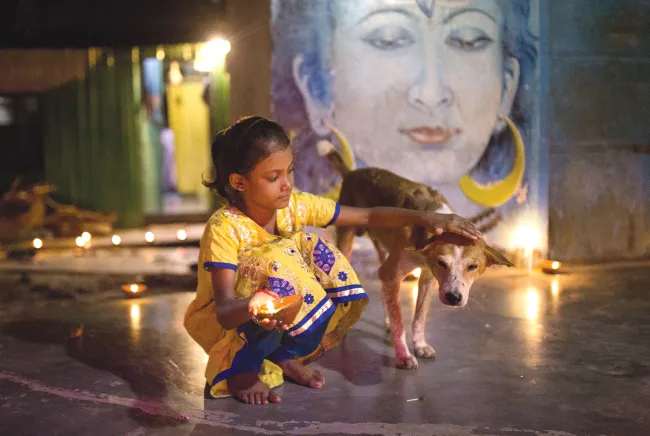
The festival of lights, Diwali, might light up the sky across South Asia with beautiful displays, but its unregulated nature leads to many accidents. Community animals—dogs, cats, cows, birds and other urban wildlife—bear the brunt of this.
In India, we’re working with communities to make celebrations more animal friendly. The holiday represents the triumph of light over darkness and knowledge over ignorance. In that spirit, we spread awareness of animals’ needs so all are treated with compassion.
Some Diwali celebrations take place in areas usually occupied by street dogs, and unfortunately, some people throw firecrackers at the dogs. To help remedy this, our team has put up posters listing do’s and don’ts for the holiday: “DO keep a first aid kit handy for injured street dogs” and “DO NOT let anyone tease or scare street dogs with firecrackers.” Our volunteers reported the outreach leading to safer celebrations.

Gayatri Gautam
For Diwali 2024 and 2025, we:
- Worked in 260 neighborhoods.
- Put up over 1,500 posters.
- Reached hundreds of individuals through WhatsApp.
- Conducted meetings and awareness sessions for hundreds of students.
In Pomli Faliyu, a neighborhood in Vadodara, residents ensured dogs were fed before celebrations began in the evening, so that they did not come out while firecrackers were being lit. In Kanha Upvan, Lucknow, residents reduced the firecrackers and stopped giving dogs leftover sweets. The result of our work was a quieter and safer Diwali for all.
—Dalia Jacob, senior manager of community engagement, India

Glow Images/Getty Images
Bullfighting: New rules in the ring
The tradition where matadors provoke and eventually kill bulls in an arena is heading toward extinction in Mexico, due to evolving concerns about animal cruelty.
In 2025, Michoacán became the sixth Mexican state to ban bullfights, joining Guerrero, Sinaloa, Sonora, Coahuila and Quintana Roo. In addition, Mexico City voted to ban “violent bullfights.” New rules now determine how long a bull can be in the ring and limit bullfighters to using only capes. And the city’s Plaza de Toros México bullring—the world’s largest—announced that because of the restrictions it would end all bullfighting there.
“I think that shows that there is an evolution in the public sensibility toward cruelty to animals, cruelty in entertainment,” says Antón Aguilar, executive director of our team in Mexico.
Elected leaders have also grown increasingly aware of animal issues. “The spectacle of blood cannot be justified as art or tradition,” Clara Brugada, Mexico City’s head of government, noted when the city banned violent bullfights. “Culture evolves, and we have the responsibility to transform it in favor of animal welfare.”
We helped pave the way for this evolution in thinking, Aguilar says.
Dr. Claudia Edwards, a behaviorist who works as our Mexico team’s program director for campaigns, was part of a committee appointed by the Mexico City Attorney General’s Office for the Protection of the Environment to study the suffering of bulls during bullfights.
Our team also worked with legislators to get the principle of animal sentience included in Mexico City’s constitution and animal protection enshrined in the country’s federal constitution.
Bullfighting is still legal in several countries, but those that have banned it include Argentina, Canada, Colombia, Cuba, Denmark, Italy and the United Kingdom.
Aguilar is encouraged to see Mexico “heading in the right direction. In the last decade or so at least, Mexico has been very impressive in how public attitudes are shifting.”
—James Hettinger
Renphoto/Getty Images
Fireworks celebrations: Quiet, please
When I was growing up on Long Island, New York, in the 1960s, the “cool dad” in our neighborhood was Mr. Z. He rode a minibike and constructed elaborate model airplanes. And every July Fourth, he lit up our sky with fireworks launched from his backyard. I oohed and aahed along with the rest of the neighborhood kids.
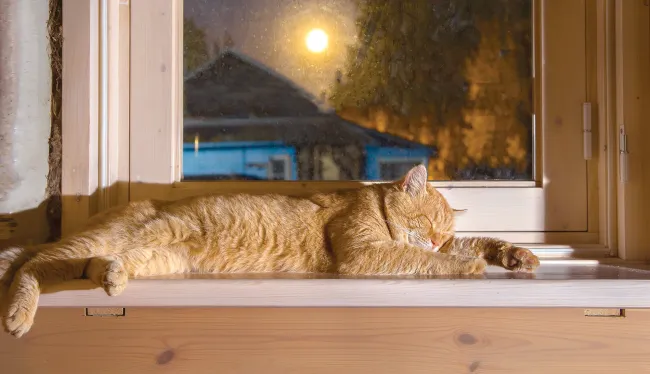
Nowadays, at my home in Maryland, I curse the noisy backyard fireworks I endure every Independence Day (as well as Juneteenth and New Year’s). They upset my cat, Vinny. And, judging from the positive reactions to my angry Facebook posts, I know I’m not the only person with pets who finds neighborhood fireworks annoying.
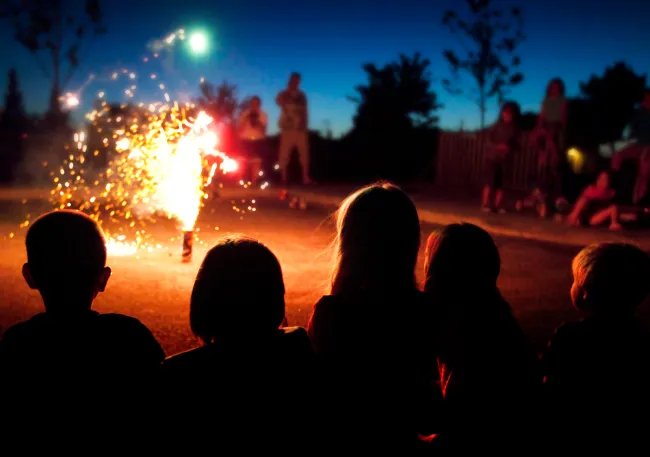
Fireworks celebrations remain popular around the world—marking everything from the Chinese New Year and Eid al-Adha to Guy Fawkes Night and Hanabi festivals. Some wildlife rehabilitation centers see an uptick in traumatized animals after a fireworks holiday. Pets frightened by fireworks often run away and get lost.
But pet owners aren’t powerless. Ask your veterinarian about medications and techniques that can help allay your pets’ fear and anxiety, and for ways to help dogs cope with fireworks, head to humaneworld.org/loudnoises. Fortunately, other ways to celebrate are becoming more popular. Drone displays, laser lights and musical fountain shows give us ways to make holidays fun for all.
—James Hettinger
Sergey Kuznetsov/Getty Images
Humane World also encourages people to:
Keep their pets indoors during fireworks and provide permanent identification with a collar and microchip.
Ask local and state officials to consider requiring colorful silent or “quiet” fireworks and regulating when they can be used.
Urge your community to switch from fireworks
to drone displays.
Related Stories

Anton Aguilar and Felipe Marquez/Humane World for Animals
A decade ago, Citilcum’s festival involved animal cruelty. Many thought it would never change.
Photo collage by Rachel Stern/The HSUS
Many people are drawn to animal attractions out of a love for animals but end up inadvertently supporting cruelty. Here's how to avoid exploitative wildlife attractions.

Goodboy Picture Company/Getty Images
When you adopt a cat or dog, you may experience a bit of adoption shock. Here are the four stages you can expect after bringing home your new pet.