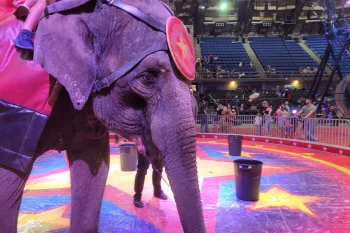
WASHINGTON—This month marks 10 years since Ringling Bros. and Barnum & Bailey Circus last used elephants in their shows. Yet, a decade later, 14 elderly elephants are still forced on the road to tour with other circuses. At a time when many Americans assume circus elephant acts are long gone, these shows continue quietly across the country with a population of geriatric elephants, many of whom are in their mid-to-late 50s.
These elephants are owned by six exhibitors: Carden International Circus (based in Missouri), Elephant Walk (Florida), Carson & Barnes Circus (Oklahoma), Franzen Bros. Circus (Florida), Tarzan Zerbini (Missouri) and Trunks and Humps (Texas). These six businesses rent their elephant shows to other exhibitions and venues such as Shrine and other circuses, fairs and Renaissance festivals each year, the animals hauled around and put on contract as if they are rental cars. When the elephants are not forced to travel and perform, they are warehoused at roadside zoos in Missouri, Oklahoma, Florida, Indiana and Texas that pose as sanctuaries or educational facilities with many offering dangerous, cruel encounters that compromise the elephants’ wellbeing and public safety.
Laura Hagen, managing director of wildlife at Humane World for Animals, formerly called the Humane Society of the United States, said: “The elephants still trapped in the wild animal circus racket have spent their entire lives suffering for the sake of ‘entertainment.’ They were taken from the wild and sentenced to decades at the end of a bullhook in an industry that—by its very nature—subjects them to physical and psychological harm. Some have even escaped from the terror they face daily, posing risks to themselves and the public. And yet they remain on the road. This archaic cruelty must end, and these elephants retired to accredited sanctuaries where they can live life on their own terms, without spectacle. The continued exploitation of elephants in traveling shows reflects an industry stubbornly resisting meaningful reform even as many circuses have moved away from these acts and lawmakers increasingly ban the use of elephants for entertainment.”
In 2025, traveling acts that typically feature elephants made nearly 250 appearances across the United States including at circuses, fairs and festivals. Elephants used in traveling acts have been forced to endure violent training methods like bullhooks, electric prods and other painful devices, and suffer constant confinement and stressful transport on the road from show to show.
Three elephants—Viola, Kelly and Betty—illustrate the severe danger and hidden suffering behind circus acts. Viola, owned by Carson & Barnes, went viral in 2024 when she bolted through downtown Butte, Montana, running through traffic and parking lots in what was at least her third known escape. Kelly, another Carson & Barnes elephant, has a similar history of dangerous breakouts, including a 2017 escape in Baraboo, Wisconsin, and a 2014 incident in which she, Viola, and a third elephant burst out of a St. Louis–area arena, injuring themselves and damaging vehicles as they ran.
Betty, owned by Carden Circus, was still forced to give rides and perform in shows despite being chronically lame, visibly declining and at risk of a fatal collapse. In September 2025, the U.S. Department of Agriculture cited Carden for improper handling after inspectors observed Betty walking with a stiff, painful gait that worsened when she was made to give rides to the public. Inspectors noted that Carden knew about her lameness and still failed to provide even basic anti‑inflammatory medication needed to treat her condition. Rather than retire her, Carden shipped Betty to a roadside zoo in Indiana, where she has recently been used for hands‑on photo opportunities.
Injuries to the public also have occurred. On March 28, 2021, an elephant attacked a visitor who was participating in an “elephant encounter” at the Endangered Ark Foundation, a roadside zoo in Hugo, Oklahoma, operated by the owners of Carson & Barnes Circus. The visitor alleged that she sustained serious and life-threatening injuries and was left disabled and disfigured.
These 14 elderly elephants are forced to perform and travel throughout the U.S. (Ages are approximate):
- Betty, 57, (currently at an Indiana roadside zoo) and Janice, 54, owned by Carden.
- Essex, 52, owned by Elephant Walk.
- Kelly, 56; Viola, 55; Isa, 55; Chang, 54; Lulu 51, and Isla, 58, owned by Carson & Barnes.
- Okha, 56, owned by Franzen Bros.
- Patty, 59, owned by Tarzan Zerbini.
- Krissy, 42; Jeanie, 41, and Paige, 52, owned by Trunks and Humps.
To date, 12 states and 200 localities have banned the use of certain wild animal species in traveling shows in the United States. (Full list of locations)
Hagen adds: “Humane World for Animals remains focused on ending the use of wild animals for entertainment, city by city and state by state in the United States. We also encourage the public to be mindful of what their dollars support and decline to buy tickets for these performances. Animals deserve better.”
#