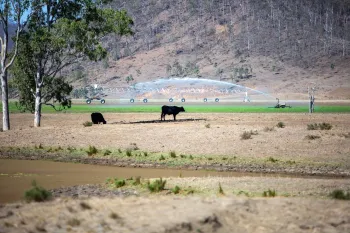
Last month, the United Nations made a startling announcement: Within the next few years, the planet is expected to heat up by more than 1.5 degrees C (2.7 F) compared to pre-industrial levels. This means governments around the world failed to meet the goal of the Paris Agreement, which was designed to reduce the anticipated impact of climate change.
Animal agriculture is a major contributor to this current crisis, but the animals stuck within this industry are also among its most vulnerable victims.
In 2018, Hurricane Florence hit North Carolina—one of the top animal agricultural states in the United States. Researchers found the storm was larger and produced significantly more rainfall because of climate change. Over 3 million chickens and 5,500 pigs died from the flooding, according to state government estimates.
As Kelly Guerin-Buckley documented the fallout, the word that came to mind was “apocalyptic.” Traveling by boat through the flooding with nonprofit We Animals, she saw hundreds of floating dead chickens before she even found her first barn. Later, she documented pigs who’d survived the devastation wandering a flooded highway.

Jo-Anne McArthur/We Animals
“The animals who are strategically hidden away, warehoused in CAFOs [concentrated animal feeding operations], were now washed up, dead and alive…where we could see their faces,” Guerin-Buckley, now a video producer with Humane World for Animals, wrote about her experience.
Earlier this year, countries across Europe were hit with five heat waves over four months. In a region known for mild summers and a lack of air conditioning, temperatures soared so high that highway and train tracks buckled.
An estimated 30,000 people died. On farms, animals died in massive numbers. An estimated 2.5 to 3 million birds bred for their meat died in France alone. Services that remove dead animals were so busy that some farms were left with piles of carcasses rotting in the sun, according to reporting from The New York Times.
In between these two tragedies were numerous other extreme weather events, including Zambia’s worst flooding in over 50 years in 2023 and the 2025 Los Angeles wildfires. But experts warn the worst is yet to come.
“This summer’s scorching heat, raging wildfires and deadly floods are a warning of what lies ahead,” U.N. Secretary-General António Guterres said in a press release about the new climate projections.
The impact may reach such a degree that even using heat-resilient species such as goats may prove inadequate, as future climates in large regions such as Africa will exceed the upper-temperature threshold (29 to 30 degrees C) for all common grazing species.”
Chaohui Li, et al. in a 2026 Proceedings of the National Academy of Sciences study
How factory farming practices exacerbate the harms animals face
Many of the species people use for farming are already biologically prone to heat stress. Chickens and pigs cannot sweat to cool themselves off. Because cows use so much energy to process their highly fibrous diet, their internal temperature often ramps up.
Add in more than a century of selective breeding to make farm animals produce a massive amount of “product” incredibly quickly and the risks grow exponentially. “Particularly with chickens who are bred for meat production. They grow so fast that they go from hatching to market weight in just six weeks,” says Sara Shields, our managing director of global farm animal welfare. “There's a trade-off between putting all of their genetic energy into growth versus health.”
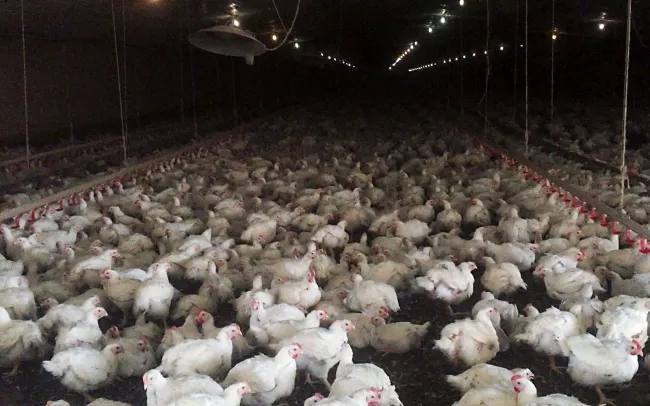
Living conditions can also put animals at high risk too. Most cows used for beef production spend their final months on feedlots—facilities where bovines rapidly gain weight before slaughter. The animals are usually kept in outdoor dirt plots with little to no shade. Inside barns, conditions can be similarly risky.
Mercy for Animals
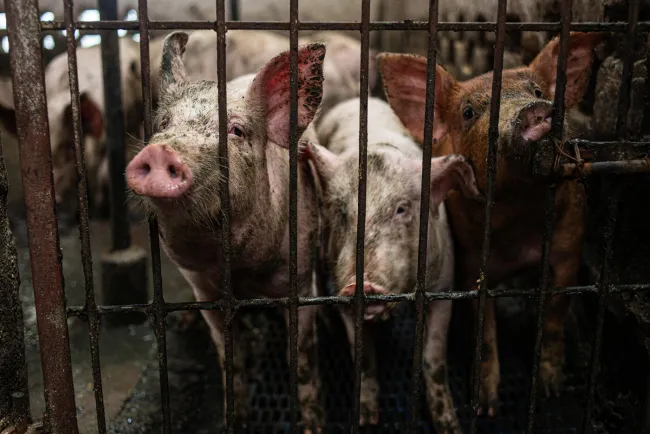
“High stocking densities can reduce airflow, while concrete flooring prevents animals from engaging in instinctive behaviors that help regulate body temperature, such as pigs cooling themselves in mud wallows or cattle seeking relief in ponds and shaded areas,” says Dr. Jan Raines, managing director of veterinary medicine at our sanctuary, Black Beauty Ranch.
In Latin America, Mexico and Southeast Asia, the open-sided barns commonly used provide little protection from sweltering temperatures or floods.
There is no clear estimate on how many farm animals are killed by extreme weather a year. In fact, there does not appear to be a single country government that tracks farmed animal deaths from heat stress and extreme weather. The closest estimate comes from a 2025 report by Compassion in World Farming that found 14.8 million farm animals were killed during just 11 extreme weather events.
Even if global numbers were available, they wouldn’t show the full picture, as heat stress weakens animals’ immune systems, putting them at higher risk of dying from other diseases.
died from heat stress en route to slaughterhouses during the UK’s record-hot 2025 summer compared to the previous year’s summer, according to an analysis by Carbon Brief.
in the UK will experience at least 15 additional heat wave days by 2050, according to a 2026 study in Nature.
When profits come ahead of animal welfare
Much of the current discourse about how extreme weather impacts animal agriculture revolves around the economic losses farmers face. Significantly less attention is given to the welfare of the animals themselves.
In addition to increased risks of death from heat and other diseases, heat-stressed animals often lose weight, produce less milk and are more likely to miscarry. This means that, in some cases, more animals likely need to be used to get the same amount of “product.”
When disasters do occur, it’s nearly impossible—and incredibly expensive—to evacuate the huge number of animals kept on factory farms. Countless animals are simply left to die from the elements or from trampling one another in a panic.
There does not appear to be a single country that mandates farmers to create proactive evacuation plans for their animals. In the U.S., for instance, farmers are eligible for compensation for animals lost during extreme weather. Because of this, animal welfare experts argue there’s little incentive for them to implement costly measures to try saving their animals.
Without regulations in place, the level of preparedness varies widely from farm to farm. “Some farmers care very deeply about this and they're very concerned and they have great emergency management plans,” says Shields. “Others simply do not.”
Shatabdi Chakrabarti/We Animals Media
An uncertain future for farm animals
Over and over, experts have been warning that climate change will seriously disrupt our global food system.
In addition to directly harming animals, climate change is making it harder to grow the crops needed to feed the 97.6 billion land animals used globally for food each year. Farm animals who live on pastures and graze their food are not exempt from the harms.
A 2026 study in Proceedings of the National Academy of Sciences found that by 2100, suitable grazing areas for farmed animals could shrink by up to 50%, displacing 1.4 billion farm animals and creating “substantial declines in grazing suitability across entire continents.”
Animal agriculture also uses massive amounts of water to grow feed, provide drinking water to farm animals and cool them down on hot days. Earlier this year, the U.N. announced the world had moved past a water crisis and into a “global water bankruptcy.”
“If something happens in the supply chain for either the feed or the water, that can have devastating effects on the animals,” Shields with Humane World for Animals says. “With climate change, I think those types of situations could become more common.”
Humane World for Animals is calling for an array of changes to address this growing threat. Our UK team is asking the British government to track and publish heat-related farm animal deaths and include farm animals in climate adaptation planning as sentient beings, not just economic units.
Shields urges the global industry to stop selectively breeding animals for rapid growth, which makes it harder for their bodies to cope with extreme heat. She also encourages people to shift their diets toward more plant-based eating: In addition to reducing demand for animal products, this has the added benefit of reducing peoples’ carbon footprint.
Through human intervention, farm animals have become some of the most vulnerable victims of climate change. But far too often, their suffering is either ignored or hidden from the public. As the climate crisis continues to accelerate, humans must consider the billions of animals we put on this earth to be used as food.
Konrad Lozinski/We Animals Media
Speak up for farm animals
More than 97.6 billion farmed animals are kept and killed for food each year, causing immense animal suffering and releasing greenhouse gas emissions at levels on par with all cars, planes, trains and boats around the world combined. We need to prevent the suffering of animals on factory farms and protect the world around us.
Related Stories
dhughes9/iStock.com
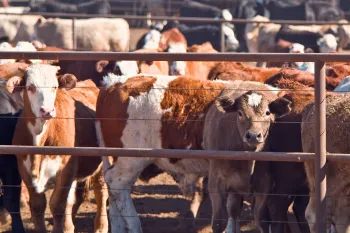
In the first part of a two-part series, we explore how breeding millions of cows a year for their meat harms farm animals.
Jo-Anne McArthur/We Animals Media
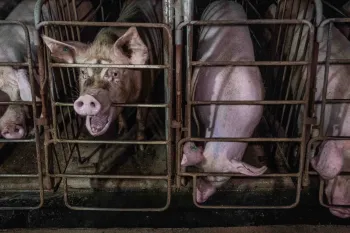
Protecting farmed animals and advocating for a more humane and plant-based future is really an all-hands-on-deck issue. Here are five things you can do right now to help farmed animals.
Helen Camacaro/Getty Images
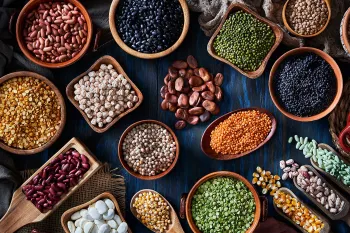
Every Wednesday, we're celebrating Beansday—the day we ask people to swap meat for beans each week. This simple ask saves animals, the environment and even your wallet. Here's how to make Beansday part of your routine.