Food insecurity is a major global issue. It’s about more than just having enough food to go around—it’s about whether everyone can access healthy, affordable and nourishing food. According to the State of Food Security and Nutrition in the World 2024 report, a staggering 2.33 billion people experienced moderate or severe food insecurity, and over 2.6 billion people were unable to afford a healthy diet. Tragically, millions of children aged 5 and under also suffered from malnutrition. While it’s easy to think that the problem is a lack of available food globally, the truth is much more complex.
There are many reasons why so many people are food insecure—including food waste, global poverty and international politics or conflict. A lesser-known yet still important reason is the dominance of animal agriculture and factory farming within our food system, which plays a massive role in food insecurity and diverts precious resources away from where they are most needed. The positive news? What’s good for people and the planet is also good for animals. In other words, we can advance food security and protect animals simultaneously.
available for human consumption goes to farmed animals.
is the minimum amount it takes to produce 1 calorie of meat.
is used for animal agriculture, but produces just 18% of the world’s calories.
The inefficiency of animal agriculture
The primary reason why farming animals is at odds with food security is because of the sheer inefficiency of breeding, feeding, keeping, transporting and killing animals for food. It takes a lot of resources—including land, water and energy—to produce meat, dairy and eggs, and a lot of calories and protein are lost in the process. Most people are startled to learn that half of the world’s habitable land is used for agriculture and about 83% of this is used for animal agriculture, which produces just 18% of the world’s calories. Or that, on average, a slaughtered chicken would have consumed about 9 calories of crops to produce just 1 calorie for humans—and this feed-to-food conversion is even less efficient in other animals.
To help that sink in, imagine growing a garden full of fresh vegetables. Instead of eating them, you feed them to animals and eventually get only a small fraction of that nutrition back. That is basically what happens in our current global food system.
The truth is that because producing animal protein is so incredibly resource intensive, it makes much more sense to produce crops for direct human consumption instead. Global organizations working on food security, such as the United Nations and the World Health Organization, have already recognized that a more plant-forward food system is a much more sustainable, healthy and efficient way to feed the world because it would require far fewer resources.
Why detour our harvest through animals? Feeding people directly is the shortcut to a nourished world."
While it is true that some animal farming takes place on land that cannot produce crops suitable for human consumption, these animals are still fed plenty of crops that humans can eat. In fact, an article published in Elementa: Science of the Anthropocene estimates that 41% of the food available for human consumption goes to farmed animals, and just 34% of those calories re-enter the food supply as meat, dairy and fish. It’s a wasteful process that only makes sense in areas without better alternatives (for example, in resource-poor regions where the only way that small-scale farmers can produce food is by grazing animals on land unsuitable for human food production).
Factory farming, climate change and inequality
This inefficiency is also linked to the second reason why farming billions of animals is not compatible with food security: animal agriculture’s disproportionate impact on the planet.
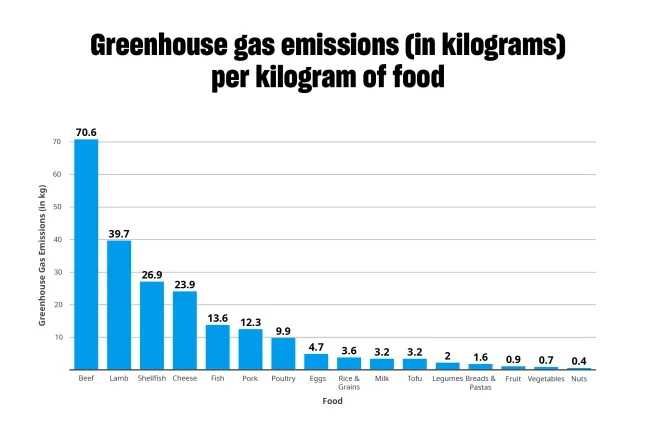
Our food system, with its current emphasis on animal-based proteins, is the leading driver of environmental breakdown and responsible for roughly 30% of all human-caused greenhouse gas emissions, with the production of animal-sourced foods responsible for an estimated 57% of that. Factory farming, or industrial animal farming, uses a significant share of the world’s land and freshwater, and causes deforestation, ocean acidification and biodiversity loss. This has two important effects on food security.
Speak up for farm animals
More than 97.6 billion farmed animals are kept and killed for food each year, causing immense animal suffering and releasing greenhouse gas emissions at levels on par with all cars, planes, trains and boats around the world combined. We need to prevent the suffering of animals on factory farms and protect the world around us.
First, these environmental impacts threaten our ability to continue growing food, since agriculture is sensitive to changes in our climate and weather. As the Intergovernmental Panel on Climate Change has observed, “Climate change results in more frequent heatwaves, extreme rainfall, drought and rising sea levels, which negatively affect crop yields,” requiring more land to grow crops for humans and animals.
Second, since climate change most heavily impacts the world’s most disadvantaged regions, vulnerable populations already facing food insecurity are more likely to experience further threats to their livelihoods. As the World Economic Forum notes, the climate crisis will lead lower-income populations to “be impacted by changes in food production, higher consumption prices and changes in rural incomes.” A harsh injustice, given the 74 lowest-income countries produce just one-tenth of the world's greenhouse gases.
United Nations
Unfortunately, the inequalities with modern food production don’t end there. Natural resources in economically disadvantaged regions are frequently depleted for the sake of the world’s wealthy. A prime example of this is “land grabbing,” whereby wealthy investors acquire large tracts of land in lower-income countries for their own economic benefit. This land transfer often results in lost agricultural opportunities, production and incomes for local populations.
Another example is the “virtual water trade.” Global agricultural trade tends to ease water scarcity for higher-income populations while making water scarcer for lower-income countries as their water is virtually exported in the form of food.
Given their high environmental inputs, Western diets, rich in meat and other animal-based foods, are simply unsustainable at every level.
Health, food security and animal agriculture
If the goal of achieving food security is so that everyone can be nourished and live life to their full potential, they also need to be able to access healthy food. It’s well established that diets rich in whole plant foods, including vegetables, fruits, whole grains, beans, peas and lentils, have enormous health benefits, from reduced risk of chronic disease to longer lifespans. Yet, average fruit and vegetable consumption remains below recommended levels around the world, leading to preventable death and disease. In low-income socioeconomic groups and in low- and middle-income countries, the consumption of fruits and vegetables is even lower.
Meanwhile, poor diets in industrialized countries—characterized in part by high quantities of unhealthy fat from processed meats, particularly red meat, as well as high-fat dairy products—are leading to obesity, type 2 diabetes, cardiovascular diseases and more at alarmingly high rates. Our reliance on animal agriculture and factory farming is not only jeopardizing our planet’s health but our own as well.
The wealthiest 30% of people drive more than 70% of food-related environmental impacts.”
2025 EAT-Lancet Commission in its Report on Healthy, Sustainable, and Just Food Systems
The path forward
Rather than increasing the amount of available food to feed the world’s growing population by relying on industrial production practices that are bad for animals, the planet and people, we need to dramatically transform the ways that we produce and consume food to adopt more sustainable practices. Our World in Data estimates that shifting away from animal agriculture and factory farming to a more plant-forward food system would allow us to cut the amount of land we need for agriculture by 75%. This would leave us plenty of room to continue growing enough food for everyone while ideally returning some land to nature.
We need systemic change
A plant-forward food system alone will not achieve global food security. In addition to changing how we produce and consume food, we need sound policies in place to ensure all the components of food security—availability, access, utilization, stability, agency and sustainability—are met. If we pair these policies with actions—such as rewilding plots of land, reallocating subsidies, reducing food waste, returning to indigenous crops and providing income supports—we could finally eradicate hunger.
Shreya Swaminath/Humane World for Animals
Our commitment
At Humane World for Animals, we’ll keep working to reduce the harmful impacts of factory farming while driving the shift toward a more compassionate, equitable and sustainable food system. We’ll keep working to focus the conversation on the root causes, share information and debunk myths, and equip individuals and organizations with the resources and tools they need to make a difference. Systemic problems are complex and will take time to solve, but we can all be part of the solution by choosing foods that are kinder, more just, better for the planet, and better for our bodies whenever we get the chance.
Related stories

Tom Woollard/For Humane World for Animals
Two mother pigs rescued from farrowing crates in the UK now live free in sanctuary, as advocates push to ban this cruel farming practice.

Meredith Lee/The HSUS
What is the Animal Welfare Act and how does it work? We dive into the history and future of this landmark legislation.

Do you know what happens on a factory farm? Learn about the harmful reality of factory farms and explore alternatives to animal agriculture.