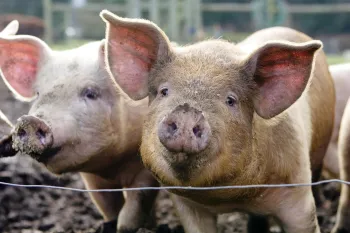
LONDON—As temperatures exceed 35°C, Humane World for Animals U.K. (formerly called Humane Society International U.K.) warns that pigs, chickens and other farmed animals are suffering out of sight, with no transparency or a clear national system to monitor heat-related deaths or welfare incidents.
Pigs are among the animals most vulnerable to hot weather because they cannot sweat effectively and rely on their environment to cool down. Industry guidance acknowledges that heat stress in pigs can lead to collapse and, in the worst cases, death. The risk is especially acute in poorly ventilated sheds, during transport, or where animals cannot access shade, water or effective cooling.
While the U.K. rightly issues heat-health alerts for people and tracks the human impact of extreme heat, there is no equivalent transparent national picture for millions of farmed animals. Humane World for Animals U.K. says this leaves heat-related suffering, collapse and deaths among pigs, chickens and other animals largely invisible to the public and policymakers.
The Agriculture and Horticulture Development Board has also warned that sustained high temperatures, humidity and warm nights can compound heat stress in farmed animals, with animals unable to recover overnight.
The Climate Change Committee has stated that the U.K.’s preparations for climate change remain inadequate, with adaptation planning still too slow and disjointed. Humane World for Animals U.K. says farmed animals are a stark example of this gap: climate risks are recognised, but the systems needed to prevent, monitor and respond to heat-related animal suffering remain underdeveloped.
Current government advice tells farmers to plan for extreme weather and contact the Animal and Plant Health Agency or their local authority in an emergency. However, campaigners are concerned that this is insufficient for heatwaves affecting many farms at once, particularly where local authorities may lack the capacity or specialist animal welfare expertise to respond at scale.
Claire Bass, senior director of campaigns and public affairs at Humane World for Animals U.K., said:
“We rightly recoil at the thought of dogs being left in conditions where they could suffer or die from extreme heat. That same compassion must extend to pigs, chickens and other farmed animals, whose lives are increasingly—but so far invisibly—being put at risk by more frequent and intense heatwaves. The industry talks about the need to reduce heat impacts, such as ‘increased mortality’ and ‘reduced productivity’, but our primary concern should be the welfare of individual animals, not how these events affect the bottom line.
“Pigs are especially vulnerable because they cannot sweat effectively and can suffer heat stress at temperatures far below those being recorded in this heatwave. Chickens and other farmed animals can also face serious welfare risks when ventilation, water provision, stocking density or transport conditions are inadequate during extreme heat.
“These are sentient animals who can experience distress, pain and fear. Yet the U.K. has no clear national picture of how many farmed animals are suffering or dying during extreme heat. That is a serious blind spot in our climate planning and animal welfare system.”
Humane World for Animals U.K. is calling on the government to:
- Publish clearer, detailed and species-specific guidance to prevent heat-related suffering and deaths on farms and during transport;
- Commission a comprehensive national review of farmed animal housing to assess the investment needed to properly protect animals from extreme heat.
- Establish a transparent system to aggregate and publish data (from government agencies, vets, insurers, local authorities and industry bodies) on heat-related farmed animal mortality and serious welfare incidents, to understand the scale of the problem;
- Ensure farmed animals are properly included in climate adaptation planning as sentient beings, not merely as economic units.
Claire Bass added, “If we do not know how many farmed animals are suffering, collapsing or dying in heatwaves, we cannot know whether existing protections are working. As extreme heat becomes more frequent and intense, the government must close this data gap and make farmed animal welfare part of national climate resilience planning.”
Notes:
- AHDB guidance states that heat stress in pigs can cause increased respiration, attempts to cool down through wallowing or lying in urine, collapse and, in the worst scenario, death.
- AHDB has warned that the current heatwave is particularly challenging for farmed animals because high overnight temperatures mean animals may not get relief, allowing heat stress to build over consecutive days.
- Defra’s official guidance for keeping farmed animals in extreme weather does not provide species-specific advice, nor does it stipulate detailed plans to mitigate animal suffering during extreme heatwaves, at scale.