Editor’s note: While the beef industry uses “cows” to refer only to female bovines, we use the word “cows” in this article to refer to both males and females as this is more familiar to the general public.
For every four people in the United States, there is one cow.
Home to 94.2 million cows, the U.S. is the largest beef-consuming—and second largest beef-producing—country in the world. Throughout its second term, the Trump administration has pushed to make the beef industry even bigger.
In October 2025, it announced a plan to “fortify the American beef industry” by expanding livestock grazing on public lands an additional 24 million acres—more than the size of 10 Yellowstone National Parks. In January, the federal government followed up by releasing an updated food pyramid that placed meat and dairy at the center of its recommended diet.
These are troubling moves in the wrong direction, says Chris Holbein, Humane World for Animals director of public and corporate policy with our Farm Animal Protection campaign. Concern over the welfare of farm animals has been growing for decades; as our climate crisis intensifies, people are increasingly worried about the environmental harms from of factory farming too. Animal agriculture—particularly beef production—also poses a massive yet overlooked threat to wild animals such as wolves, grizzly bears and prairie dogs.
The massive cattle farming industry
Far from the fantasy of idyllic small farms with red barns and verdant pastures, modern-day beef production is a highly segmented process involving multiple massive operations.
Most cows start their lives on breeding facilities, often called “cow-calf operations,” spread out across the country. They’ll stay here for a few months before their fates diverge.
Some female calves will stay at these facilities to be used for breeding. Others are sent to livestock auctions where they’re sold to the highest bidder. Most go to “backgrounding” or “stocker” operations to continue growing for meat.
of all U.S. cows live on farms or ranches housing 5,000 or more cows.
of U.S. cows live on farms with fewer than 50.
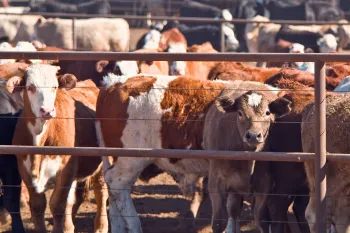
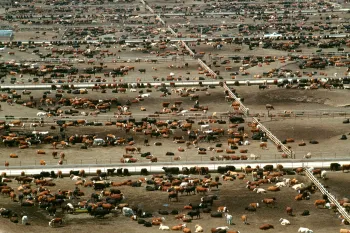
In the final stage before slaughter, called “finishing,” most cows are sent to feedlots to get to market weight, which has been steadily rising for decades. They’ll stay here for a few months up to almost a year. On feedlots, cows are often crowded into separate outdoor pens of expansive dirt.
Each day they’ll gain as much as 4 pounds. Although cows’ complex digestive systems were built for foraging foods such as grass, in feedlots, cows eat corn-heavy diets to fatten them up quickly. This unnatural diet can cause bloat, which is highly painful and sometimes fatal.
Over time feedlots have gotten bigger and bigger. When feedlots started taking hold in the United States around the 1960s, facilities often had between a couple thousand to 30,000 cows. Today, feedlots can hold more than 150,000 cows, and the industry is trying to make them even larger still.
At the end of the beef production process, cows spend their last moments inside a slaughterhouse. The average cow is around 2 years old at this point. Their natural lifespan is 20 years.
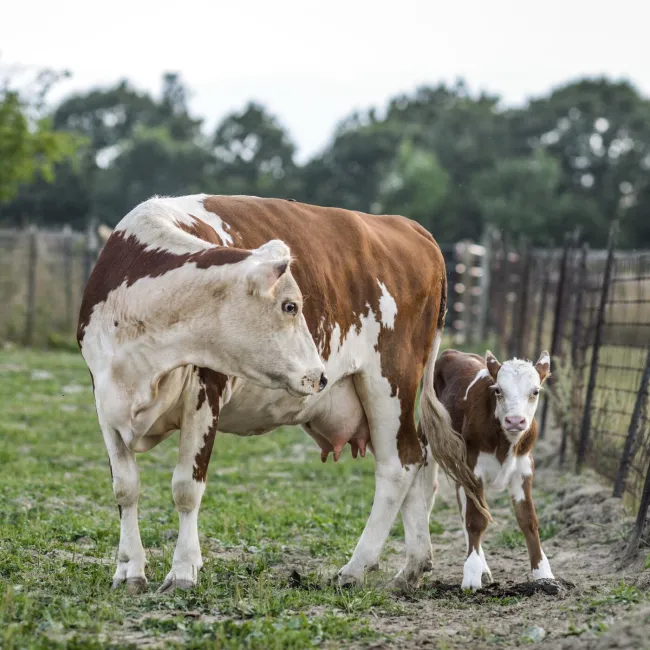
A growing number of dairy cows are slaughtered for their meat too. Female cattle will often be killed once their milk production wanes. Since males can’t produce milk, they are separated from their mothers shortly after birth and raised for beef or veal. Calves used for veal are usually slaughtered when they’re around four months old, however 15% of calves in the U.S. are killed when they’re just three weeks old. Veal has experienced a massive decline in popularity in recent years as people have learned about its cruelty. Additionally, ten U.S. states now ban the use of veal crates (cages so small calves can’t even turn around).
Julie LP/We Animals Media
A cow’s life on the road
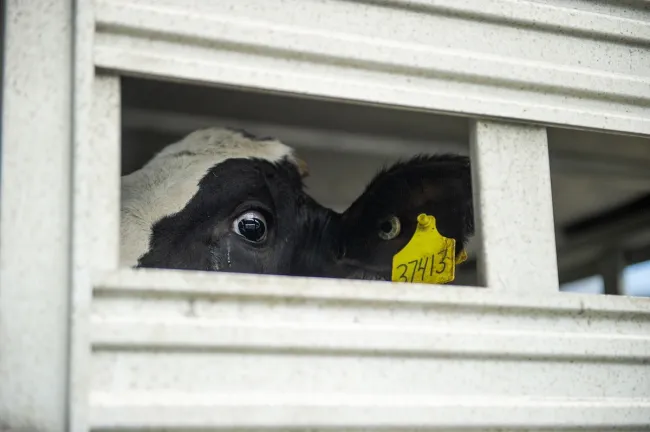
During their short lives, cows will spend much of their time being trucked from one massive facility to another. Transportation is largely considered one of the most stressful events cattle experience. They’re often stuck inside trailers where they are exposed to loud noises, fuel and exhaust fumes, and, occasionally, sweltering or freezing temperatures.
Under U.S. law, cows can be transported up to 28 hours straight without food, water or rest. Even cows who are given the chance to rest may be too stressed to eat or drink.
Throughout the complicated beef production process, many cows will undergo painful procedures. Male cattle are usually castrated, which is often done by removing the testicles with sharp tools or an elastic band. This is usually done with no anesthesia. While some steers are now bred not to have horns, those with horns often have them burned with chemicals or a hot iron to prevent them from growing. Pain relief during dehorning is not required in the United States, so it is often not used.
Jo-Anne McArthur/We Animals Media
These procedures are done, in part, to increase economic outputs. Cows without horns need less space and are less likely to bruise each other, which producers say reduces the quality of the meat.
Stuck within the industrial animal agricultural system, cows live a bleak existence. But like many other animals killed for their meat, cows are complex social and intellectual beings. Research has found they form close friendships, and these bonds help alleviate stress and agitation. Earlier this year, scientists documented a cow using a tool for the first time, which suggests these animals are much smarter than we currently know.
At the same time, Holbein worries that demand for beef may be growing within the United States. In addition to presidential actions, current societal trends toward eating lots of protein and “real food” are pushing some that direction too.
Instead of embracing even more beef production, it is well past time we start reexamining our meat-heavy American diet and the system that makes it.
Konrad Lozinski/We Animals Media
Speak up for farm animals
More than 97.6 billion farmed animals are kept and killed for food each year, causing immense animal suffering and releasing greenhouse gas emissions at levels on par with all cars, planes, trains and boats around the world combined. We need to prevent the suffering of animals on factory farms and protect the world around us.
Related Stories
Alamy Stock Photo
In the second part of a two-part series, we learn how beef farming contributes to wildlife habitat loss, water shortages, pollution and biodiversity decline.
Meredith Lee/Humane World for Animals
The growing farm sanctuary movement offers animals a life of comfort while revealing the immense suffering inside factory farms.

Coty Tarr
Discover how swapping meat for beans one day each week can benefit animals, people and the planet.