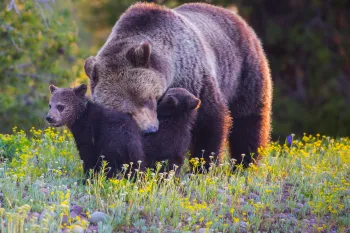
In bear country, May is a month of rebirth. As temperatures warm, the bears who have been hibernating through the winter emerge. Mama bears will show their new babies the world for the first time and help them navigate their cubhood. Grizzly bears, in particular, spend so much time raising their young—four years or more—teaching them how to be a bear before they venture off on their own.
Just as these vulnerable animals are emerging into the wilderness, we are tracking threats emerging in the U.S. government that could strip them of their Endangered Species Act protections. For months, the U.S. Fish and Wildlife Service has signaled it may soon move to delist grizzly bears.
And just this week, the House Appropriations Committee proposed a partisan federal funding bill for the Department of the Interior that, if passed, would direct the agency to delist grizzly bears in the Greater Yellowstone and Northern Continental Divide ecosystems and block our ability to fight back in court. This is in addition to a previously introduced bill, the Grizzly Bear State Management Act that would remove endangered species protections from Greater Yellowstone Ecosystem grizzly bears.
We need your help to stop this.
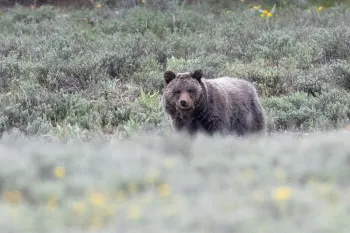
It is thanks only to the Endangered Species Act, a landmark environmental law that grizzly bears have slowly begun to recover their numbers from the devastating killing campaigns that brought them to the brink of extinction. Yet just around 2,000 individuals are left in the Lower 48; it’s critical that they retain these protections if they are to survive.
Miracle’s story
This year, in Grand Teton National Park, a young bear called Miracle is surviving solo. Miracle was originally a triplet. But after reportedly being separated from their mother, Bonita, in 2025, two of Miracle’s siblings were confirmed dead.
For a while, we did not know what had happened to the last cub—but then the aptly-named Miracle reappeared and was briefly reunited with Bonita before they entered separate dens for hibernation.
For grizzly bears, hibernating alone at such a young age is a risky move as the harsh winter takes a toll on their bodies—particularly when there is no snow to insulate their dens as occurred in the winter of 2025/2026. Many feared Miracle would not survive. But this little bear beat the odds. Spotted in the park once again this month, Miracle appears healthy and fit.
Miracle’s story is a reminder not only of the incredible odds grizzly bears face today, but that the reemergence of bears on the landscape is a true cause for celebration. After the species was almost wiped out because of hunting and habitat loss, each grizzly bear is an important, true “miracle” in their own right.
How you can help grizzly bears
Both 2024 and 2025 saw record-level mortalities for grizzly bears living in the Greater Yellowstone Ecosystem, as bears have to roam further to find food when key sources dry up. It may also be difficult for bears to find food in the national parks and beyond this summer and fall after a tremendous drought in the Northern Rockies where all Lower 48 grizzly bears live. And yet, some are still calling for grizzly bears to be removed from Endangered Species Act protections so they can kill them for trophies.
You can speak up and tell the U.S. Fish and Wildlife Service that you value grizzly bears and want to see them protected:
Niebrugge Images/Alamy Stock Photo
Help grizzly bears
Grizzly bear protections in the United States are under attack. Help us protect the laws that keep them safe.
As bears struggle to exist in an increasingly human-dominated world, it’s more important than ever that we learn to coexist with them, too. Grizzly attacks on humans are exceedingly rare, and thousands—the vast majority—of encounters with these animals occur without incident.
That said, we can all take simple, commonsense precautions to coexist with bears. Experts at the National Park Service, U.S. Fish and Wildlife and the Interagency Grizzly Bear Committee regularly provide informative reminders about how to stay “bear safe.”
Here are some things you can do:
- Know your bears. How to best respond to a bear encounter depends on the species, environment and overall context. Read up before stepping out.
- Respect bears’ space. Just like humans enjoy personal space, bears do too. This is especially important when encountering a mother and her cubs as grizzly mama bears are protective by nature.
- Take off the headphones. Staying aware of your surroundings is critical and headphones can interfere with that.
- Travel in groups and make noise constantly. Hiking alone can be riskier in bear country. It’s best to go with a group of three or more people. Plus, bears are less likely to be surprised by a group of people than a single hiker.
- Safely dispose of food in bear-proof containers and learn how to store foods safely while hiking or camping, such as hanging a bear bag. This helps keep you and other people in the area safe; human food is never appropriate for a bear.
- Always carry bear spray and keep it accessible. When used properly, bear spray is 90% effective in stopping a bear attack, and far more efficacious than using a gun, according to several studies.
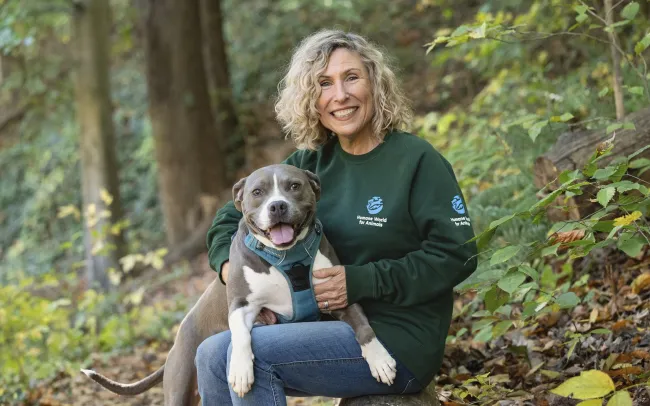
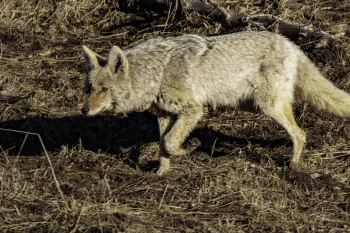
- Consider your canine companions. Wildlife generally pose low risk to companion animals, but it never hurts to take an extra step to keep them safe outdoors. Use a leash (6 feet long or shorter) and equip your pups with a bright, high-visibility vest, bandana or collar when you venture out with them so they’re easy for you to spot and to distinguish from hunted species like coyotes. Make sure to educate yourself about the area you’re exploring.
Everyone can play a part in creating a more humane world, one that values and protects animals in their natural homes. Our actions matter to so many species, and as vulnerable grizzly bear mothers bring their young out of hibernation and into our wild landscapes, we have a responsibility to protect these families.
Vote NO on H.R. 281/S 316!
The Grizzly Bear State Management Act (H.R. 281/S 316) would undermine ongoing grizzly bear recovery efforts.
Kitty Block is president and CEO of Humane World for Animals. Follow Kitty Block on X. Sara Amundson is president of Humane World Action Fund.
Journey with Humane World for Animals to British Columbia where you will hear firsthand how we are working around the world to protect keystone species, such as grizzly bears. Learn more.
Michael Bernard/Humane World for Animals
Great Bear Rainforest
Journey with Humane World for Animals to British Columbia where you will hear firsthand how we are working around the world to protect keystone species, such as grizzly bears.