Editor’s note: While the beef industry uses “cows” to refer only to female bovines, we use the word “cows” in this article to refer to both males and females as this is more familiar to the general public.
Cows aren’t the only animals harmed by the beef industry. Our planet is losing wildlife species tens to hundreds of times faster than any other point in the past 10 million years.
And agriculture is the main driver.
Today, agriculture takes up about half the world’s habitable land. Almost 80% of this farmland is devoted to livestock, whether that’s directly raising over 80 billion land animals for food a year or growing crops to feed this astronomical number of animals.
Sensitive habitats are being decimated to make room for all these farm animals, particularly cows. The North American prairie used to be compared to the African Serengeti because of the vast number of wild animals it supported. It is now one of the most endangered ecosystems in the world.
This widescale habitat loss hurts wild animals in multiple ways. Most directly, they lose their natural habitat and the food, water and shelter it provides. But even within their natural habitats, wildlife can't escape the impacts of animal agriculture.
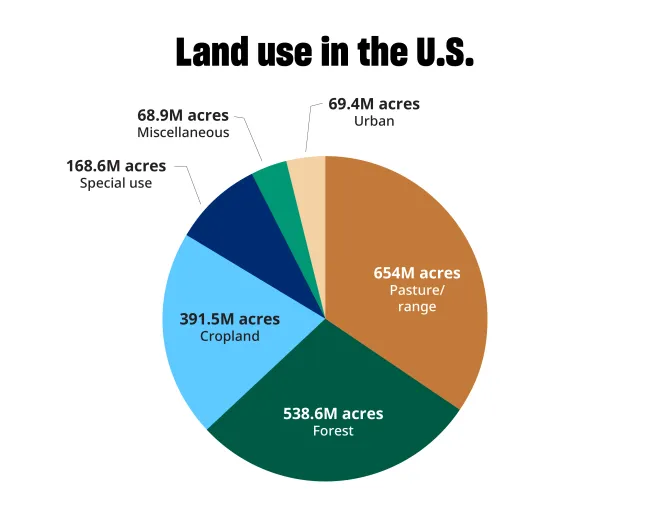
Source: Graph adapted from Dave Merrill and Lauren Leatherby, Bloomberg, “Here’s how America uses its land,” 2018
Wild animals are seen as a threat to farm animals
In the western United States, federal agencies allow ranchers to graze cows and other farm animals on over 200 million acres of federal public land—more than the size of two Californias. A further 24 million acres of land could be used for livestock grazing under the Trump administration’s October 2025 plan.
Close contact between wildlife and farm animals can create a lot of animosity and fear in farming and ranching communities. Even prey animals like prairie dogs are often viewed as “pests” because ranchers believe they take vegetation away from cows and create burrows that the bovines can trip in.
In reality, prairie dogs pose little threat to animal agriculture, says Lindsey Sterling Krank, who leads the prairie dog conflict resolution work at Humane World for Animals. In fact, they do a lot of good for grassland ecosystems. But the perception of prairie dogs as nuisances has persisted and made them one of the most controversial species in North America.
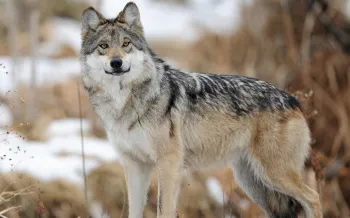
Glenn Nagel/Alamy Stock Photo
Wolves today inhabit just 15% of the land in the contiguous U.S. they did before European colonists came to America. Grizzly bears inhabit around 6% of their historic range in this area. Prairie dogs live on less than 5% of their historic range.
Wendy Keefover with Humane World for Animals, in her work to protect native carnivores, often battles similar misconceptions even though data shows wildlife poses a small threat to farm animals.
In 2015 (the most recent year the U.S. Department of Agriculture has data for), a little more than 2% of all adult cow deaths and 11% of all calf deaths nationwide were attributed to animal predators. Included in this category are deaths caused by dogs, which makes up a sizable chunk of the losses.
In fact, some research has found that killing carnivores can increase predation on farm animals by disrupting the carnivores’ social structures and territorial behaviors. Researchers have also found that coyote populations can actually be higher in areas where more coyotes are killed, as younger coyotes move into newly empty habitats and start reproducing. There’s an old adage, Keefover says, that “for every coyote killed, three come to its funeral.”
Our wildlife team works with farmers and ranchers to help them implement nonlethal strategies to scare off wildlife, such as attaching flags to fencing and using motion activated lights or guardian dogs. Farmers and ranchers can also receive compensation from the government for livestock losses caused by wild animals.
Interest in humanely managing their relationship with wild animals has been growing in farming and ranching communities, but so too have calls to kill the animals.
Wildlife is caught in a political battle
Grizzly bears and wolves have been entangled in a long political battle over their federal protections under the Endangered Species Act. Those advocating for stripping their protections often cite agricultural interests as a driving reason. In fact, President Trump released an executive order in September entitled “Supporting America’s ranchers” that could pave the way for delisting gray and Mexican wolves from the Endangered Species Act.
Even with federal protections in place, animals can still be legally killed in certain circumstances to safeguard agricultural interests. And states often make exceptions to bans on cruel methods to kill wild animals, such as trapping and snaring, for private landowners and farmers.
In Minnesota
Home to around 2,300 wolves, the largest population in the lower 48 states.
verified by the Department of Natural Resources for assistance due to “wolf-killed or injured domestic animals or public safety concerns” in 2025.
were killed in response.
in wolf range experience conflicts each year, according to officials.
Much of the sanctioned killing of wildlife happens under a little-known program within the USDA called Wildlife Services. It is tasked with handling conflicts between farmers, ranchers and property owners and wild animals and even preemptively killing wild animals living near animal agriculture.
Environmental and animal welfare organizations have long criticized the program for senselessly killing millions of animals—often by shooting them from helicopters, trapping or poisoning them, and even gassing coyote pups and fox kits in their dens—at the behest of the agricultural industry.
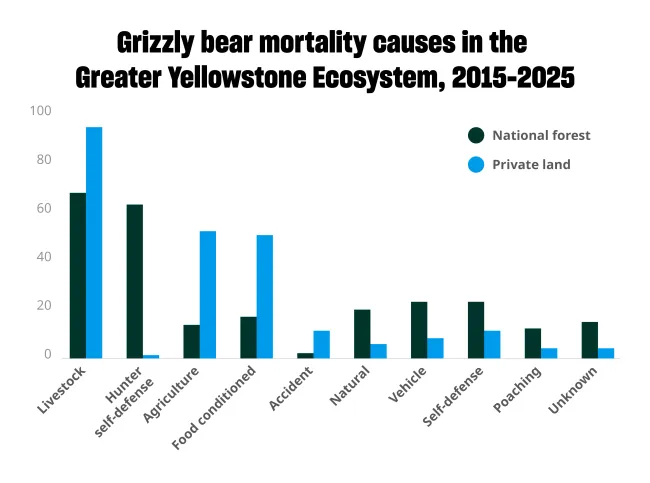
Humane World for Animals/Data courtesy of USGS
“We were the hired gun of the livestock industry,” one former Wildlife Services employee told Vox in 2024.
Between 2015 and 2024, the agency killed 654,772 coyotes, 126,514 prairie dogs (Sterling Krank estimates this number to be much higher), and 3,360 gray wolves. In April, the Trump administration lifted a ban on the use of cyanide bombs (spring-loaded traps that shoot sodium cyanide into animals’ mouths) on the more than 245 million acres of public lands administered by the Bureau of Land Management, subjecting countless animals to painful and cruel deaths by cellular asphyxiation.
The beef industry drives water shortages
Cows’ methane-laden burps also make them the No. 1 agricultural source of greenhouse gases worldwide. That doesn’t even include all the fossil fuels used to transport cows between almost a half dozen farming operations during their lifetime.
And then there’s the water issue.
Earlier this year, the United Nations warned that our planet has barreled past a “water crisis” and into a “global water bankruptcy.” The Colorado River, which provides water for more than 10% of the U.S. population, is currently suffering critically low water levels as the western U.S. battles its worst drought in 1,200 years. Meanwhile, animal agriculture sucks up massive amounts of water to produce crops for cows to eat.
“We find irrigation of cattle-feed crops to be the greatest consumer of river water in the western United States; implicating beef and dairy consumption as the leading driver of water shortages and fish imperilment in the region,” write the authors of a 2020 study in Nature Sustainability.
The situation is so dire it’s been called a “megadrought” and some experts are comparing it to the Dust Bowl of the 1930s.
“There’s no way to solve the math problem [of supply and demand on the Colorado River] without taking on agriculture,” Kathryn Sorensen, director of research at Arizona State University’s Kyl Center for Water Policy, told Politico in June. “You can’t fix this by focusing on the conservation efforts of the cities. It’s just not enough water.”
The toxic byproduct of raising cows for their meat
Agriculture is also one of the leading causes of nutrient pollution, which the U.S. Environmental Protection Agency calls “one of the most widespread and challenging environmental problems our nation faces.”
Farm animals in the U.S. alone produce over 1 billion tons of manure every year—five times the amount of solid waste Americans make. This manure can be an effective natural fertilizer for crops, but because of its sheer quantity, it often secretes too much nitrogen and phosphorus into the environment.
Nutrient pollution occurs when excess nitrogen and phosphorus enter a waterway and cause harmful algal blooms that eat up the oxygen in water, which can then create “dead zones” that kill marine animals. A growing number of blooms are also producing deadly toxins. In 2022, over 100,000 animals reportedly became ill from harmful algal blooms. The actual number is probably much higher.
“Livestock’s untreated sewage is America’s least-regulated source of pollution,” write Denis Hayes and Gail Boyer Hayes in the book Cowed.
Emerging evidence has also found a link between nitrogen pollution from factory farming and higher cancer rates in people. Unhealthy nitrate levels are primarily seen in parts of the U.S. with intensive agriculture, such as the High Plains and northern Midwest, according to a 2026 report from the Natural Resources Defense Council.
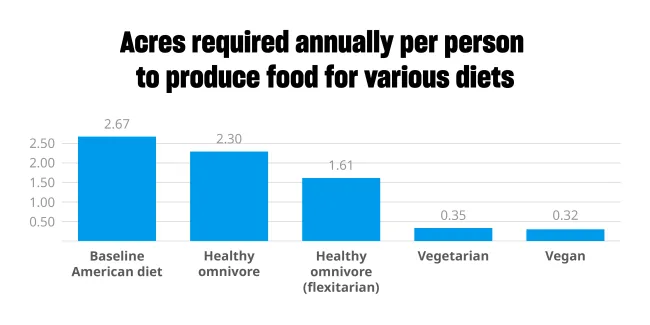
Source: Graph adapted from Kenny Torella, Vox, “This land isn’t for you or me. It’s for the meat industry,” 2023
What’s the solution?
At the same time animal agriculture causes all this damage, it provides just a small portion of the world’s calories.
Humans make enough crops to feed 14.5 billion people—almost twice the current human population. But much of this food goes to farm animals.
As our climate crisis intensifies, it will only become increasingly challenging to produce food. Animal agriculture is already seeing the impacts. Persistent droughts and wildfires are destroying the crops farm animals eat. More frequent heat waves put farm animals at higher risk of death.
Put simply, our current system of food production is not sustainable. It’s a conclusion experts come to over and over again.
Chris Holbein, Humane World for Animals director of public and corporate policy with our Farm Animal Protection campaign, says it can be difficult to talk about the harms caused specifically by the beef industry. Some people may think the solution is eating so-called “greener” meats like chicken, but the same problems plaguing beef production also exist in other animal industries too, he explains. And switching from eating beef to chicken causes more animals to suffer.
It takes roughly 134 chickens to produce the same amount of meat as a single cow. Chickens also face some of the worst conditions and abuses in animal agriculture, says our farm animal protection team.
Global dietary patterns need to converge around diets based more on plants, owing to the disproportionate impact of animal farming on biodiversity, land use and the environment. Such a shift would also benefit the dietary health of populations around the world and help reduce the risk of pandemics.”
2021 report by Chatham House, the Royal Institute of International Affairs
The solution then seems obvious: Shift to more plant-based diets. In fact, 70 experts released a paper last year recommending people eat a “planetary health diet,” which is high in fruits, vegetables, nuts and whole grains and low in animal-based products. (The EAT-Lancet Commission first recommended this diet in 2019.)
Research has found switching to fully or largely plant-based diets would massively reduce the number of animals killed for their meat and the amount of land used by agriculture.
“We find a substantial reduction in the global environmental impacts by 2050 if globally 50% of the main animal products (pork, chicken, beef and milk) are substituted,” write the authors of a 2023 study in Nature Communications.
For years, plant-based eating has been gaining popularity and momentum. Vegan alternatives to meats, milks and cheeses have become increasingly available in stores and restaurants.
But now the highest levels of U.S. government are pushing for more meat and dairy consumption, threatening to undo years of progress. At the same time, the harms to farm animals, wildlife and our planet have not changed. Rather, it’s us who must change.
Imagebroker/Alamy Stock photo
Preserve ESA protections for wolves and grizzly bears!
As gray wolves and grizzly bears continue to face ongoing threats to their survival, Congress is trying to axe science-backed Endangered Species Act protections that are critical to their recovery. And we need your help to fight back!
Related Stories
dhughes9/iStock.com
In the first part of a two-part series, we explore how breeding millions of cows a year for their meat harms farm animals.
Claire Bass/Humane World for Animals UK
Protecting farmed animals and advocating for a more humane and plant-based future is really an all-hands-on-deck issue. Here are five ways you can make a difference.

Sara Kerens/AP Images for Humane World for Animals
Chef Priyanka Naik shares how her love of cooking and commitment to animal welfare shaped her journey to becoming a vegan chef, author and television host.