
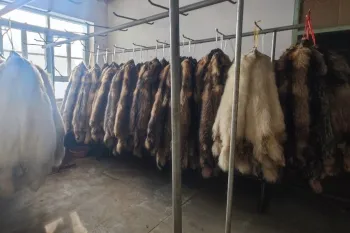
ROME—Humane World for Animals, formerly called Humane Society International, welcomes the submission of two parliamentary questions by Italian policy makers concerning the removal of Russian sable fur pelts from the list of products subject to the trade ban under the European Union’s sanctions regime against Russia. The removal of Russian sable was reportedly made in response to requests put forward by Italy and Greece, the two main EU buyers of these fur pelts, a move that was criticized by Humane World for Animals as “an indefensible concession to the fur industry.”
The two parliamentary questions — one submitted by MEP Annalisa Corrado (Socialists and Democrats) to the European Commission and the other by Italian MP Eleonora Evi (Italian Democratic Party) to both the Minister of Foreign Affairs and International Cooperation and the Minister of Enterprises and Made in Italy — seek to shed light on the EU’s decision to remove “a non-essential good” from the list of products subject to sanctions.
MP Eleonora Evi said: “We are calling on the Italian Government to clarify the reasons that led it to request an exemption for Russian sable fur pelts within the EU Council, an inexplicable and shameful request. Exemptions should be reserved exclusively for essential goods, whereas sable fur pelts are non-essential goods intended solely for the luxury market.”
MEP Annalisa Corrado said: “In light of the objectives of the EU sanctions regime, we are calling on the European Commission to clarify the reasons behind its decision, also on behalf of the 1.5 million people who supported the European Citizens’ Initiative (ECI) ‘Fur Free Europe’ and who dream of a fur-free Europe.”
Humane World for Animals calls on the European Commission to immediately reinstate Russian sable fur pelts on the list of goods subject to sanctions and to respond as soon as possible to the “Fur Free Europe” ECI, to which it should have responded as early as March 2026. The organization also stresses that the only acceptable proposal from the Commission would be a permanent ban on fur farming in the EU, in line with the “One Health” approach, which recognizes the interconnectedness of human health, the health of other animals and the environment. As highlighted by a group of experts in zoonotic diseases in an article published in the scientific journal The Lancet, fur farming represents a preventable public health risk that cannot be effectively mitigated through the introduction of controls and animal welfare standards.
Dr Joanna Swabe, senior director of public affairs at Humane World for Animals Europe, comments: “By carving out an exemption for Russian sable fur, the Commission appears to be listening more closely to the fur industry than to the 1.5 million citizens who demanded a fur-free Europe. This decision is out of step with public opinion and public morality and must be reversed.”
Martina Pluda, country director at Humane World for Animals Italy, concludes: “It is paradoxical that Italy itself, which banned fur farming as of 1 January 2022, recognizing the incompatibility of this industry with animal welfare and public health, has called for a measure that serves the interests of the fur industry and played a role in this absurd situation. We call on the Government to show consistency and leadership: no more fur in Italy or in Europe.”
Humane World for Animals works across the globe to end the fur trade. With a focus on Australia, China, Europe, North America, South Korea and the United Kingdom, our work includes government, industry and corporate campaigns, collaborations with designers and fashion brands, undercover investigations and education campaigns. In recent years, our work has led to a steadily decreasing number of animals suffering and dying for this cruel trade.
#
Fur facts:
- Under Regulation (EU) 2026/506 of 23 April 2026, the European Commission included tanned or dressed fur pelts (CN code 4302) among the products subject to the import ban from Russia. The measure was explicitly part of the strategy to reduce Russian revenues that contribute to its capacity to finance the war in Ukraine. Just three months later, however, Regulation (EU) 2026/1848 of 23 July 2026 amended this measure, expressly excluding sable fur pelts.
- The ban on the export of finished fur garments valued at over €300 to Russia and the ban on raw mink pelt imports from Russia remain in force.
- Fur farming is already banned in 24 European countries, including 18 Member States. However, more than 6 million mink, fox, raccoon dogs and other animals are still confined in small wire cages on almost 1,200 fur farms in the EU.
- According to the 2025 report “A full-cost account of the EU fur industry,” EU fur farming has seen a dramatic decline, mirroring a global downturn. The number of animals killed and pelted for their fur has declined by 86% in the last decade, to 6.3 million animals in 2024. The value of fur pelt sales has declined by 92% in the same period, to an estimated €183 million in 2024. As existing phase-out periods come to an end by 2028, production is expected to decline by a further 15-20%.
- Most leading designers have fur-free policies including Max Mara, Saint Laurent, Gucci, Alexander McQueen, Balenciaga, Valentino, Prada, Armani, Versace, Michael Kors, Jimmy Choo, DKNY, Burberry and Chanel. Fashion houses are choosing to innovate with sustainable, cruelty-free alternatives.
- Fashion Weeks including Copenhagen, London and New York have dropped the use of fur from their events, and publishers of titles including Vogue, Elle, GQ, Harper’s Bazaar, Glamour, Esquire and Vanity Fair have committed to fur exclusion policies.
#