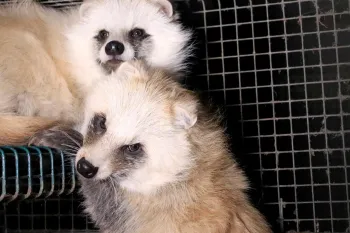
BRUSSELS—As the European Commission considers its final response to the Fur Free Europe European Citizens’ Initiative, The Lancet Regional Health – Europe has published a commentary by leading zoonotic disease experts and academics warning that fur farming poses a preventable public health threat. The authors argue that if the Commission is serious about One Health – the principle that the health of people, animals and wider environment are interconnected – it must propose a ban on fur farming rather than welfare standards.
Lead author Dr Joanna Swabe, senior director of public affairs at Humane World for Animals Europe, says: “Fur farming is an unnecessary and preventable public health threat. The EU cannot claim to champion One Health while allowing a declining fur industry to continue cruelly breeding susceptible species, such as mink, foxes and raccoon dogs, in intensive conditions where dangerous viruses can spread, adapt and potentially spill over to people. Surveillance and spurious welfare tweaks will not remove that risk. The Commission must act decisively and ban fur farming.”
Dr Neil Vora, director of Preventing Pandemics at the Source Coalition, adds: "Caging wild species, like mink, is dangerous to our health. These animals are like viral sponges under these awful conditions: They can contract respiratory viruses from us, incubate them, then pass them back to us in mutated form. It does not make sense to take wild species and confine them in small cages for their entire lives, only to be gassed or electrocuted, solely to produce fur for fashion. Aside from the animal abuse, the risk to our health is too great. It’s long past time to phase this industry out. The EU should ban fur farming, as many of its citizens want, and show the world what true prevention looks like."
The European Commission was due to respond to the Fur Free Europe ECI by the end of March 2026, but its decision has been delayed by apparent disagreement within the College (the EU’s executive leadership body) over whether to ban fur farming or introduce welfare standards. A document leaked to the media in March suggested the Commission was leaning towards standards. This came despite an unequivocal EFSA opinion by independent EU science agency, the European Food Safety Authority, that the most serious welfare problems for mink, foxes, raccoon dogs and chinchillas cannot be prevented or substantially mitigated in the cage systems used for fur farming.
The Lancet piece argues that the EU’s commitment to One Health is undermined by its hesitation to ban fur farming, despite clear zoonotic disease risks and strong public support for action. It highlights how fur farms create ideal conditions for pathogens such as SARS-CoV-2 and H5N1 to spread, adapt and potentially spill over to humans, with past outbreaks in the Netherlands, Denmark, Finland and Spain demonstrating the danger. The authors note that the fur industry is in steep economic decline, imposes wider public health and environmental costs, and cannot resolve its core welfare or disease risks through minimum standards. They conclude that an EU ban on fur farming would be a practical, preventive One Health measure and a clear example of upstream pandemic prevention.
Notes
- The Lancet commentary entitled If the EU is serious about One Health, it must ban fur farming was co-authored by Dr. Joanna Swabe (Humane World for Animals), Prof. dr. Chris Walzer (University of Veterinary Medicine, Vienna/WCS), Dr. Benjamin Roche (MIVEGEC, Université Montpellier/ Universidad Nacional Autónoma de México (UNAM)), Prof. dr. Arnaud Fontanet (Institut Pasteur, Université Paris-Cité), Prof. dr. Thijs Kuiken (Erasmus University Medical Centre, Rotterdam), Dr. Manon Lounnas ((MIVEGEC, Université Montpellier), Prof. dr. Andrea S. Winkler (Technical University of Munich, Germany/University of Oslo), Prof. dr. Sarah Cleaveland (University of Glasgow), Prof. dr. Dirk U. Pfeiffer (Royal Veterinary College, London/ City University of Hong Kong), Prof. dr. Latiffah Hassan (University of Missouri), Prof. dr. Raina K. Plowright (College of Veterinary Medicine, Cornell University), Dr. Neil M. Vora (Preventing Pandemics at the Source Coalition).
- The European Food Safety Authority published its scientific opinion on the Welfare of American mink, red and Arctic foxes, raccoon dog and chinchilla kept for fur production in 2025.
#