At Humane World for Animals, we’re fighting to keep wild animals wild by standing against the cruelty of the wildlife trade and preventing wild animals from being sold as pets or exploited for tourist attractions. Here, Grettel Delgadillo Molina, director programs and policy for Humane World for Animals Costa Rica, tells the story of one species targeted for such cruelties—the sloth.
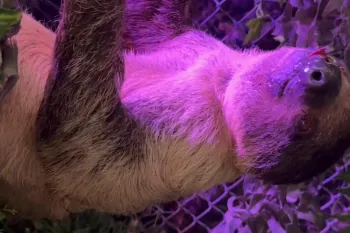
Among the vegetation of the northern Costa Rican forest, I can watch in the distance a grayish-brown ball of fur, perfectly camouflaged in a guarumo tree. Among Costa Ricans, we already know what this ball of fur is: a two-toed sloth taking a midday nap in the warmth of the sun.
After more than 20 years working to help and protect wildlife in Costa Rica, I know the challenges of observing animals in their natural habitats. The only photograph I may get is of that little ball of fur, and if I am lucky, of some small movement where I can see an animal’s claws as they cover their little face from my camera lens.
Undisturbed, the sloth continues to nap, while I feel happy to have the opportunity to see this animal in a natural setting.
Tourists beware: Wildlife attractions that promise sloths
What I described above is a realistic and humane sloth encounter. Here’s where alarm bells should go off that something is wrong in the broader global tourism sector: When tourist attractions promise 100% certainty of getting a photograph with a sloth. Some even promise an opportunity to touch a sloth or hug a sloth and take a selfie for social media.
These are what we call direct-encounter attractions. In recent years, interest in direct-contact encounters with sloths—combined with the marketing of products that show sloths in “chill-out” situations, anthropomorphizing their image and portraying them with “big smiles” for social media—has increased demand for these types of direct-contact attractions around the world, including in the United States. Humane World for Animals even conducted an undercover investigation to expose the cruelties behind this type of business.
We have worked together with authorities in Costa Rica to better understand and to tackle the illegal trafficking of sloths in Costa Rica and across borders, as well as to address its connections to the tourism sector.
Those of us who work with wildlife know that, with animals in their natural habitat, encounters are fortuitous, often fleeting, and nothing is ever set in stone. The opportunity to see sloths will never depend on people’s desire to observe them.
But that desire is strong—and it can create new forms of the same old cruelty.
New packaging, same old cruelty
In Costa Rica, we have recently detected a new and deeply troubling model: sloth parks that guarantee 100% certainty of observing sloths “in their natural environment.” That is when we begin to suspect that something is not right.
Behind many of these establishments is a story of suffering and illegal trafficking. Sloths are taken from their natural habitat—often from other parts of the country—and placed in these parks to simulate that they are there naturally for people’s enjoyment. As a result, up to three or four sloths may be seen clustered very close to one another, even though we know sloths prefer to be alone and not in large groups in the same tree.
To supply the tourism industry, sloths are often transported in sacks or boxes in complete secrecy and under very precarious conditions, which causes them great stress. In addition, because they are species with highly specialized diets, many die shortly after being moved. As sloths are slow and not very aggressive in the wild, their behavior also makes them relatively easy to exploit for capture; therefore, it has become easier to fuel this cruel model, as these establishments keep replacing individuals again and again, endlessly repeating this story of suffering and trafficking.
Ethical wildlife tourism is possible
At Humane World for Animals, we promote and encourage good practices in ethical and responsible wildlife tourism through interinstitutional alliances with government, law enforcement, nonprofit organizations, the tourism sector, universities and other partners. The Costa Rica Silvestre program, for instance, seeks to promote human-wildlife coexistence through practical tools that use information, awareness-raising and education to show tourists what they can do to have an ethical wildlife experience during their travels.
This program promotes tour operators that have rules in place to protect animals and people, such as:
- Do not feed wild animals.
- Properly dispose of trash.
- Observe animals from a safe distance and in silence.
- Properly safeguard pets so they do not disturb natural environments where wildlife is present.
Following such guidelines is the least we can do to protect and respect wild animals. And it’s up to us—all of us—to ensure the norms continue to change in favor of the animals.
What’s inspiring about working in this area of animal advocacy is that everyone can make a difference. We all have the power to reduce demand for these unethical activities and choose to be responsible wildlife tourists.
We owe it to the sloths. We owe them the possibility of continuing that midday nap, and the possibility of breathing, moving and feeding without human intervention.
Let us act responsibly and allow sloths and other animals to live their lives in the wild—only then will the sloth’s smile be authentic.
Grettel Delgadillo Molina is director programs and policy for Humane World for Animals Costa Rica.