In 2021, during a severe snowstorm in San Antonio, Texas, authorities received a strange phone call. A concerned citizen in a neighborhood near Interstate 35 reported hearing the distressed cries of some kind of animal nearby.
When authorities arrived, they quickly realized this would not be a typical rescue.
A six-month-old tiger cub was shivering—here was a dog harness around her neck.
Her beautiful striped fur was patchy, suggesting that she had been pacing a small cage and rubbing against its sides over and over, likely from the distress of confinement.
It was clear that there was no natural reason for a tiger to be in a harness in a snowstorm in Texas. She was just one of countless victims of the wild animal pet trade, a highly lucrative and operation that robs animals all over the world of their ability to express their natural behaviors and instincts, a life in their natural environment and often their lives.
It is impossible for private owners in a domestic environment to replicate the advanced expertise and resources that are required to properly care for captive tigers. Because of this, tigers are often found to be suffering from health issues, such as malnourishment and metabolic bone disease, when they are rescued from the pet trade.
Now her name is Elsa. A member of the sheriff’s office gave her that name, after a character from the movie Frozen. It was a moment of sweet whimsy in a situation that was otherwise entirely heartbreaking.
Rescuing Elsa
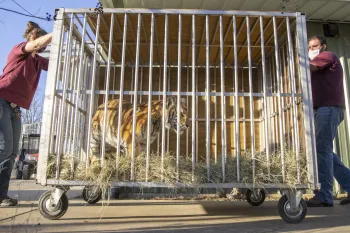
The local authorities got in touch with our team at Black Beauty Ranch in Murchison, Texas. All too often, wild animals caught up in the pet trade have nowhere to go once they become too large or dangerous to handle. Because they cannot be responsibly released back into the wild, placement in a sanctuary or zoological facility is their only remaining option.
As a sanctuary accredited by the Global Federation of Animal Sanctuaries, Black Beauty Ranch has been entrusted with caring for more than 40 different species, including several big cats. At the sanctuary, these animals enjoy spacious habitats that mimic their native habitats and greater freedom to live how they wish. It is our honor to be able to provide them the next best thing to life in their natural habitat.
The extraordinary gift that Black Beauty Ranch provides is a home to animals just like Elsa, who cannot be safely returned to the wild. But she can live the rest of her life in as natural an environment as possible, receiving top-of-the-line care.
Black Beauty Ranch is home to numerous former wild animals kept as pets. The sanctuary staff develop personalized care plans for each animal, taking into account their individual personalities and unique histories. These plans ensure that every animal receives the care and support needed to thrive, both physically and psychologically.
When they are forced to live as pets, wild animals’ lives revolve around the desires of humans. But at the sanctuary, our caregivers cater to their specific needs.
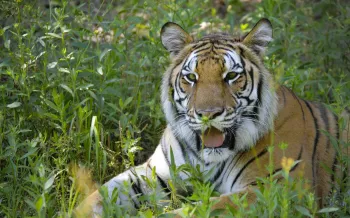
“Most of our rescued animals have never had a choice in how they lived,” said Christi Gilbreth, senior specialist at Black Beauty. “At Black Beauty Ranch, they get that freedom back—freedom to spend their days as they wish, being what they were always meant to be. For Elsa, she has the freedom to be a tiger whether that’s playing in a pool, scratching on the trees, lying in the shade or enjoying the various enrichment that is offered to her by her care team.”
Christi Gilbreth/Humane World for Animals
Sanctuary life
When Elsa first arrived at the ranch, she was a very curious cub. Now, five years later, she’s become more laid-back and prefers to take her time checking things out.
Now an adult tiger, Elsa enjoys a healthy diet, enrichment and an expansive naturally wooded habitat where she can safely roam.
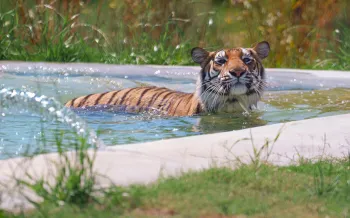
Her 3-acre habitat provides her with plenty of space to lounge in the forest while keeping a watchful eye on everything around her. She spends most of her days swimming in her pool and playing with her enrichment toys.
Becky Koesel/For Humane World for Animals
You can help end the wild animal pet trade
There are 800 residents at Black Beauty Ranch, a 1,400-acre state-of-the-art sanctuary created for animals who have endured suffering of the worst kind. Even though they aren’t equipped to return to the wild, our staff has gone to great lengths to create tailored environments that feel as natural as possible for the sanctuary residents.
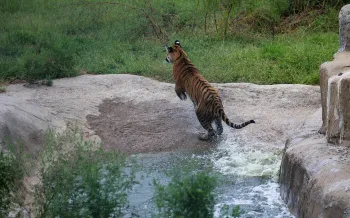
Because she was rescued at such a young age, Elsa was able to grow into a healthy, spirited tiger. Unfortunately, this is not the typical outcome for animals affected by the wild animal pet trade.
Maura Flaherty/Humane World for Animals
All over the world, wild animals are stolen from their habitats or bred in captivity to feed a massive multinational pet trade that robs them of their natural lives. From parrots to reptiles to primates, these animals endure immense stress, injury and death during capture and transport. Parrots, for example, are one of the most heavily traded groups of animals globally, researchers found that nearly half of all bird species worldwide (45.1%) have been recorded in trade, with the pet trade identified as one of the key drivers.
Those wild animals who survive capture and transport often suffer in captivity, enduring a lifetime kept in a cage, vivarium or aquarium. While they may be kept by well-meaning people, these animals have complex physical and behavioral needs. People keeping them captive do not understand how to meet these needs and have difficulty recognizing when they need to see a vet.
No animal deserves to live like that. That's why we're fighting the wildlife trade to keep wild animals where they belong.
Kathy Milani /Humane World for Animals
Help captive wildlife
Wild animals belong in their natural habitats, not kept in roadside zoos and circuses for our entertainment. With your help, we are working to end this cruelty.
Kitty Block is president and CEO of Humane World for Animals. Follow Kitty Block.