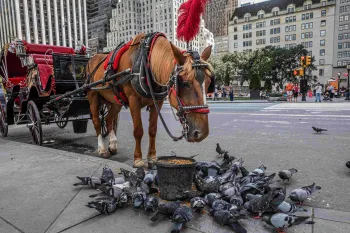
What is safest for people is so often also the most humane option for animals. This is an idea that applies to so many animal welfare issues right now—and one shining example of this truth is still walking the streets of New York City, squeezed between bikers, pedestrians and traffic, cowering from car horns and sirens: The iconic carriage horse.
But animals are not icons, not inert objects to help us live out our fantasies of a former world. They are living, breathing individuals with needs, instincts and intentions all their own.
The divide between this reality and the lingering fantasy about the carriage horse came into brutal contrast most recently over the summer, when an 18-year-old tourist tragically died in a horse-drawn carriage accident in New York City.
And just about a week later, the rides in and around Central Park started up again. It’s said that the definition of madness is doing the same thing over and over again and expecting different results.
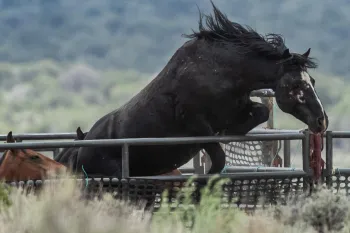
We’ve seen the stories of horses collapsing on city streets or becoming frantic and dangerously bolting. We’ve seen one accident after another. And we must now reckon with the fact that it is 2026, not 1896. Our world is a different world than the one described by Edith Wharton and Henry James. It is time we all acknowledge that some practices and traditions belong in novels and period films—not in our contemporary cities.
New report takes a close look at NYC’s carriage horse industry
Horses, no matter how well trained, experienced or handled, are sensitive and powerful animals with particular needs and instincts that are essentially at odds with dense urban environments.
Our new Humane World for Animals special report shows why another round of promises and regulations is not enough. Who is responsible for protecting New York City’s carriage horses? examines the inherent problems with keeping carriage horses in and around Manhattan’s Central Park as a tourist attraction.
Here are some key findings:
- For generations, New York has tried to reconcile carriage work with horse welfare through work limits, veterinary requirements, weather restrictions, stable standards, recordkeeping and inspections. Yet, our review of city records, veterinary examinations, audits and testimony found persistent gaps in horse-by-horse accountability.
- An independent city-retained veterinarian was unable to complete trot examinations and blood testing he considered necessary for soundness assessments because consent was not provided.
- One horse, Sophia, clearly had significant hind-limb abnormalities and pain, and the veterinarian determined she was unfit to work.
- For other horses, including Destiny, Blackie and Layla, the veterinarian said he could not determine soundness in good faith without consent to completing examinations and blood testing.
- City records listed a horse named Sally as born in 2017 and her license status as expired. But when our staff photographed her working in July 2026, her visible permanent freeze brand appeared to identify her as a mare born in 2007—about a decade older than the age the city recorded.
- What should be simple questions related to these carriage horses—Who is this horse? How old are they? Are they fit to work? Who is responsible for them? Where will they go when their working life ends?—are left unanswered.
- So, not only is the practice of keeping carriage horses on the streets of dense urban environments dangerously outdated, but the carriage horse industry in New York City also seems to be particularly rife with conflicting information and lack of oversight, making it impossible to determine whether a high standard of animal welfare is being maintained, much less ensure it. This in turn puts both animals and members of the public at risk.
Momentum builds toward a NYC ban on carriage horses
Mayor Zohran Mamdani and City Council Speaker Julie Menin have committed to phasing out the horse-drawn carriage industry in Central Park and Times Square, and we are grateful to them and to Health Committee Chair Lynn Schulman, Council Member Christopher Marte and other council members working to move this issue forward while protecting both horses and workers. Now, the City Council can turn that commitment into action by voting to ban carriage operations.
To arrive at this pivotal moment has taken years of persistence and partnership. We work alongside Voters For Animal Rights, the ASPCA, Animal Legal Defense Fund and a growing coalition of equine rescues and sanctuaries prepared to help provide safe futures for the horses retired from the carriage industry.
Ending carriage operations would not erase the legacy of carriage horses in New York City; it would honor the full measure of what they have meant to us while ensuring a humane transition for the horses and the people whose lives have been tied to them.
Few animals have shaped human civilization as profoundly as the horse. For thousands of years, horses carried us, cultivated fields, connected communities, transported families and goods, built cities and powered public transportation. They helped create the modern world—and represent this kind of freedom and movement.
That makes the image of a carriage horse in modern Manhattan especially heartbreaking: an animal so deeply associated with open space and motion standing amid pavement, congestion and noise, their movement confined to a commercial route and a stall in a warehouse stable.
We honor horses best not by asking them to keep carrying yesterday’s burdens, but by ensuring that they are treated in a way that reflects our understanding of what they need to thrive.
Norbert Rehm/iStock.com
End horse-drawn carriages
A carriage horse ban gains momentum in New York City, signaling a global push to retire a tradition built on cruelty.
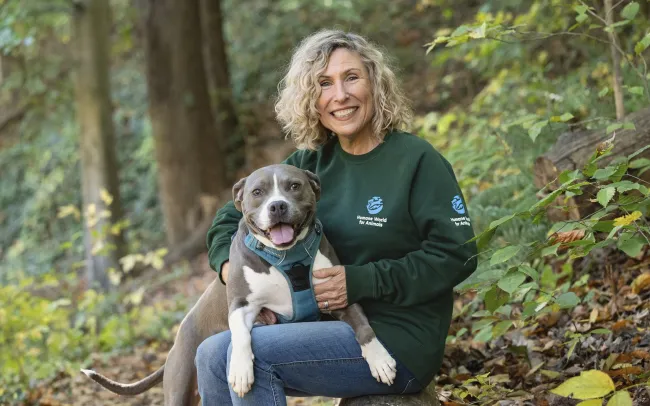
Kitty Block is president and CEO of Humane World for Animals. Follow Kitty Block on X.