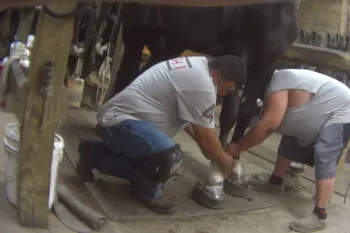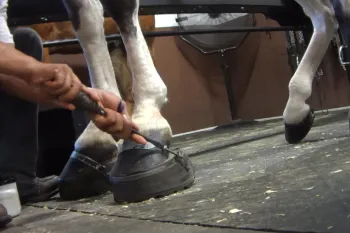
Soring is an undeniably cruel practice involving the use of caustic chemicals (blistering agents like mustard oil, diesel fuel and kerosene) and constricting devices —stacked pads, chains and tight metal bands, and sometimes even the cutting or thinning of horses’ soles or the use of other means to make their feet particularly sensitive to pain.
This is what some people do, intentionally inflicting pain on horses’ feet and legs to force them to perform the “Big Lick,” an exaggerated high-stepping gait for Tennessee Walking Horse shows.
We have been battling to end horse soring for years—and we are so close to winning this fight. But every time we get to the finish line, it feels like there’s a few exaggerated high steps back. For years, we have constructively engaged the U.S. Department of Agriculture and encouraged efforts to build a system of enforcement that actually works. But something always gets in the way, and the agency just isn't honoring its obligation to protect horses under the Horse Protection Act.
We were infuriated by the USDA’s January 2026 announcement of a further suspension on the implementation of long overdue regulatory reforms to protect horses from soring. We had seen enough, and we decided to do something about it. We’re suing the agency.
In a lawsuit filed this week by attorneys from the Humane World Animal Protection Law division, Humane World for Animals, Humane World Action Fund and several individuals who love and care for Tennessee Walking Horses challenged the USDA’s decision to withdraw several rules and procedures critical to the prevention of soring.
These are not minor but long-standing rules designed to help inspectors identify horses at shows with signs consistent with soring —the “scar rule”—and prevent horses from being shown again after failing inspection—the “no showback rule.” The agency also abandoned the process for disqualifying sore horses at shows, and suspended a final regulation intended to replace the ineffective system of industry self-policing.
Without these rules, we believe the agency is violating its statutory mandate to end soring, and we’re already seeing the harmful consequences. In prior years, USDA inspectors referred soring violations directly to show management, resulting in real-time disqualifications at shows just as Congress intended when it passed the Horse Protection Act decades ago. The agency has now explicitly abandoned that enforcement pathway.
On March 14, 2026, the USDA made clear it was returning essentially all responsibility for enforcement to the industry—to the very people who profit from soring—stating that it hoped that the industry could “make the sixth time the charm,” allowing self-policing to continue despite repeated past attempts and decades of evidence that it does not work.
The results are disturbing. Our staff members have observed horses entering the show ring this season (after passing inspection by industry inspectors) while struggling to move, stumbling and being unable to even complete a class. This is a direct consequence of a system where industry-led inspections fail to detect or deter soring.
Our lawsuit asks the court to hold the USDA accountable to the law and to prioritize protecting horses, as the Horse Protection Act intended, rather than shielding an industry that profits from their suffering.
Without proper oversight, the risk is not theoretical. Soring involves the continued use of methods designed to make every step agonizing. Substances are used to inflame and agitate the legs so that even light contact causes pain. Heavy, stacked shoes and pads are manipulated to create pressure and horses’ hooves may be pared down to increase sensation. Chains strike chemically burned and already sore areas with each step, amplifying pain and forcing the show gait that judges reward in some walking horse competitions.
The horse was clearly in agony
One of the suit’s individual plaintiffs, Bill Coon, recalls the day he realized trainers had sored his horse, National Bank, without his consent or knowledge. “I showed up at the barn unannounced. I asked the barn manager to get National Bank out of his stall [and] was surprised at the shocked look on the barn folks’ faces. The stalls in the barn had a 6-inch berm [barrier] that the stall sliding door opened on. To my surprise I was watching a 16.2 hand horse not able to step over the berm.”
The horse was clearly in agony. Bill ended the training and brought National Bank home. Bill has since dedicated himself to advocating for the humane treatment of walking horses and promoting alternative shows for sound, pain-free horses.
A beloved horse abused behind closed doors
Another plaintiff, Jacqueline (“Jacque”) Kasselman experienced similar deception and gained firsthand knowledge of the utter inadequacy of the current inspection system.
Jacque purchased Trip, her Tennessee Walking Horse, so that her granddaughter could participate in shows. Concerned about the widespread use of soring, Jacque relied on the representations of industry professionals that her horse could be trained to perform the “Big Lick” walk without the cruel practice. Jacque also relied on the USDA’s legal obligations to protect horses. But things were not adding up. The trainer did not allow Trip, who was kept in a show barn away from Jacque’s home, to see Jacque’s veterinarian or farrier, insisting they use a different local veterinarian and a farrier flown in from Tennessee. Later, at shows, Jacque and her granddaughter were told to stay away from the inspection zone.
Suspicious, Jacque removed Trip from the walking horse shows and brought him home. Only later did she grasp what had happened. Trip had been sedated, the soles of his feet cut thin to intensify the impact of his heavy padded shoes.
Jacqueline Kasselman
Jacque’s personal veterinarian and farrier, who saw Trip shortly after she pulled him from the show, said his hooves were so damaged that—had they been cut down a millimeter more— euthanasia might have been warranted.
“I learned the hard way to not play organ music around him,” says Jacque—old fashioned organ music is widely played at Walking Horse shows. If he hears the music now, he puffs up and becomes extremely anxious. Jacque has dedicated countless hours, money and energy to his recovery, but the physical and psychological impact remains. “I’ve cried a lot of tears over his journey,” she says.
The end of soring
When we sue an agency of the federal government, we do not do so lightly. We do so as a matter of justice, and in this case specifically, to restore the protections that we and many other parties have worked for years to achieve. The law is clear, and so is the USDA’s responsibility: Horses should not suffer for the sake of a show ribbon.
Kitty Block is president and CEO of Humane World for Animals. Follow Kitty Block on X. Sara Amundson is president of Humane World Action Fund.