Editor's note: After the death of a passenger earlier this year, the New York City Council passed legislation on Oct. 22, 2026, to phase out horse-drawn carriage operations by June 2028. This ban aligns with state law, prohibiting the horses from being sold for slaughter. Humane World for Animals and other organizations have offered placement options for horses currently working in the city.
The video starts with a horse collapsed on a busy street in Manhattan. His front legs are buckled, body still attached to a carriage decorated with flowers, head hung down. A man in shorts and a T-shirt circles the front of the horse, grabs the reins and pulls up again and again. He swats the bay’s hindquarters several times. But the horse remains on the pavement in the August heat.
“Get up! Get up! Get up!” the man says. Passersby call out for him to stop. Instead, the man walks behind the horse and smacks him with the outstretched reins. The bay rolls onto his side and lies still. Only then does the man detach the carriage from the horse’s harness.
The old horse, named Ryder, was retired after his collapse but euthanized two months later in October 2022 (an autopsy found he had leukemia). Advocates, including Humane World for Animals and the New York City group Voters for Animal Rights, took up his name as they campaigned to end the carriage horse industry in and around Central Park, amidst a string of accidents, injuries and deaths.
During the past year: In August, a horse named Lady collapsed and died while pulling a carriage at 11th Avenue and West 51st Street. In September, Bambi spooked and ran off through Central Park without her driver but with riders still in the carriage. In January, a horse pulling a carriage ran out of the park and into a busy intersection, crashing into parked cars.
The fight to protect carriage horses
“Ryder’s Law,” which would have banned horse-drawn carriages this coming June, was endorsed by much of the city council and every mayoral candidate last year, as well as the nonprofit Central Park Conservancy that runs the park. A recent survey by Voters for Animal Rights and the Animal Legal Defense Fund found 71% of city residents support a ban. In November, though, the proposed law failed to make it out of committee for a full vote of the council.
The horse industry is struggling with social license to operate, struggling with society’s acceptance of the use of horses in this way."
Chelsea Perez, Humane World for Animals senior program manager for equine protection
This year opens with activists continuing their push to remove horses from the traffic of the city’s streets and the busy bike lanes of Central Park. In late December, Mayor-elect Zohran Mamdani, on the eve of his swearing in, pledged he would work with the carriage drivers’ union to bring about a ban. Singer Kim Petras posted on X that she would send Mamdani a copy of her new album if he would get horse carriages out of Central Park.
“This is 2026, not 1896” says Brian Shapiro, Humane World New York state director. “As we become more enlightened about animal welfare, this will end. There have been so many accidents. The public is engaged.”
Carriage horse rides, which tourists used to uncritically accept as a fun and iconic way to experience New York City, are now under scrutiny, says Chelsea Perez, Humane World senior program manager for equine protection. “The horse industry is struggling with social license to operate, struggling with society’s acceptance of the use of horses in this way.”
/The HSUS
Protect horses from soring
Join us in calling on the U.S. Department of Agriculture to support the updated Horse Protection Act regulations and protect American horses.
A carriage horse’s life in the city
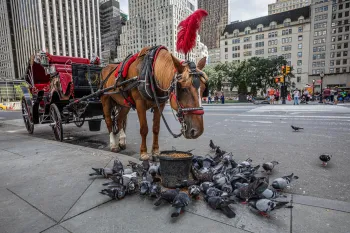
Nearly 200 New York City carriage horses work long hours every day except when the temperature rises above 90 F and during five mandated weeks of rest. They sleep in multistory tenement stables on the West Side of Manhattan, often in stalls too narrow to lie down, and must travel a mile and a half each way to get to Central Park, breathing in vehicle exhaust and surrounded by the clamor of the city. It’s especially stressful for the many old horses newly arrived in the city after being purchased from Amish country in nearby Pennsylvania or from the harness racing industry. They may be used to pulling carriages. They are not used to living in a big city.
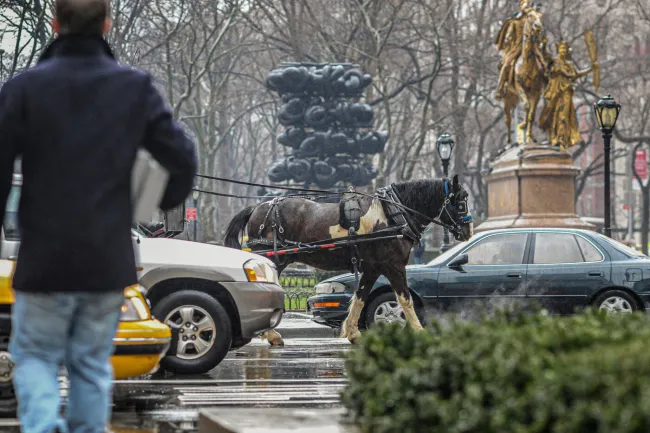
Horses possess a flight drive—they evolved to bolt in response to loud noises and sudden movements to avoid predators. There are no rules or regulations that would make their routine in New York City humane, says Allie Taylor, president of Voters for Animal Rights. “They’re going through midtown, with taxicabs, police sirens, trucks, buses. Horses need time to socialize, to graze, to run.”
Beyond New York, horse-drawn carriages still operate in at least 27 other U.S. cities, despite horses collapsing and dying. They have been banned in more than a dozen—including Biloxi (Mississippi), Chicago, Key West, Las Vegas, Philadelphia, Salt Lake City and San Antonio (where, with the help of Humane World, they will be phased out by 2030). Worldwide, 12 more cities have banned horse-drawn carriages in their centers—including Barcelona, Beijing, Brussels, London, Melbourne, Mumbai and Montreal.
Jo-Anne McArthur/The Ghosts In Our Machine / We Animals
Bans are proposed elsewhere: Atlanta, Cape May (New Jersey), Cincinnati, Dallas, Memphis, Pittsburgh and Savannah (Georgia) in the U.S.; Amsterdam and Palma de Mallorca (Spain) in Europe. Where cities still allow horse carriages, Dallas, Savannah and other cities besides New York now regulate the maximum temperature at which they can operate.
That’s not enough to protect the horses bought to pull carriages, says Dr. Barbara Hodges, advocacy and outreach program director for Humane Veterinary Medical Alliance (part of Humane World for Animals). “You take a horse who’s already had a hard life, and now you’re exposing them to vehicle exhaust. That can cause them to develop heart problems, and lung problems.” Horses who walk many miles on city streets can also develop arthritis and foot problems, she says.
Humane World has worked to end carriage horse rides since 1999, when Dr. Holly Cheever, a founding member of the leadership council of what is now HumaneVMA , first testified about the industry in New York City. A HumaneVMA white paper states that horse-drawn carriages and motor vehicles should not share the same roadways, citing the health risks to horses with medical issues such as COPD (or heaves) and lameness. Often, carriage horse drivers are inexperienced, and the foot care given to horses is inadequate, the paper says.
They’re going through midtown, with taxicabs, police sirens, trucks, buses. Horses need time to socialize, to graze, to run.”
Allie Taylor, president of Voters for Animal Rights
A growing movement to end horse-drawn carriages
A 2017 compromise would have reduced the number of horses in Central Park, kept them off streets outside the park and introduced electric carriages. But it was rejected by the Teamsters, the union that represents the carriage horse drivers.
Advocates continue to lay the groundwork for a ban in New York City. In September, 24 equine rescue and sanctuary organizations signed a letter offering to place the retired carriage horses. Ryder’s Law included a provision that drivers and others employed by the industry would receive help getting new jobs.
In Brussels and Philadelphia, rides are already offered in electric carriages. Brussels’ carriage harks back to an early 20th century horseless carriage. Philadelphia’s, white with gold trim, harks back to an early 19th century wooden carriage. Both feature a human driver perched high at the front.
A Philadelphia organization called Carriage Horse Freedom gave the city the electric carriage on Independence Day in 2023 and named it Caroline. Last year, CEO and founder Janet White took Caroline to Savannah to show the city council. “Cool carriage rides are better than cruel carriage rides,” she posted December 31 on her group’s Facebook page.
Caroline now regularly appears in and around her native city, including Philadelphia’s St. Patrick’s, Fourth of July and Thanksgiving parades, and the opening ceremony of the Christmas Village in the city’s LOVE Park.
After all the movies about New York featuring couples riding in horse-drawn carriages, after years of people associating them with celebrations, people’s ideas are changing, says Humane World Pennsylvania state director Kristen Tullo.
“Caroline is helping to make electric carriages the ‘norm,’” she says. “People just don’t want to ride in horse-drawn carriages any more with this alternative.”
They can see the suffering behind the romance.
Related stories
Anon/Humane World for Animals
Humane World investigation reveals the cruel reality of horse soring as trainers in “Big Lick” contests continue illegal practice.
Christi Gilbreth/Humane World for Animals
At Black Beauty Ranch, wild horses deemed “unadoptable” now roam 800 acres and form bonds within a herd of more than 200.
Christi Gilbreth/Humane World for Animals
Sam Elliott arrived at Black Beauty Ranch weak and emaciated. Today, he’s healthy, resilient and home for life.