Until the systems that profit from tormenting and killing animals no longer exist, we will keep exposing unthinkably cruel realities. That’s why we are releasing another investigation exposing fur farms, this time in China, the biggest fur-producing country in the world.
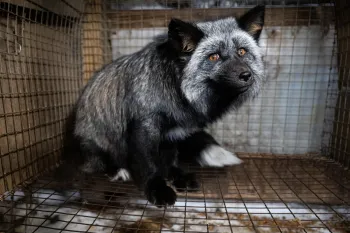
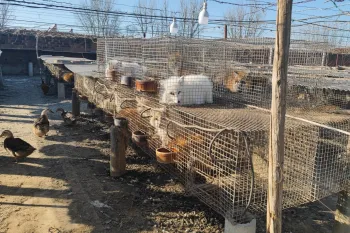
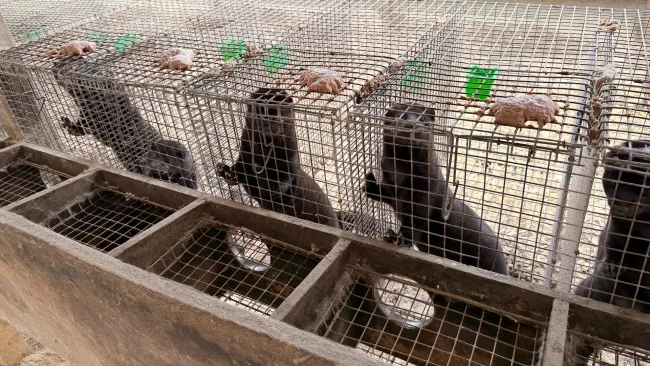
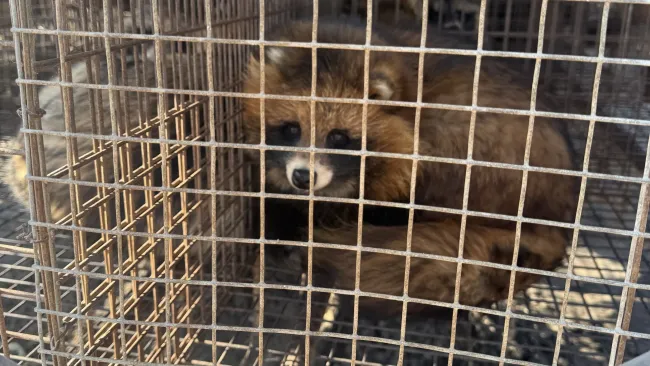
Our new exposé, following an investigation by our partner in China, reveals what goes on inside five fur farms in Qinhuangdao and Dandong, northern China, and it is sparking renewed calls for an end to fur imports around the world. Mink beaten to death. Raccoon dogs and foxes pacing frantically in wire boxes.
The scale of suffering is hard to fathom.
Thousands of mink, foxes and raccoon dogs are kept in small, barren wire cages on these farms. Every wild impulse they have to run, swim, nest and dig is thwarted again and again, causing chronic stress. Many of them repeatedly pace or bob their heads, both signs of psychological distress. Essentially, they spend their short lives going crazy before being electrocuted or bludgeoned to death.
Vshine
The ongoing downfall of fur
Milan Fashion Week has just announced it will no longer promote real fur, joining the likes of New York, London, Iceland, Copenhagen and many more fashion shows that have turned their backs on real fur in recent years.
There are true signs of progress, even if it feels like allowing one more day of this cruelty is one day too long. While China is the largest fur-producing country in the world, the trade there has been in steep decline over the past decade. There has been a 90% reduction in animals kept and killed by China’s fur industry, from 87 million animals in 2014 to 8 million in 2025.
The fur trade’s decline in China mirrors a similar downward trend worldwide; globally there has been an 86% decline in the number of animals kept and killed for fur in the last decade; it’s dropped from 140 million in 2024 to 20.5 million in 2025.
Vshine
From investigation to action: How exposing cruelty helps animals
Our UK office is using the new investigation to motivate renewed calls to end imports of fur into the UK—a measure supported by 77% of the UK public.
In the U.S., not only do a handful of fur farms remain—most notably in Wisconsin and Utah—it's the third largest importer of fur products in the world, behind only Russia and South Korea. Investigations like this show why our efforts to end furs sales at the local and state level is so important. For instance, in Massachusetts, where eight communities have already voted to phase out new fur sales and two-thirds of voters agree, a state bill prohibiting the sale of new products from fur factory farms (H. 990) was reported out of committee and is now poised for consideration by the Massachusetts House of Representatives. Massachusetts has the third highest fur retail sales in the country, much of it from China. So, it’s vital that we pursue a strategy there that prohibits the sale of products from these cruel facilities, and ends Massachusetts‘s role in propping up the industry.
In Australia last week, the council of Northern Beaches, an area north of Sydney, voted to ban the sale of fur products on council-owned land and at council-managed events. The decision makes Northern Beaches the seventh council in Australia to adopt a fur-free policy. In the European Union, we are awaiting publication of the Commission’s policy position on an EU-wide fur farming ban. While fur farming is already banned in 24 European countries, including 18 Member States, and many more have placed restrictions on the practice, more than 6 million animals are still kept on almost 1,200 fur farms across the European Union in countries such as Finland, Denmark, Spain, Greece and Hungary. In July 2025 the European Food Safety Authority concluded that fur farms across the EU fail to meet basic animal welfare needs. More than 1.5 million EU citizens who signed the Fur Free Europe European Citizens’ Initiative petition are urging that the Commission will recommend an end to fur farming and trade in the EU.
Comedian Ricky Gervais, a longtime supporter of our Fur Free Britain campaign, added his voice to our calls for a ban: “We banned fur farming in the UK because we decided it was morally wrong. But the animals being brutalized in the name of fashion don't care if they're suffering in Britain, the EU or China—they just want the cruelty to stop. If fur farming is morally wrong here, it's morally wrong everywhere, so the UK should ban importing fur full stop.”
I couldn’t agree more.
Kristo Muurimaa/Oikeutta eläimille
End cruel fur farming
Millions of foxes, mink, raccoon dogs and chinchillas spend their entire lives trapped in tiny wire cages before being killed and skinned for so-called fashion.
Kitty Block is president and CEO of Humane World for Animals. Follow Kitty Block.