There’s a lot happening this week, to say the least: The U.S. midterm elections have mostly concluded, and our annual To the Rescue! gala takes place later today. But the urgent work of animal rescue on the ground doesn’t pause for important elections or special events—and neither do we.
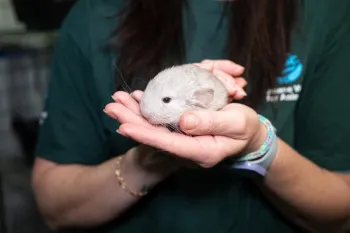
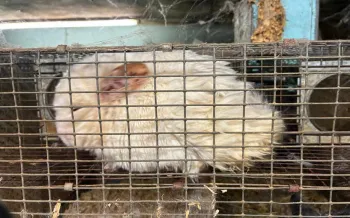
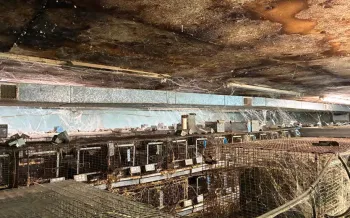
Earlier this week in Ohio, our Animal Rescue Team completed the removal of 951 chinchillas who had been suffering in a wild animal breeding operation in Jenera. The U.S. Department of Justice had requested our help to rescue these animals after the facility had racked up many violations of the Animal Welfare Act over the years: These violations included enclosures lined with the animals’ waste, a chinchilla with a metal disk-shaped collar embedded in her neck, and failing to disclose hundreds of animals, kept in conditions described by the government as “dire,” to federal inspectors over a period of years.
Following legal action from the Department of Justice and U.S. Department of Agriculture, the facility’s USDA license has been permanently revoked, shutting this operator down.
Mark Sanderbeck/U.S. Department of Agriculture
One rescuer on our team, after seeing the rows and rows and cramped and filthy wire cages where the many hundreds of chinchillas had been languishing, called the breeding operation a “factory of forgotten souls.”
Now the work of recovery is just beginning.
Mark Sanderbeck/U.S. Department of Agriculture
Chinchillas are not commodities to be bred and sold
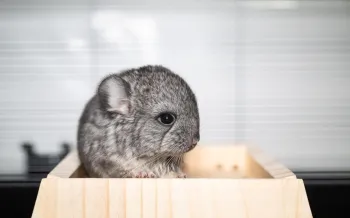
As cute and cuddly as they appear, chinchillas are wild animals, native to South America. Their natural behaviors include socializing in herds and bathing in the volcanic ash of the Andes Mountains. In the wild the animals are endangered—past and current threats to their survival include hunting for fur, shrinking habitat, poaching and the pet trade.
And what these chinchillas experienced was a far cry from the high and wild altitudes of the Andes—and the marks of their suffering show.
Meredith Lee/Humane World for Animals
The conditions at R&R Chinchilla paint a grim picture of how animals can suffer in the wild animal pet trade. According to the DOJ, in the fewer than four years between September 2022 and August 2026, the USDA cited the facility for 59 Animal Welfare Act violations. During that time, and over the course of 18 inspections, the USDA identified multiple violations during almost every inspection, including 17 classified as critical or direct (those with a serious adverse effect on the health and well-being of the animal).
Inspectors identified startling conditions at the facility, including, in just one inspection in August 2026: chinchillas who required critical veterinary care, such as animals with severely swollen eyes, pus-like material around their eyes, nasal discharge, matted fur, hair loss, and overgrown teeth. Inspectors observed the operator restrain a chinchilla with badly matted fur by the base of her tail and put her over his knee to slowly peel a 6-by-4-inch mat of fur from her body as she kicked and attempted to bite. A large area of her skin was left bare.
The USDA and DOJ actions that led to the rescue of these animals from R & R Chinchilla follows a recent increase in the agencies’ efforts to strengthen Animal Welfare Act enforcement. It is an immense relief to see so many chinchillas brought to safety; and we will continue to urge the agencies to pursue enforcement actions against other operators that repeatedly violate the Animal Welfare Act.
Now that the chinchillas have been transferred into our care, in-depth veterinary exams reveal that many have been suffering from chronic and painful ailments such as inflamed skin, overgrown teeth, urine scalding, scabs, sores and severely matted fur. Numerous chinchillas also had missing limbs, toes or ears.
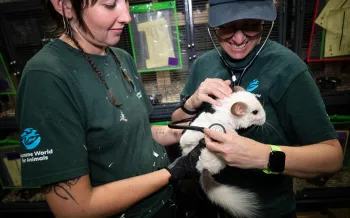
Meredith Lee/Humane World for Animals
Creating a best-case scenario for hundreds of rescued chinchillas
We are in the process of working with our network of shelter and rescue partners to arrange the best possible outcomes for these captive-bred chinchillas, who have already been deprived of their place in the natural world. And that means finding caring families who are also fully prepared to meet chinchillas’ unique, lifelong needs.
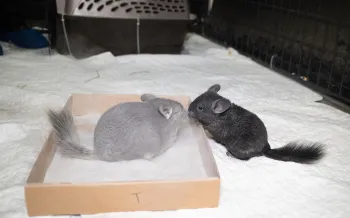
Meredith Lee/Humane World for Animals
Captive chinchillas can live up to 20 years. Inherently social animals, chinchillas live their best lives when they can enjoy the companionship of other chinchillas. They also need to be able to express natural wild behaviors like dust-bathing, exploring, exercising and hiding.
Unlike dogs and cats, who became human companions through thousands of years of selective breeding and natural adaptation across many generations, chinchillas were taken from the wild to be used as pets only relatively recently, in the early 20th century. They are still wild animals who have not been selectively bred for human companionship.
How you can help wild animals in the pet trade
Wild animals are not pets. Yet, all over the world, they are stolen from their habitats or bred in captivity to feed a massive multinational pet trade that robs them of their natural lives. From chinchillas to parrots to lizards to monkeys, these animals endure immense stress, whether in captive breeding cages like those at this facility or during capture and transport from the wild—and many animals die in the process. Those who survive primarily spend their lives suffering in cages.
No animal deserves to live like that. That's why we're fighting to end the wild animal trade to keep them in the wild, where they belong.
Kathy Milani /Humane World for Animals
Help captive wildlife
Wild animals belong in their natural habitats, not kept in roadside zoos and circuses for our entertainment. With your help, we are working to end this cruelty.
You can help: Tell your friends and family to refrain from purchasing chinchillas or other wild animals from breeders, online marketplaces or pet stores, which fuels an inherently cruel trade that treats wildlife as commodities to be captured, bred, bought and sold.
You can also voice your support for federal legislation that would strengthen interagency collaboration in the enforcement of the Animal Welfare Acthttps://www.humaneworld.org/en/blog/us-congress-has-new-chance-take. The Better Collaboration, Accountability, and Regulatory Enforcement (CARE) for Animals Act. would help to address cases like this would and would provide more meaningful civil enforcement tools, including penalties, license revocation and the ability to more quickly remove animals from facilities where they are suffering.
Jo-Anne McArthur/Montreal SPCA / We Animals
Help pass critical legislation
Animals deserve to be protected. Tell your U.S. Senators and U.S. Representative to cosponsor the Better CARE for Animals Act (H.R.3112/S.1538), which will strengthen Animal Welfare Act enforcement.
Kitty Block is president and CEO of Humane World for Animals. Follow Kitty Block on X. Sara Amundson is president of Humane World Action Fund.