The factory farming of mink for fur is cruel and unnecessary, and it certainly shouldn’t be subsidized by the United States government. Or any government.
Last week, the U.S. Department of Agriculture’s Animal and Plant Health Inspection Service detected H5N1, avian influenza, on a mink fur farm in Salt Lake County, Utah. This marks the first detection of the contagious virus on a fur factory farm in the U.S.
While avian influenza has been spreading throughout other animal agricultural operations since 2022, its discovery on a fur farm in the U.S. is of specific concern. That’s because right now —incredibly— both the House and Senate versions of the Farm Bill include a proposal to subsidize this dying industry, which has become nothing less than a biosecurity risk across the globe. From a public health perspective, it’s hard to imagine a more irresponsible giveaway.
The factory farming of animals for fur is a serious public health risk
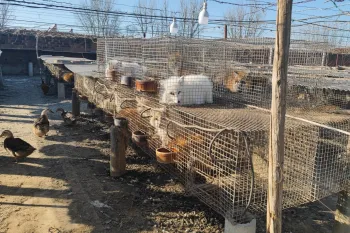
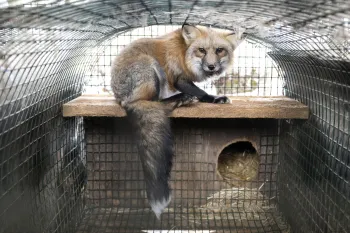
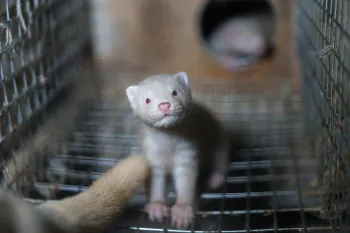
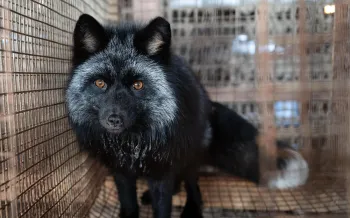
Mink fur farms pose a particularly high risk of disease transmission because mink are vulnerable to both human and animal influenza viruses. Keeping them in large numbers, in cages closely packed together on fur farms, creates a “mixing bowl effect,” allowing for the efficient spread of H5N1 and other viruses to humans or other animals living on or near these facilities.
Disease outbreaks accelerate the
decline of the U.S. mink industry as public health risks mount.
It certainly doesn’t help that there are but a scant few state or federal regulations pertaining to fur factory farms in the U.S. The animals confined in these operations are not protected by the Animal Welfare Act or the Humane Slaughter Act, and in most states the people raising and killing animals for fur aren’t even required to have a permit to operate.
Meredith Lee/Humane World for Animals
Fur farms also continue to be a worrying source of SARS-CoV-2, the virus that causes COVID-19, and scientists have repeatedly sounded the alarm over the public health risks associated with the industry. In the U.S. alone, mink have contracted SARS-CoV-2 on 16 fur farms in the states of Utah, Wisconsin, Michigan and Oregon, and the Centers for Disease Control and Prevention has confirmed four cases of humans infected with the virus causing COVID-19 originating in farmed mink.
Because it is possible for a few farmed mink to escape their confines and put other animals at risk through the spread of avian influenza and COVID-19, fur factory farms are also a threat to non-captive wildlife populations. Animals like scavengers and native carnivores are particularly susceptible to disease transmission because they may prey upon and consume those who have escaped into the wild.
A dying industry
This is not a healthy industry in economic terms, either. The number of mink killed in U.S. fur factory farms has dropped 80% between 2014 and 2024, going from 3,763,250 mink to 771,200 in a decade’s span.
Utah is the second largest fur farming state in the country, behind Wisconsin. In the early 1980s, Utah had 190 mink fur farms, but according to 2022 USDA Census data, there were only 26 fur farms left in the state. Moreover, the number of mink killed for their fur in Utah has dropped 90% between 2014 and 2024, going from 958,760 mink to 95,230.
In that same period, there has been an 86% reduction in animals kept and killed for fur worldwide. Europe is leading the charge to end fur factory farming, and 24 countries so far have already taken action to ban or restrict fur farming. Poland was the most recent to do so, in late 2025. These nations see fur farming operations for what they are: incubators for cruelty, disease and public health risks. And their citizens see it too. Over 1.5 million EU citizens have signed a European Citizens’ Initiative calling on the European Commission to ban fur farming and prohibit the placement of fur products on the European market.
Why pander to a dangerous sector?
In the U.S., however, the global fur lobby and some influential allies in Congress are using the Farm Bill as a vehicle to undo a decades old law that has prevented the use of federal tax dollars to support the mink fur industry’s marketing and promotions budget. And the majority of the mink pelts the U.S. sector produces are shipped overseas, ending up primarily in China and Russia.
To place a provision like this into the Farm Bill at this or any time is outrageous. It simply makes no sense for any government to waste taxpayer funds on an industry built upon animal suffering and death, that is itself now dying—in every sense of the word.
That’s the argument we’ll make if the Farm Bill is taken up for a vote in the fall, and that’s why we’ll be pressing policymakers in the next Congress to embrace legislation to end fur factory farming in the U.S. altogether. Because there’s no excuse for pandering to a dangerous industry in the pandemic era.
Kitty Block is president and CEO of Humane World for Animals. Follow Kitty Block on X. Sara Amundson is president of Humane World Action Fund.