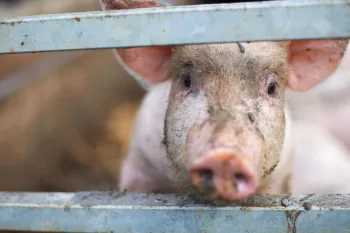
California’s Proposition 12, Massachusetts’ Question 3 and the other state-level laws that have simultaneously enhanced public health and animal welfare in the United States represent the agricultural market of the future, and perhaps more importantly, the moral progress of the nation. Industrial agriculture’s cruel crating of pigs and caging of laying hens are giving way—inexorably—to more humane approaches that will better serve and sustain family farms, public health and the social and cultural integrity of rural communities.
Even so, there is aggressive and defiant opposition from the National Pork Producers Council—a single belligerent and laggard trade group based in Iowa, the epicenter of intensive confinement operations for pigs. Together, with congressional allies, it’s pushing for a Farm Bill package that stymies the adoption of more humane approaches to raising pigs for food, unapologetic in its defense of mass-scale industrial pig factories, which are a blight on the landscape, a source of tremendous environmental harm, and a driver of rural decline in the United States.
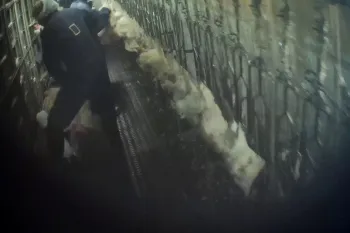
For the rest of us, of course, when it comes to the animal welfare implications of such operations, the case is closed. They’re hell for animals, sites of utter disregard for animals’ suffering, and a genuine embarrassment to humanity.
Unfortunately, a majority of the House Agriculture Committee has turned a blind eye to the rampant cruelty of intensive confinement systems for pigs, and the real and urgent needs of America’s rank-and-file small-scale producers and farmers and its rural communities, by advancing a Farm Bill that truly does not meet the moment. A few key congressional leaders have embraced the pork council’s lies and adopted its broken-record bleating about the humane standards being adopted in state after state.
That’s too bad, because the pork council isn’t the voice of America’s farmers and producers, and it certainly doesn’t represent the will of the American public. Simply put, the NPPC is a conscienceless trade association that serves the largest corporate pork producers and processors, and the animal factories those interests operate are among the worst neighbors one could have in rural America.
In this desperate phase of its campaign to overturn duly enacted laws in nearly one-third of American states (it has failed in every previous attempt to do so in Congress and the courts), the pork council is putting its money on a ludicrously named bill, the Save our Bacon Act. Its supporters are deliberately mischaracterizing this as a battle over bacon, when all that we and other supporters are trying to do through these voter-approved state laws is to spare animals from the abuses of intensive confinement in the pork industry.
The serious challenges now facing rural America, and especially its responsible family farmers, include corporate consolidation, depressed commodity markets, rising input costs and trade disruptions, many of which could be addressed through a balanced and bipartisan Farm Bill. In that light, it’s not merely irresponsible but bizarre that the committee chair and his allies would insist on the Farm Bill incorporating the Save Our Bacon Act and another controversial measure—one that immunizes pesticide manufacturers from accountability via lawsuits challenging the use of products linked to cancer.
The decision to include these poison pills makes it very likely that the Farm Bill will fail in the full House.
Dog import measure raises concerns
There are other measures in the committee’s Farm Bill package that concern us. One involves the importation of dogs into the United States. We respect the desire of the legislative sponsors of the Healthy Dog Importation Act to prevent sick dogs from entering the country, and we believe that effective disease prevention protocols are critical to lifesaving importation programs. However, the bill goes a step further and sets a precedent that could prevent animal welfare organizations from requesting donations to offset the cost of care for animals rescued from cruelty.
Through our own programs, we understand the decisive importance of safe and well-managed importation channels for international rescue work involving animals in hurricanes, earthquakes and other emergencies, dog meat farm closures and other situations in which we and other organizations are active around the world. Helping dogs and puppies receive care, including translocation to the U.S. when their home countries are overwhelmed by an emergency, should not be up for discussion.
Who benefits by creating more obstacles to bringing dogs and puppies to safety in the U.S.? The measure’s supporters include the National Animal Interest Alliance, the American Kennel Club and a few other organizations with conflicts of interests and hidden agendas, such as selling puppies from puppy mills and protecting from scrutiny certain cruelties of importance to their membership. This time around, they’ve even got the support of the pork council for their bill!
The Healthy Dog Importation Act is an especially worrisome proposal because there is a Senate version with many Agriculture Committee members in support, which increases its chances for inclusion in a final version of the Farm Bill.
An unwarranted handout to the mink industry
One of the most peculiar handouts in the House Farm Bill is the proposed earmark of tax dollars to help the mink industry develop and expand into international markets. There has been a prohibition on this handout for nearly 30 years, but the House committee bill inexplicably revives it. In the United States as in other nations, this industry is sinking fast, with approximately 100 mink operations left, consumer demand for real fur at an all-time low and some countries banning fur imports. Mink operations are proven incubators for COVID-19 and avian influenza, and scientists consider the industry a high risk for future viral pandemics, including zoonotic variants that could jump to humans with terrible consequences. This boondoggle doesn’t deserve a penny of the public’s money.
From time to time, over the years, the Farm Bill has been a vehicle for good when it comes to animals and their protection. Not this time around. At the end of the day, there is no daylight between one backwards-facing faction of the pork industry and key members of the House Agriculture Committee in their hostility toward some of the most important animal protection laws ever passed. Nor is there any daylight around the two. They’re standing together in the dark, blind to the dynamics of a changing world and to rapidly shifting public opinion about the mistreatment of animals. Their collusion has made this a fiasco of a Farm Bill, and so long as it is bogged down by the language of the Save our Bacon Act, it isn’t worthy of passage.
Kitty Block is president and CEO of Humane World for Animals. Follow Kitty Block on X. Sara Amundson is president of Humane World Action Fund.