Update Dec. 9, 2025: Hearst Magazines, the parent company to Harper’s Bazaar, Cosmopolitan, ELLE and several others, announced today that it will eliminate all promotion of animal fur across its global platforms, which includes all print pages, websites, social media, editorial content and advertising, effective immediately. The policy was written in collaboration with Humane World for Animals.
--
As we were compiling the 2025 wins against the fur industry, two major announcements came out just this week. Poland banned fur farming, and New York Fashion Week went fur-free. These two announcements represent two of the main angles in which we work to end the cruelty of fur forever: legal bans and corporate commitments. And it is urgent that this momentum continue until the fur trade is eradicated globally.
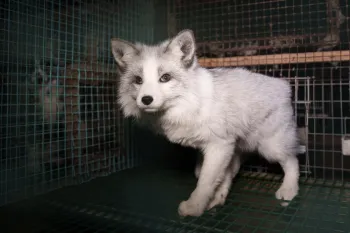
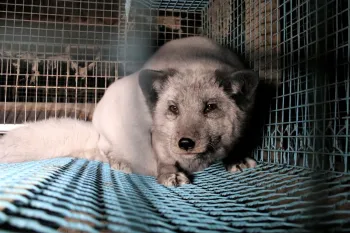
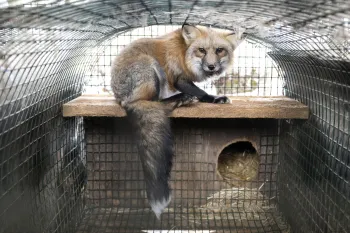
The cruelty of this industry is palpable whenever and wherever it is glimpsed. Nearly a year ago, our Animal Rescue Team arrived at a frigid property in Ashtabula County, just east of Cleveland, Ohio. Local officials had requested our help, and from the scene, the team reported back that what they found at Grand River Fur Exchange was one of the most horrific situations the team had ever seen. The owner of the fur farm had died, leaving hundreds of foxes, raccoons, wolf-dog hybrids, skunks, opossums and coyotes, who had already endured the everyday suffering of life in a small cage, in life-or-death situation.
But as our team opened cages and took animals into their arms, a sense of warmth arose on that freezing property. More than 300 animals were rescued that day and placed with wildlife rehabilitators, zoological facilities and sanctuaries. The rescue offered a rare glimpse at the suffering caused by fur farming, agony that so often persists in secret, and the knowledge of this immense pain is what motivates our work to end fur sales, imports and killing of animals for their fur around the globe.
At the end of each year, we celebrate the progress we’ve made for animals facing a vast array of cruelties across the globe. This year, we saw some huge wins for the millions of wild animals who languish in small barren cages on fur factory farms for their entire lives, only to be killed solely for a fashion accessory. And just earlier this week, we celebrated the announcements that New York Fashion Week is going fur-free and that Poland banned fur farming.
Each victory makes it harder for the fur trade to justify its existence, especially when animal-free faux fur alternatives are now readily available—materials that have the same look and feel but without the suffering, public health risk or devastating environmental impacts.
Here are some inspiring highlights from 2025 that show the end of the fur trade is near:
Switzerland became the first country to ban the import of cruel fur. Even though Switzerland has no fur farms following regulations passed in 2008, this new law succeeded because of the hard work of local campaigners and investigations like ours that exposed the brutal reality behind the fur trade in other countries like the U.S., Romania, China and Finland.
Poland, the largest producer of fur in the European Union, and second only to China in the world, became the 18th EU country to prohibit fur farming. This is a major blow to the fur trade and helps make the case that fur farming should be eradicated throughout Europe.
The UK, which has already banned fur farming because of animal welfare concerns, could be on a trajectory to become the first country to ban both the import and sale of fur products. In support of our #FurFreeBritain campaign, this year we partnered with other animal protection organizations and delivered a petition of more than 1.5 million signatures to the Prime Minister. The message is simple: If it’s too cruel to produce, it should be too cruel to sell.
While the suffering on fur factory farms is a clear enough reason to end the fur trade, scientific data also helps explain why this industry is harmful to animals, the planet and public health. This is why this year’s release of the European Food and Safety Authority’s scientific opinion questioning whether fur farms meet the welfare needs for undomesticated animals, like foxes, mink, raccoon dogs and chinchillas, has been greatly anticipated. As expected, the experts concluded that the suffering of wild animals “cannot be prevented or substantially mitigated” in current fur farming systems. The report was in response to a European Citizens Initiative, signed by more than 1.5 million citizens, asking for a complete prohibition on fur farming and trade in the EU.
A policy decision from the EU Commission in response to that Citizens Initiative is planned for March 2026, and in preparation for that, as part of the Fur Free Alliance and together with Eurogroup for Animals and Four Paws, we released a report showing the economic impact of the fur trade in Europe. Since the fur industry has declined so rapidly in Europe, and globally, and the environmental and public health costs remain high, the fur sector comes at a cost to European citizens of 446 million euros (more than half a billion dollars) annually. On top of that, the EU added American mink to its list of Invasive Alien Species of Union Concern, which means that keeping and breeding American mink is banned starting July 2027, unless countries apply for authorizations to allow their fur farmers to continue. It’s hard to see why any country would want to continue propping up an industry that costs wildlife and its taxpayers so much.
In the U.S., we worked closely with Colorado State University’s Animal-Human Policy Center to survey residents in four Northeastern states —Connecticut, Massachusetts, New Jersey and New York—to gauge support for banning new fur sales. After learning of the cruelty and risks posed by the fur trade, 64% of respondents supported banning fur sales across the region. Banning fur sales not only creates a more humane marketplace in those states, but it impacts the overall demand for fur products globally.
It seems doubtful that the global fur industry will ever rebound, especially when so many major fashion companies and influencers have gone fur-free, including this year’s major fur-free announcements from New York Fashion Week and Condé Nast, the parent company for Vogue, Glamour, GQ, Vanity Fair and several other publications. These announcements not only mean that the fur trade will never be able to advertise or promote its products on New York Fashion Week runways or in the pages of Vogue again, but also that two of fashion’s biggest trendsetters have determined that fur is too cruel to ever be fashionable.
Also, during this year’s fashion weeks in New York, London, Milan and Paris, we again teamed up with fellow Fur Free Alliance members to put pressure on outdoor apparel brand Woolrich, one of the last companies still selling fur from foxes, coyotes and raccoon dogs. Supporters took to the streets with colorful demonstrations outside stores, sent more than 200,000 emails and calls into the company and posted countless messages on social media, asking the company to go fur-free. While Woolrich has so far declined to discuss the issue, we know they heard us and will continue to reach out to them until they remove fur from their shelves.
The fur industry is collapsing, which is good news for material innovators, ethical fashionistas, public health and environmental specialists, and above all, animals. With so many urgent issues affecting animals, we often don’t take the time to pause and appreciate all that has gone into getting us to this point. The new year is the perfect time for that reflection, if only for a moment as we look to 2026 to continue this momentum and end this cruel trade for good.
Kitty Block is president and CEO of Humane World for Animals. Follow Kitty Block.