After disasters strike, the recovery takes far longer than the news cycle. But the end of the storm is not the end of the story. Our teams around the world work to put animal-inclusive disaster plans for communities, and we support them in various ways, long after the news has moved on. As the U.S. begins to prepare for hurricane season, on the other side of the planet, it’s winter for Humane World for Animals Australia. Here, Evan Quartermain, director of programs at Humane World for Animals Australia, tells the story of the animals rescued from bushfires and heatwaves in January—who have been recovering at wildlife rehabilitation centers—and what the team is doing to prepare the communities for next year’s heat.
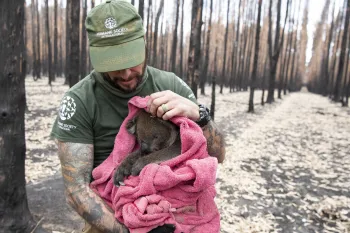
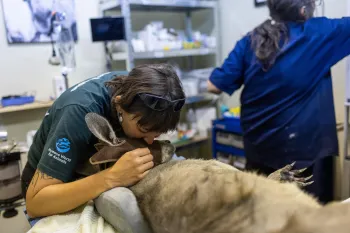
Earlier this year, a kangaroo now known as Valor was found with severe burns to his feet and paws. I was at the wildlife hospital when he was brought in needing urgent attention at the end of a long day treating many injured kangaroos. He was just one of countless animals struggling to survive amid raging bushfires that were burning out of control in Australia’s state of Victoria.
Local wildlife rehabilitators were in full-on crisis mode. Heatwaves, too, were soaring to such high temperatures, flying foxes were dropping dead from the trees. We deployed a team from Humane World for Animals Australia to help.
Flash forward to today, and Valor can be seen happily hopping in the wild. But it was no easy journey getting there.
Paul Jeffers/AP Images for Humane World for Animals
Helping kangaroos make their comebacks
The recovery typical in wildlife rehabilitation continues long after headlines have moved on to other news.
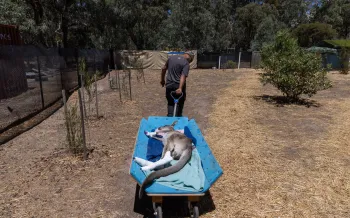
Without intervention to treat his injuries, rescuers believe Valor may not have survived much longer in the wild. He came into Red Box Wildlife Shelter in January and was released 10 weeks later in April.
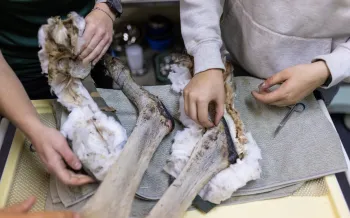
Valor’s burned legs and paws had to be carefully bandaged, which took time and immense care. Rehabbers estimate they changed his bandages about 30 times.
Slowly, Valor gained strength—helped in part by eating bundles and bundles of fresh-cut grass, hay and his favorite, apples—and started being able to stand tall again—a far cry from the exhausted kangaroo lying on the examination table.
Paul Jeffers/AP Images for Humane World for Animals
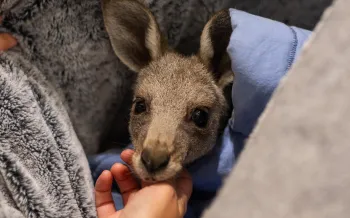
A kangaroo family—two brothers and their mother—were also treated at the shelter.
In a heartbreaking turn, their mother passed away, but the brothers regained their strength, even little Logan, who needed bottle-feeding after his mother’s death. Now he’s joined the resident mob at the sanctuary that saved his life.
Paul Jeffers/AP Images for Humane World for Animals
Helping flying foxes take to the sky again
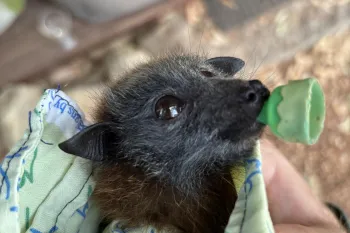
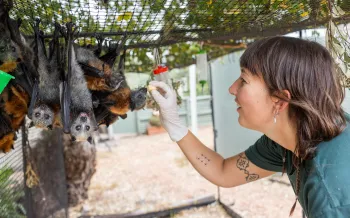
Thirty-five flying foxes who could be saved from the extreme heat went to another rehabilitation center, Animal Abbey, to recover from the heatwaves and bushfires. The rehab work was also quite intense for caregivers, as young orphaned bats who lost their mothers need to be fed a special milk formula every three hours.
Older bats, meanwhile, required a lot of fruit, all chopped and prepared for them. They ate, in total, more than 20 pounds of apples, pears, watermelon and grapes every day.
Paul Jeffers/AP Images for Humane World for Animals
After months of recovery, all of the flying foxes at the shelter gained enough strength to hang around their enclosures, stretching their wings and getting ready to fly again.
They have since all been successfully released back into the wild where they belong.
Looking ahead
Preparing for disasters before they happen is essential to saving lives. That’s why Humane World for Animals Australia is already thinking about next summer and how wildlife can be kept out of harm’s way.
Protecting wild animals in the face of ever-increasing disasters is a labor of love. To help them, our team in Australia submitted to a parliamentary inquiry into the bushfires, advocating for better focus on animal (particularly wildlife) impacts. Humane World for Animals Australia urges support for animal rescuers and their inclusion in frontline disaster operations. And we’re also pushing for funding via small grants of these animal rehabilitators. Without support, animal lives will be at stake.
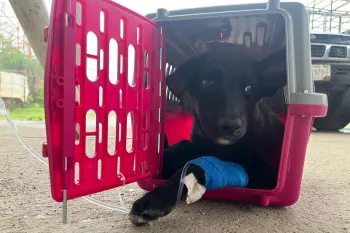
For decades, our teams have been going into disaster zones to rescue and transport tens of thousands of animals to safety. We’ve partnered with communities and local organizations to train rescue personnel and volunteers to mobilize for animals when disaster strikes. This is part of what it takes to create a truly humane world, one in which animals are considered part of the communities that need protecting.
Evan Quartermain is director of programs at Humane World for Animals Australia.