Bushfires and heatwaves are devastating wildlife in Australia
It’s summer in Australia, which means it’s heatwave and bushfire season. Several bushfires in the state of Victoria were burning out of control, when we deployed a team from Humane World for Animals Australia to help to assist local wildlife rehabilitators who are being inundated with new patients.
Emergency care for animals affected by extreme heat
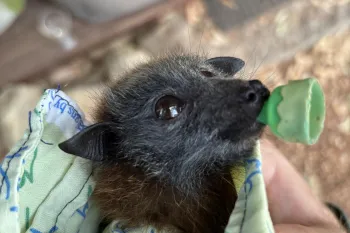
Red Box Wildlife Shelter and Animal Abbey, two shelters we are supporting, have seen a massive influx of animals suffering from heat stress and burns. Our team hit the ground running by helping to move and care for flying foxes recovering at Animal Abbey. Temperatures have soared so high recently, these bats have literally been dropping dead from the trees.
Flying foxes lucky enough to still be alive are getting close care and attention. Orphaned pups who lost their mothers need to be fed a special milk formula every three hours; they also need help for toileting and keeping clean. Older bats need their large enclosures cleaned and a lot of fruit chopped and prepared. The 35 flying foxes at Animal Abbey eat more than 20 pounds of apples, pears, watermelon and grapes every day.
Evan Quartermain/Humane World for Animals
Around-the-clock care for injured and orphaned wildlife
Evan Quartermain, Humane World for Animals Australia’s programs director, gave a sense of what it’s been like on the ground there. He said many wildlife rehabilitators, who were already at capacity, are working literally around the clock to treat animals in need. “They really do need all the help they can get, and we are proud to be supporting them and the animals,” he said.
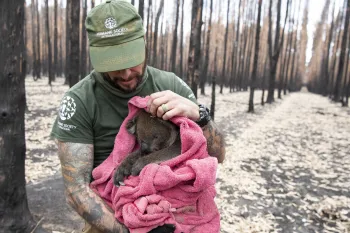
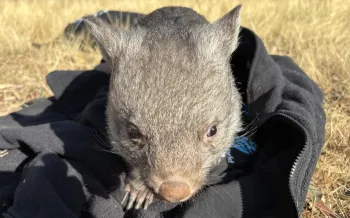
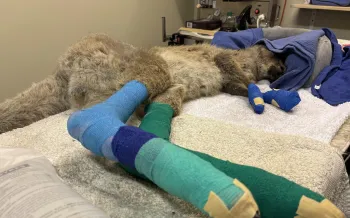
It has been an honor for the team to help rehabilitators care for animals, bottle-feeding orphaned wombats and cleaning cages. When kangaroos are sighted with burned paws and tails, suffering from dehydration, our team is helping rescue and transport them to Red Box Wildlife Shelter and assisting wildlife vets with the difficult task of treating and bandaging burns wounds. It’s a lengthy and complex process that needs to be repeated at least every couple of days as these animals recover from terrible injuries. The work is saving lives and preventing much suffering.
Evan Quartermain/Humane World for Animals
A growing global need for animal disaster response
At the same time as we are helping in Australia, we are working in two other continents where wildfires have broken out. In South Africa, unprecedented wildfires have ravaged parts of the country. When word reached our team in South Africa that the Panthera Africa Big Cat Sanctuary was in danger, they leapt into action arranging for urgent transport and relocation of lionesses to another partner, the Lions Foundation South Africa, outside of the fire zone. Thankfully, the move went smoothly. Sadly, three big cats were critically injured, and a tiger later died because of the catastrophic fire. Our team in South Africa are continuing to provide support to Panthera Africa for the relocation of the tiger and lioness currently under veterinary care, once they are ready.
In Chile, many animals—wild, farmed and companion—are now facing serious harm from wildfires. Our team is working with local veterinarians and the government to provide veterinary supplies for burned animals and support shelters so people can stay together with their pets.
For decades, our teams have been going into disaster zones to save animals. We have rescued and transported tens of thousands of animals to safety, partnered with communities and local organizations, trained generations of rescue personnel and volunteers, and developed advanced protocols for rapid assessment, resource mobilization and animal care. We’ve stepped in to help animals affected by volcanic eruptions, earthquakes, deadly storms, flooding and other emergencies. Often, we are still there even after the media moves on to other stories.
As data about climate change shows, there is an increase in intensity and frequency of disasters, and so we increased our capacity to respond across the globe. And we will be prepared to step in again, wherever and whenever, to help animals and the local residents on the ground working tirelessly to save them.
You can help by donating to our Emergency Animal Relief Fund.
Kitty Block is president and CEO of Humane World for Animals. Follow Kitty Block on X.