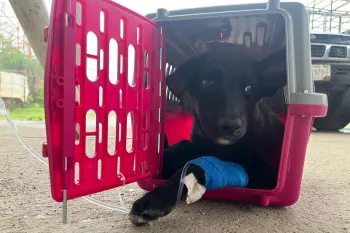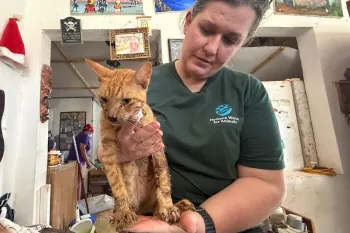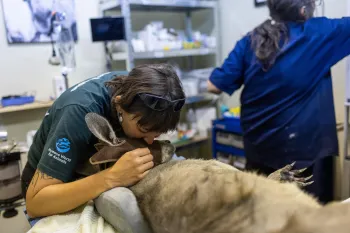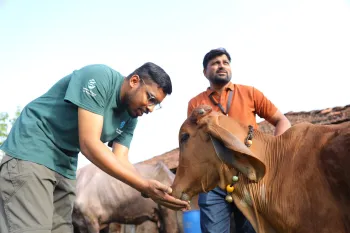
Earlier this month, in the wake of devastating floods in Maharashtra, India, we deployed our India disaster response team to help animals and their caretakers. Our team conducted rapid needs assessments and provided relief in some of the worst-affected areas to pets and farm animals. Praveen Suresh, disaster program manager at Humane World for Animals India, was on the ground and tells this story.
During our needs assessment in one of the flood-affected villages of Raigad district, I watched a farmer climb a tree to cut leaves for his animals. He had enough dry fodder left to feed them for perhaps one more day. His neighbour had none.
The floodwater had receded, but there was almost nothing left for the animals to eat. From a distance, the grazing lands looked lush and green. At first, I wondered why we were even there. It seemed there was enough vegetation for the animals.
But up close, the reality was very different. The grass had not grown enough for the animals to graze properly, and what little had emerged was mixed with silt left behind by the floodwaters. In truth, recovery had barely begun.
For many families, keeping their animals alive had become a daily struggle. What we were witnessing was not simply the aftermath of a flood. It was a crisis caused by two extremes: first, too little rain, and then far too much.
A crisis that began before the floods
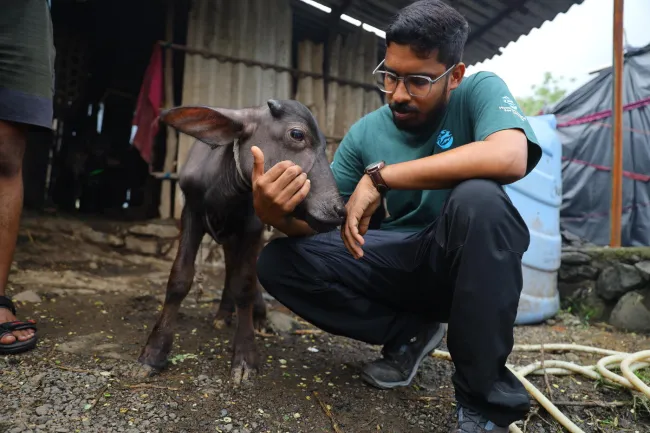
Much of rural India depends on the annual monsoon, a seasonal period of rainfall that usually begins in June and supports agriculture, water availability, and the growth of new grass. This is true of Mahad, a city in the Raigad district of the Indian state of Maharashtra. Farming and the feeding of animals depend heavily on the timely onset of the monsoon. A delayed monsoon can create a short but serious seasonal drought, exhausting stored fodder and water before fresh grass becomes available.
Prannoy Dutta/For Humane World for Animals
Farmers typically store leftover dry crops to feed their animals during the hot, dry months before the monsoon begins. Once the rains arrive, grass grows again and animals can graze, reducing farmers’ dependence on stored feed.
This year, however, the expected rains were delayed by a month, due to the El Niño and climatic variations. By the time heavy rainfall and flash floods arrived, many families had little or no reserve left.
The floods damaged the remaining feed, contaminated storage areas and covered grazing land with mud, silt and debris. In many places, the fresh grass that farmers had been waiting for disappeared almost overnight.
Farmers told us that it could take at least two weeks for grass to recover enough for animals to graze properly. Until then, thousands of animals would depend on emergency feed.
When the monsoon shifted from deficit to sudden surge
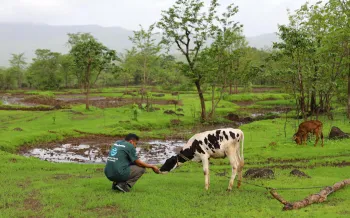
When we conducted a needs assessment in four severely affected villages of Mahad, with the help of our local partner the Sahyog foundation, we found animals were eating small quantities of grass mixed with mud because there was nothing else.
Farmers reported that their animals were weak and afflicted with diarrhoea. We learned of at least 20 animal deaths due to starvation because of inadequate feed availability and deteriorating conditions. Over 5,500 animals were severely affected.
Prannoy Dutta/For Humane World for Animals
Some families had already given away their animals because they could no longer feed them. Others feared they would be forced to sell animals at very low prices.
Climate change has resulted in rapid shifts in weather patterns. This is clearly affecting the Indian farmers who depend upon the seasonal weather.
The rain that should have ended the shortage instead deepened it.
The vulnerability loop
The families we met are small-scale farmers. They cultivate crops while keeping a relatively small number of animals.
Farmers care for these animals every day, over many years. They know their behaviour, health and individual needs. The animals are not seen simply as units of production, they are family.
When a flood kills an animal or leaves a family unable to feed one, the consequences therefore extend far beyond its purchase price. The household may lose milk, income, nutrition, manure, savings and a chance at recovery. Farmers and their families are also struggling mentally with the plight of their animals.
Floods also affect animals that survive the immediate event. Inadequate nutrition, contaminated feed and water, prolonged exposure to wet conditions, interrupted veterinary services and disease can reduce milk production, impair health and cause deaths days or weeks later. Rebuilding after the loss may take years.
What begins as one bad season can become a long-term cycle of poverty and vulnerability.
This pattern is sometimes missed because disasters are assessed as individual events. Drought is recorded as one emergency and flooding as another. But for the farmer, they may form one continuous experience. The dry period consumes the household’s reserves. The flood destroys what remains.
For generations, farmers have organised planting, grazing and fodder storage around the expected arrival of the monsoon. But recent years have showed how difficult that calendar has become to rely upon. This year it was an extreme delay.
For farmers, timing matters enormously.
The challenge is no longer only predicting when the rains will begin but helping farmers respond as conditions change during the season. Preparedness systems often address heatwaves, droughts and floods separately. But the same households and animals may experience all three within a single season.
Vulnerability is global
What we witnessed is not an isolated story. Across the world, farming and pastoral communities are facing a similar pattern: a long dry spell, delayed rains or drought first weakens crops, pasture and household reserves; then sudden floods, storms or other extreme events destroy what little remains.
There were 358 major disasters affecting more than 110 million people worldwide in 2025 alone. Floods and storms alone affected over 76 million people, while prolonged droughts left millions more in need of assistance.
Yet these global figures rarely show how many animals were affected. We count human deaths, people affected and financial damage inflicted but rarely record how many animals lose access to food and water, become sick, die or are sold out of financial necessity.
What is not counted does not factor into future planning. So, when animals are absent from disaster data, their feed, water, shelter, evacuation and veterinary needs can also disappear from decisions about preparedness and relief.
A farmer in Raigad climbing a tree for fodder, a pastoralist in East Africa walking farther for grazing, or a herder in Mongolia entering winter with too little hay may be facing different hazards. But they are all confronting the same question: how do you keep animals alive when the seasonal patterns you relied on no longer hold?
That is why animal-inclusive disaster preparedness deserves global attention. Protecting animals means protecting community resilience and recovery.
Animals count
Disaster management planning at every administrative level must include animals. Even as I write, my colleagues are being deployed to another district, in Assam, where an estimated 650,000 people and 600,000 animals have been impacted by massive flooding.
A promising step toward a disaster-resilient India for animals is the Animal-inclusive Disaster Risk Reduction guidelines released by the National Disaster Management Authority on May 2026. The guidelines provide an important national framework for integrating animals into risk assessments, early-warning systems, evacuation planning, temporary shelters, fodder and water arrangements, veterinary response and post-disaster recovery. Our work at Humane World for Animals India supports this vision by helping communities and government institutions translate policy into practical action.
We have been working to move animal disaster management beyond emergency relief and towards long-term resilience initiatives. Our experience has shown that animal losses can be reduced when communities, veterinarians and government agencies plan together.
This same approach shapes our work around the world. In Viet Nam, we collaborate with government agencies and local partners to strengthen animal-inclusive planning and preparedness for floods and typhoons. In Mexico, we work with authorities and civil society organizations to embed animals’ needs in disaster regulations, response systems and community-level planning. In Australia, we support wildlife care organizations not only during emergencies but also through recovery, mitigation and preparedness initiatives that build resilience ahead of future disasters.
Although the hazards and local contexts differ, the principle remains the same: communities are better able to withstand and recover from disasters when animals are included in planning before a crisis occurs. Animal-inclusive disaster risk reduction is not an optional addition to humanitarian or climate action. For millions of families, it is central to companionship, food security, income, dignity and survival.
Praveen Suresh is disaster program manager at Humane World for Animals India.