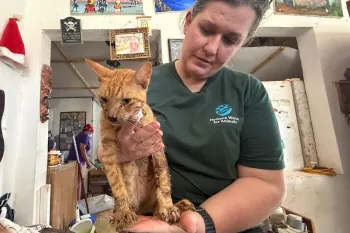
When our rescuers arrived in the Northern Mariana Islands earlier this year, they called the aftermath of Super Typhoon Sinlaku one of the worst they’ve ever seen.
The storm caused widespread power outages and disruptions in water and gasoline supply, devastating the region and effectively cutting off access to essential resources.
Even in normal times, there is no full-time veterinarian on the island of Saipan; the community relies on Saipan Humane Society to facilitate visiting veterinarians or to transport animals to Guam when they need help.
In the aftermath, the staff at Saipan Humane Society knew they needed more boots on the ground to help save animals. They reached out to our disaster response team. This contact is an essential step in disaster response work—gaining permission from local organizations to deploy, following their lead and local knowledge about their needs.
When our responders arrived, they saw endless wreckage on their way from the airport to the shelter. And they immediately got to work.
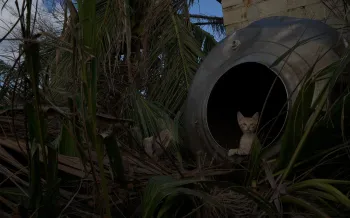
Patrick Brothers/Humane World for Animals
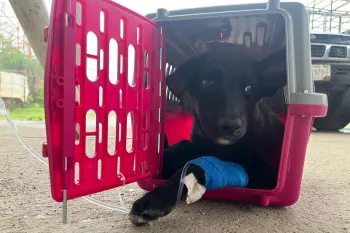
We set up and operated a temporary veterinary clinic, treating animals from over 550 households. Wounded animals required treatment including stitches, limb and tail amputations, and eye removal surgeries. Other animals needed care for heat strokes, treatment for parasites, vaccinations and emergency spay or neuter services.
Together with other responders, we helped more than 1,200 animals.
The importance of this work cannot be overstated, as the well-being of animals is so often linked to the well-being of their larger communities. Amber Weston, executive director of Saipan Humane Society, echoed this thought: “What we are witnessing is not only loss, but the undeniable reality that animal welfare is inseparable from disaster response. Animals are part of our families, and their survival is directly tied to our community’s recovery.”
Disasters affect everyone
Disasters keep occurring with greater frequency, geographical scope and intensity. Time and again we see news cycles move on from communities devastated by these increasingly brutal storms. But these stories continue out of the spotlight, and the pain persists, as does the long, difficult work of rebuilding and recovery.
This is precisely why we take a multifaceted approach to disaster response, considering both the short and long term. So much harm can be prevented in disaster planning and preparedness during “blue sky days.” It’s work that has become an essential part of building the humane world at the center of our vision.
Kitty Block is president and CEO of Humane World for Animals. Follow Kitty Block.