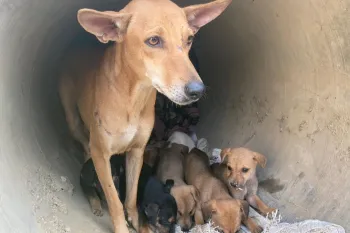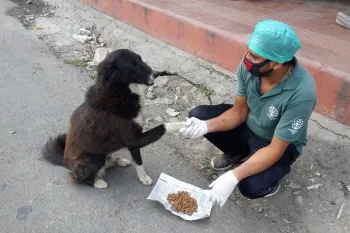
In the past, dogs living on the streets in India suffered from inhumane practices meant to manage their population. Common approaches to managing street dog populations included roundups, relocations, even culling. But we were determined to cut down on this cruelty—we knew there must be a better, kinder, more humane way that would benefit not only the dogs but also the communities in which they lived. For more than a decade, our Humane World for Animals India team has been showing what is possible for street dogs, proving on the ground that sterilization and anti-rabies vaccinations can manage populations and keep everyone safer from conflict. Here, Keren Nazareth, senior director of the street dog program for Humane World for Animals India, shares what a comprehensive new report found about our program.
There are so many stories to tell about how people have come together to bring solutions to street dogs in India. But one that sticks out for me are Nag sisters, Shaiphali and Priyanka.
These two women became known locally as determined ambassadors of our street dog program. In their neighborhood of Lucknow, the capital of Uttar Pradesh, they helped ensure that approximately 300 dogs were sterilized and vaccinated. Their story shows what happens when program teams listen to communities and stay with them. It was not easy. At first, other residents resisted the idea of coexisting with dogs—they just wanted the dogs gone. Our staff and the Nag sisters held multiple meetings and listened carefully to people’s concerns. We followed it up with action—educational initiatives and veterinary interventions.
We showed that peaceful coexistence with street dogs is possible.
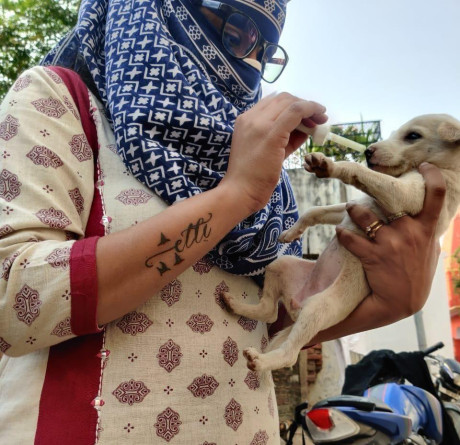
Etti Dhawan/For Humane World for Animals International
Why community engagement is essential to this work
After years of working alongside communities and local governments across India, I have seen what becomes possible when scientific animal birth control is paired with sustained community engagement that builds trust. I saw it come to life in Dehradun, which has achieved sterilization coverage of more than 91% and a 40% decline in street dog density. In December 2025, 297 neighborhoods in the city declared that they felt confident managing local street dog issues without continued support from an external agency.
This is huge. What it means isn’t that every concern had disappeared, but that residents and volunteers had built the knowledge, relationships and systems to respond responsibly to street dog issues—and that they trusted their own ability to do so.

Abhay Rawat
Community engagement is not an optional add-on to animal birth control. It is the work of responding to complaints, listening to residents and community feeders, training volunteers, supporting vaccination efforts, building awareness of rabies and dog behavior, and helping neighborhoods resolve recurring concerns. We have implemented this integrated model across approximately 1,500 neighborhoods in Dehradun, Lucknow and Vadodara.
This is how veterinary intervention becomes woven into the community, connected to everyday public safety and animal welfare.
Building a Humane World for Street Dogs and People: Over a Decade of High-Quality, High-Volume Animal Birth Control, our new report, brings together lessons learned from Humane World for Animals India’s experience in this area since 2013. It examines how sustained, high-quality sterilization and vaccination, alongside intensive community engagement, can compassionately manage street dog populations and improve coexistence—without treating relocation or sheltering as a population-management solution.
These findings feel especially urgent in the context of current discussions on street dog management in India. In May, the Supreme Court of India ordered that quality animal birth control must be used to manage street dog populations. Our new report can offer a practical road map for robust, transparent and data-driven mass sterilization and vaccination programs.
Since 2013, our teams have carried out more than 300,000 sterilization surgeries and over 450,000 vaccinations with governments in more than 20 cities and towns.
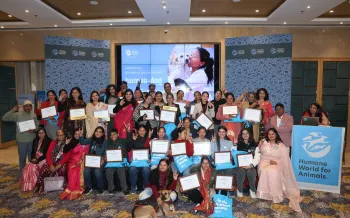
Pintu/For Humane World Of Animals
Arindam Bhattacharya/Alamy Stock photo
Humane Journeys: India
Discover the magic of Indian culture and hospitality while witnessing life-changing work for wildlife and street dogs.
Keren Nazareth is senior director of the street dog program for Humane World for Animals India.