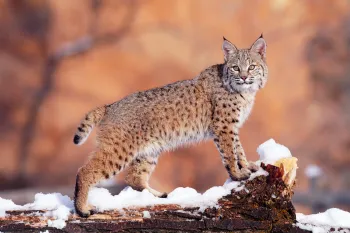
Bobcats are under attack in Indiana, and this time it could lead to their extermination in the state.
The Indiana Department of Natural Resources has proposed that the bobcat killing quota be upped from 250 to 400 this fall, and to add trophy hunting to its list of permitted killing methods. This would be a radical 60% increase in the number of bobcats that can be killed for fun, trophies or profit—even though the DNR’s own science shows that could decimate or even eliminate the bobcat population in Indiana within just 10 years.
Last November in Indiana, 253 bobcats spent the last moments of their lives terrified, struggling against devices like steel-jawed leghold traps, strangling wire neck snares, and cage traps until a trapper arrived—after as long as 24 hours—to kill them. Many trappers posed in front of frightened bobcats for a photo for social media before ending their lives. Trappers exceeded the “quota”—the number of bobcats permissibly killed—which was 250.
It was the first time bobcats were allowed to be killed for recreation since the small, shy wildcat was protected by the state in 1969 after excessive hunting, trapping and habitat loss nearly wiped the species out. The 2025 bobcat trapping season and quota were greenlit despite absolutely no scientific justification and overwhelming opposition from Hoosiers.
Like many state agencies tasked with conserving the public’s wildlife, the Indiana DNR claims to be guided by science as well as public values. But this proposal is a blatant violation of both.
Before the 2025 trapping season, the DNR put together a predictive model to project what the bobcat population would look like after ten years of different possible killing quotas. This model shows that at a 400 quota, the bobcat population could decline by up to 100%—complete extirpation—within a decade.
Let that sink in. A state agency is ignoring its own data to push a proposal that could wipe out a species that took decades to begin to recover.
Trophy hunting and recreational trapping interests often invoke a refrain meant to belittle those who challenge their agenda: “Wildlife management should be based on science, not emotion.” The irony of that statement could not be heavier, as states like Indiana routinely disregard science to maximize recreational opportunities for trophy hunters and trappers.
So, suppose we put the “emotion” aside: It is the responsibility of states to conserve wildlife for all residents, not just the tiny number of hunters and trappers who continue to wield outsized influence over how our wildlife is treated. In a survey conducted by the Remington Research Group and commissioned by Humane World for Animals in November 2025, only 24% of Indiana residents supported the 2025 bobcat trapping season (and that was for a season of “only” 250 bobcats killed), and only 18% support trophy hunting of bobcats.
On May 19, Hoosiers of all ages and backgrounds, including biologists and landowners, attended a public hearing in the middle of a weekday to speak against the increased killing of bobcats. Many wore “Blue for Bobcats” in an inspiring display. They spoke about the joy of the chance sighting of a bobcat, the essential role that bobcats play in ecosystem health (such as limiting tick-borne diseases), the inhumane and indiscriminate nature of traps and snares, and their disbelief that their natural resources agency was pushing such a backwards proposal.
Humane World for Animals Indiana State Director Samantha Chapman said: “For the last three years, I have testified against the expanded killing of bobcats in Indiana. The fact that our taxpayer dollars are funding these prioritized efforts is shameful.”
Indiana residents showed up for humane and scientific treatment of wildlife. Out of 31 speakers at the hearing, only four supported increased bobcat killing.
There is still time to stop this outrageous proposal. If you are an Indiana resident, call Governor Mike Braun’s office at (317) 232-4567. Respectfully urge him to withdraw the rules that would increase the bobcat hunting and trapping quota. That is how we move the needle against cruel practices: by persistently and consistently showing up and speaking out.
Future generations deserve the chance to see a bobcat in the wild, and bobcats deserve to live and to thrive.
Kitty Block is president and CEO of Humane World for Animals. Follow Kitty Block.