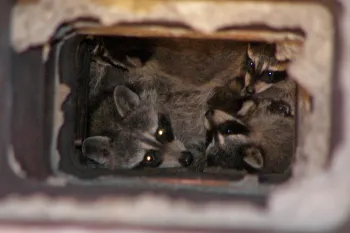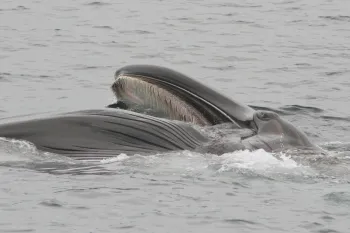
Earlier this spring, our experts gathered in Spain with colleagues from around the world to talk about fertility control for wildlife and its broader relationship to the question of human-wildlife coexistence. As human populations and development have increased, wildlife populations have been pushed into smaller fragments of their former home ranges, causing population problems in confined spaces, as well as an increase in conflicts between humans and wildlife. In the past, conflicts were “resolved” by killing the animals, often using traps, guns and poisons. These lethal methods were not only cruel—they essentially failed to meet humane standards or address root causes in such situations. As public perceptions of animals and their value have continued to change, so have approaches to these problems. Here, Dr. Audrey Delsink, principal for wildlife at Humane World for Animals South Africa and Stephanie Boyles Griffin, senior principal for wildlife protection in the U.S. at Humane World for Animals, tell the story of an approach that we’ve helped to develop so that fewer wild animals suffer—the definition of innovating for ending animal cruelty.
We recently returned from the Universitat Autònoma de Barcelona where the 10th International Conference on Wildlife Fertility Control was held. The event brought together hundreds of researchers, practitioners and decision-makers from around the world who spend a lot of time thinking about the lives of wild animals and taking action to address the many challenges associated with wildlife conflict resolution and population management.
That there is an international conference on this topic is already a testament to the progress that has been made for wildlife. Over the past few decades, we’ve seen a shift in public perception of wild animals and the environment, calling for increased protection. Undergirding this is a gradual but dramatic shift in societal values from a view of treating wildlife in utilitarian terms towards one of mutualism, a position that views wildlife as part of one's social network, worthy of care and compassion that promotes coexistence with the natural world, rather than dominance.
This has changed the lives of many wild animals for the better.
A short history of fertility control for wildlife
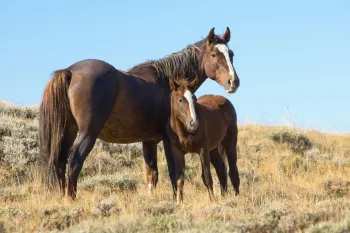
In the 1970s, Velma “Wild Horse Annie” Johnston went on a crusade to save the wild horses and burros of the American West from the cruelty of mustangers who brutally captured and killed them for pet food and the convenience of ranchers. Johnston and others documented shocking cases of mustangers driving horses off cliffs, slitting their throats, and cutting off their legs if they happened to get their hooves stuck on rocky ground. By the late 20th century, immunocontraception had emerged as a tool for humanely managing wild horse populations.
From then on growing public demand for alternative, non-lethal methods led researchers from government, non-governmental agencies, zoos and academic institutions to begin exploring fertility control as a way of humanely managing a variety of wildlife populations. Today, that exploration continues.
For over 40 years, we at Humane World for Animals have been leaders in advancing fertility control because we believe it offers a humane alternative to cruel methods, such as culls and removals. Since the late 1980s, we have been working with researchers, federal, state and local agencies, and other organizations to develop the immunocontraceptive vaccine known as PZP into a safe, effective and practical tool for the humane management of wildlife populations globally. We support immunocontraception as a humane, effective way to manage wild animal populations where it’s ethically justified.
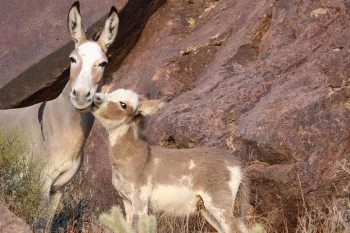
Humane World for Animals has sponsored groundbreaking work on the use of PZP to manage African elephant populations in South Africa; studies on wild horses in Colorado, New Mexico and Utah; a study on wild burros in Arizona; and long-term research on white-tailed deer in Maryland, New York and South Carolina.
We’ve seen significant progress made in the development of both agents and delivery systems for contraceptive agents, as well as in modelling the impact of fertility control, alone or in conjunction with other methods. That said, we have a long way to go. The same delivery systems, the specific contraceptive agents, the particular species, the geographic context and habitat of the animals involved, all of these factors present significant research and implementation challenges for the future.
On the horizon for wildlife fertility control
Challenges for scaling up these methods remain, mainly related to feasibility, costs and sustainability. These must be overcome to meet the demand by the public and wildlife managers for effective, humane methods that can be incorporated into successful management practices.
That’s why Humane World for Animals and other wildlife fertility control practitioners and advocates are continuously working on improving field techniques, demonstrating the effectiveness of immunocontraception in the field, refining the vaccine manufacturing process and developing training standards.
It’s also why we are committed to sharing the latest research at forums like the one in Spain. The conference—hosted by the Botstiber Institute for Wildlife Fertility Control, a hub established in 2016 to advance reproductive management as part of an integrated approach to managing populations and mitigating human-wildlife conflicts worldwide—welcomed participants from 23 countries across six continents.
At the recent conference, our teams presented on elephant management in South Africa and PZP toolkits for managing wild burros and suburban white-tailed deer (thanks to our colleague in the wildlife protection department, Grace Kahler). Those presentations underscored the progress we’ve made over decades to get us where we are today: For these species, fertility control approaches are no longer theoretical but a practical and proven method that is ready to expand.
Wild animals are an essential part of what makes our world so fascinating and beautiful. They are worthy of our care and compassion. And we owe it to them to make every effort we can to coexist with them. So, when we talk about creating a more humane world for animals, this is what we mean: Using every creative thought possible to build innovations at scale that can reduce animal suffering for generations to come.
Dr. Audrey Delsink is principal for wildlife at Humane World for Animals South Africa. Stephanie Boyles Griffin is senior principal for wildlife protection U.S. at Humane World for Animals.