Animals are part of our communities. And as communities all over the world face more frequent and severe disasters, we both advocate and act for those who cannot speak for themselves. That’s why we’re pushing for animals to be included in disaster response, supporting animal-inclusive preparedness planning and, where needed, deploying to aid in response.
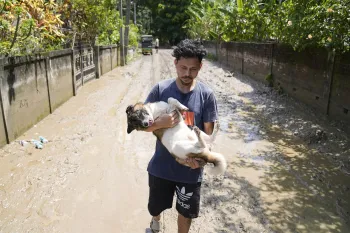
This week, our Humane World for Animals India team has deployed once again to help communities in Assam, a state in northeastern India, after massive floods there. Local officials and residents told our team that the flooding was unprecedented. The situation was reportedly intensified by heavy rainfall in the adjoining hills that flowed into low-lying areas of Sivasagar, which have not seen such flooding in the past 60 years.
This follows closely on the heels of another response in which we participated earlier this month, in Maharashtra.
Prolonged exposure to flood conditions can cause terrible suffering—for animals and the people who care for them.
Surajit Sharma /AP For Humane World for Animals
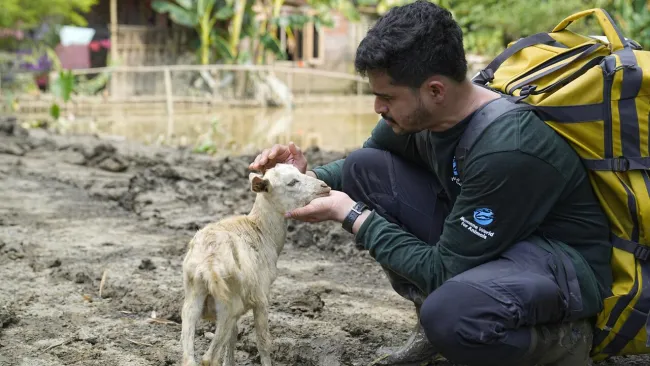
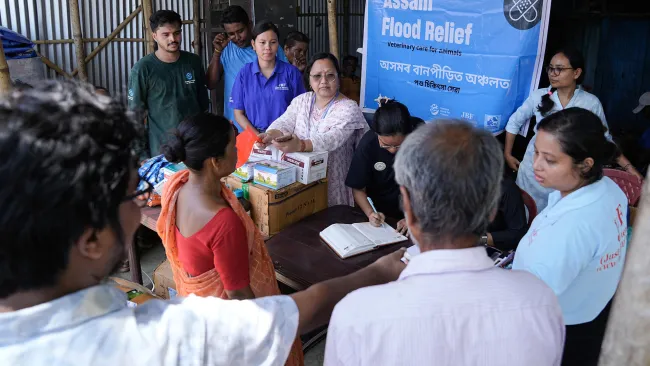
On the ground in one district and just two villages in Assam, members of the team reported that they are seeing dogs and farmed animals experiencing severe dehydration, malnourishment and weakness. These were the animals who survived after over 90,000 animals perished in the floods.
They’ve seen buffaloes and other farmed animals trying to eat while standing in contaminated floodwater or sludge, making it hard for them to move. Even where the water has receded, the land is covered with this thick sludge and mud. There is no grass for the animals to eat.
When our team feeds dogs, the animals finish the kibble up in mere seconds.
Jaihari AK/Humane World for Animals
Bringing food and care to animals who need it
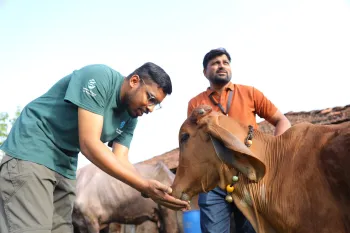
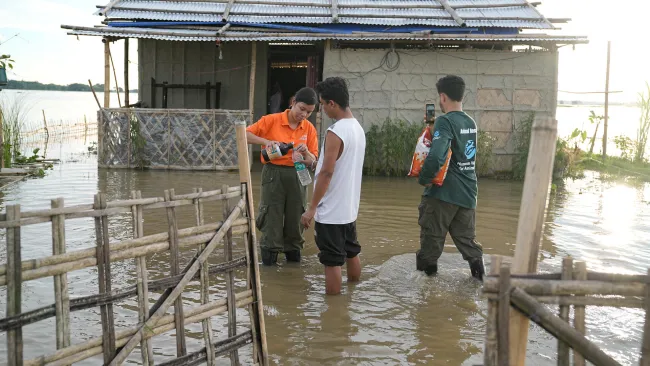
This week, our Humane World for Animals India response team members—partnering with local groups—hit the ground running. The team provided veterinary support for the villages of Gaurisagar and Nazira. Many dogs, cows and goats received door-to-door treatment and food deliveries in Luthurigaon. So far, 5,000 farmed and companion animals have received much-needed care and medicine.

Surajit Sharma/AP For Humane World For Animals
A response like this is a marathon—not a sprint. The next priority for this deployment is continued treatment, along with monitoring for disease, nutritional and hydration support, and providing temporary shelter assistance and follow-up care for weak or injured animals.
We have set aside funds to help as many as 10,000 animals in need.
Felipe Marquez/Humane World for Animals
Help animals in emergency situations
We never know where disasters will strike or when animals may be in need of urgent rescue, but we know we must be ready. Your support makes our preparedness, rescue, care and relief work possible. Please consider a donation to our Emergency Animal Relief Fund today.
Little shelter from the storm
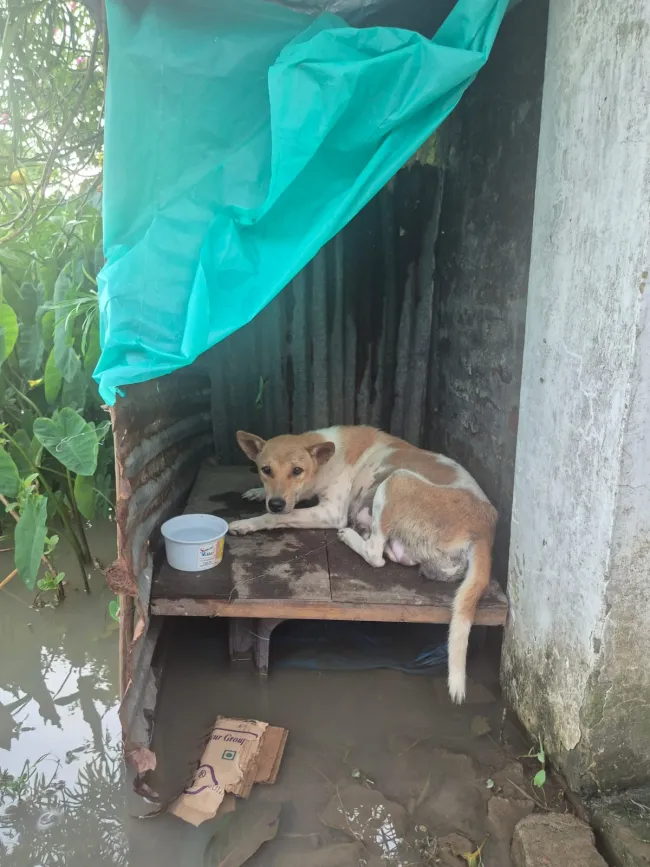
When disaster strikes, vulnerabilities are exposed. In this case, the team observed that there is inadequate shelter for animals in this area. There is no proper temporary shelter for animals.
And because there’s no place to shelter their animals, local families are trying to stay in their homes and farms rather than go to temporary camps because they don’t want to leave their animals behind.
Surajit Sharma/AP Images for Humane World for Animals
Many of the animals who have been displaced are being kept largely in temporary bamboo and tarpaulin shelters that provide limited protection from rain, wind and temperature changes, while leaving them exposed to mosquitoes and other insects. These conditions create a serious risk of diarrhea, respiratory illness, skin and hoof infections, infected wounds, parasitic infestations and diseases.
That there is a lack of adequate shelter for animals when floodwaters rise is exactly the kind of observation that must inform future disaster preparedness plans.
Surajit Sharma/AP Images for Humane World for Animals
People and animals are in this together
Protecting animals means protecting community resilience and recovery, and that’s why a core element of this work is the acknowledgement that the well-being of people is closely tied to the well-being of animals. Having an animal-inclusive preparedness plan for disaster and access to the tools, infrastructure and support to safely evacuate with animals can mean the difference between life and death.
Just last week, Praveen Suresh, disaster program manager at Humane World for Animals India, told the story of his deployment to another flood-ravaged region in western India, also suffering from devastating floods. I cannot forget his account of the farmer who was climbing a tree to pick leaves for his farm animals to eat—all the vegetation on the ground destroyed by floods.
What that farmer faced is a new paradigm—one in which seasonal weather patterns do not have the predictability they once did. He is not alone. Just last year, there were more than 350 major disasters recorded worldwide.
Part of creating the humane world at the center of our vision is helping communities everywhere to move from immediate rescue and relief work in a disaster’s aftermath towards the goals of long-term resilience and preparedness.
Our team also just wrapped up our on the ground response to the devastating earthquakes in Venezuela where over 1,700 animals were seen treated at a temporary clinic and in camps where displaced people were staying with their animals.
Animals do not have to be collateral damage. They are living, breathing individuals, who are part of people’s lives. Let’s create a future in which all communities, veterinarians and government agencies build resilience with animals in mind.
Kitty Block is president and CEO of Humane World for Animals. Follow Kitty Block.