After continued lobbying by the National Pork Producers Council, which represents the biggest companies in the industry—including Chinese-owned Smithfield—some members of Congress are trying to slip dangerous language into the 2026 Farm Bill. The provision could undermine landmark laws like California’s Proposition 12, Massachusetts’ Question 3 and other animal protection laws. It’s called the Save Our Bacon Act, and it could partially reverse decades of advances in animal welfare.
What are Prop 12 and Question 3?
More than 2.5 million Massachusetts voters approved Question 3 in 2016 to ban the sale of pork, eggs and veal from mother pigs confined in gestation crates, hens confined in battery cages and calves confined in veal crates. All of these severely restrict animals’ movement; gestation crates are so small mother pigs cannot turn around. Two years later, more than 7.5 million California voters approved Proposition 12 to ban the sale of pork, eggs and veal produced through such extreme methods of confinement. In total, more than 10 million voters in the two states backed more space for sows, hens and calves.
In response, multiple pork industry challengers filed losing cases against both laws, which Humane World for Animals defended alongside our allies. Lawsuits included one from the National Pork Producers Council, which claimed California’s Proposition 12 was unconstitutional. The case went all the way to the U.S. Supreme Court, which upheld Proposition 12 in 2023 and rejected the Pork Council’s main claim 9-0.
Konrad Lozinski/We Animals Media
Protect Prop 12
An upcoming Farm Bill is going to be used as a way to gut state animal welfare laws. Send a message to your U.S. legislators and urge them to preserve and protect Prop 12.
What is the Save Our Bacon Act?
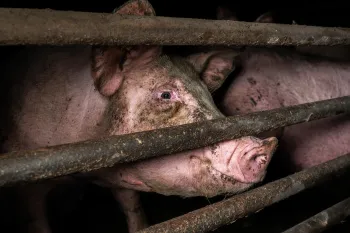
Similar to the EATS Act, which failed to advance in the House of Representatives in 2025, the Save Our Bacon Act is the latest attempt to erase reforms that freed sows from spending most of their lives in tight crates, which leave them so frustrated, many chew their mouths bloody on the metal bars.
“At the heart of this debate is something most people would find hard to argue with: that a mother pig should be able to turn around,” says Sara Amundson, chief U.S. government relations officer for Humane World for Animals. “Yet there are some lawmakers in Congress who want to force breeding pigs into tiny crates, even though states across the country already have laws that prevent this cruelty and more than 80% of voters approve of this modest animal welfare standard.”
The House Farm Bill, approved April 30, includes the Save Our Bacon Act language. This summer, the Senate will decide whether its version of the Farm Bill will include a similar provision. The current Farm Bill was signed into law in 2018, expired in 2023 and has been extended several times, with the latest deadline through September.
Who will lose if the Save Our Bacon Act remains in the 2026 Farm Bill?
Pigs, chickens and calves will suffer—and a multitude of other animals protected by laws passed at the local and state level could be affected as well, including ducks and geese who are force-fed to produce foie gras. Fifteen states have baseline animal welfare standards that allow producers to innovate and compete, selling their higher welfare products to humane-conscious consumers.
A report by The Brooks McCormick Jr. the Animal Law & Policy Program at Harvard Law School found the Save Our Bacon Act would threaten hundreds of local and state laws and regulations intended to stop the spread of farmed animal diseases and to protect public health, farmers, consumers and animals. The study also found that the Save Our Bacon Act would generate legal uncertainty and disputes.
Other losers: Consumers who care about animal welfare and do not want to contribute to needless animal suffering with their purchases. Producers who already modernized by investing in crate-free systems. Food safety advocates, environmental advocates and voters, whose choices at the ballot box will have been overridden.
Who will gain from the Save Our Bacon Act?
Some large operations represented by the National Pork Producers Council would profit significantly by continuing to raise animals in extreme confinement.
Since Proposition 12 took effect in California in 2024, the pork industry’s dire predictions of bacon and pork chops disappearing from store shelves have not come to pass. Many pork producers around the country have adapted and are profiting from selling in California and Massachusetts. Retailers have successfully adjusted their supply chains.
What can you do to keep the Save Our Bacon language out of the final Farm Bill?
Contact your U.S. senators, regardless of their party affiliation or whether they serve on the Senate Agriculture Committee, which is currently considering next steps on the Farm Bill. If the Farm Bill reaches the Senate floor with the Save Our Bacon Act language in it or is amended to include it, every vote will count—it needs just 60 to pass. Make it clear that the Save Our Bacon Act language must be removed.
Related stories
Meredith Lee/Humane World for Animals
The growing farm sanctuary movement offers animals a life of comfort while revealing the immense suffering inside factory farms.
MEDITERRANEAN/Getty Images
To feed the world, we need to change how we think about food and how we produce it.

Tom Woollard/For Humane World for Animals
Two mother pigs rescued from farrowing crates in the UK now live free in sanctuary, as advocates push to ban this cruel farming practice.