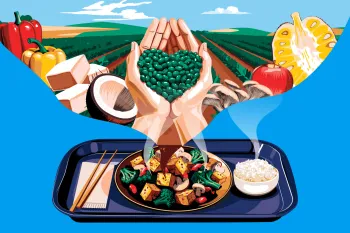
On the cavernous floor of New York City’s Javits Center, hundreds of people jostle for samples at the annual Plant Based World Expo. There is a display of marbled cuts of “beef” created through mushroom fermentation. There are breaded tenders with the texture of whole muscle chicken and Italian sausage-flavored “meatballs.” Coconut oil-based feta and parmesan cheeses. Cans of oat milk whipping cream. Meltable “cheese” made from lentils and chickpeas and similarly cultured cream cheese boldly displayed on bagels in the world capital of schmear.
Amanda Trenchard, a program manager on the Food Service Innovation team at Humane World for Animals, and Chef Tracy Burgio, a culinary specialist on the team based in the U.S., thoughtfully chew vegan “lox” made from carrot, konjac root and algae oil. “Pretty impressive,” says Trenchard. It’s a close match visually to its namesake, and they both like the taste.
Farther on, a plant-based beef jerky turns Trenchard’s head and she takes a bite: The sunflower protein stick carries a meaty flavor but is not tough or stringy. “Good, right?” says Burgio, who also tries it. “And that’s like 45 grams of protein. College students would like it.”
What really excites Trenchard is a product wrapped in nondescript beige paper that she encounters one aisle over: a “2D flat pack” of organic oat milk that would soon be available through food distributors. The “ultralight” sheets of dried milk paste (each pack of eight can produce a half gallon) could enable K-12 schools to offer plant-based milk: They’re affordable, easy to store and will be sold through distributors for schools’ use.
Meredith Lee/Humane World for Animals
Choose compassion every time you eat
Confused by food labels like “cage-free”, “pasture-raised”, or “humanely raised”? You’re not alone. Learn what food labels really mean and how to choose animal-friendly, plant-based options with our free guide. Get expert tips and recipes your whole family will love.
Promoters predict the $11.8 billion global plant-based food and beverage market will triple in size during the next decade. Our Food Service Innovation team isn’t relying on that. They’re at the expo to sell an idea, not a product: that eating “plant forward” is kinder to animals, healthier for humans, gentler on the planet—and doable for schools, universities, hospitals and other institutions.
A new way to cook
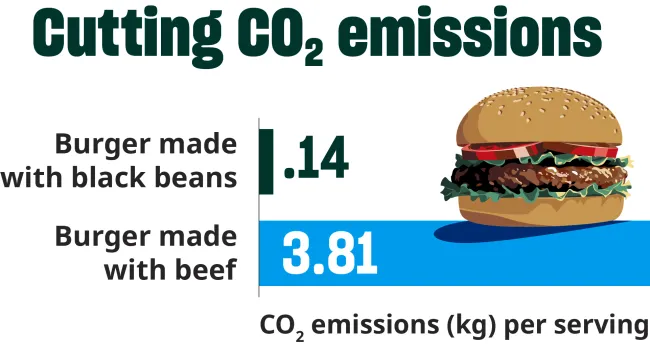
The team spreads this animal- and climate-friendly message in North America, Brazil and around the world through an initiative that in the U.S. is called the Forward Food Collaborative. At international climate change conferences, they share that at least 16.5% of greenhouse gas emissions come from animal-based agriculture, and that reducing animal agriculture emissions is critical if we want to achieve global climate goals.
Humane World chefs, dietitians and experts in menu design collaborate with food service providers who want to offer more plant-based foods. They provide recipes, menus and culinary trainings—greatly expanded online during the pandemic—along with environmental impact assessments for individual meals that show how plant-based eating can reduce carbon footprints. Success is measured in plant-based meals served instead of animal-based counterparts. Since 2023 in the U.S., more than 8 million plant-based meals have been offered daily by dining operations collaborating with the Food Service Innovation team. The goal is to get institutional dining programs to make half of their meal offerings plant-based by 2027. That means fewer chickens, cattle and calves slaughtered and fewer animals kept in intensive confinement—cages for laying hens, gestation crates for sows and pens for veal calves.
Eating “plant forward” is kinder to animals, healthier for humans, gentler on the planet—and doable for food service providers at schools, universities, hospitals and other institutions.
It means fewer chickens in the factory farm meat industry, where they’re bred to grow so big so fast that they suffer pain for much of their six-week-long lives.
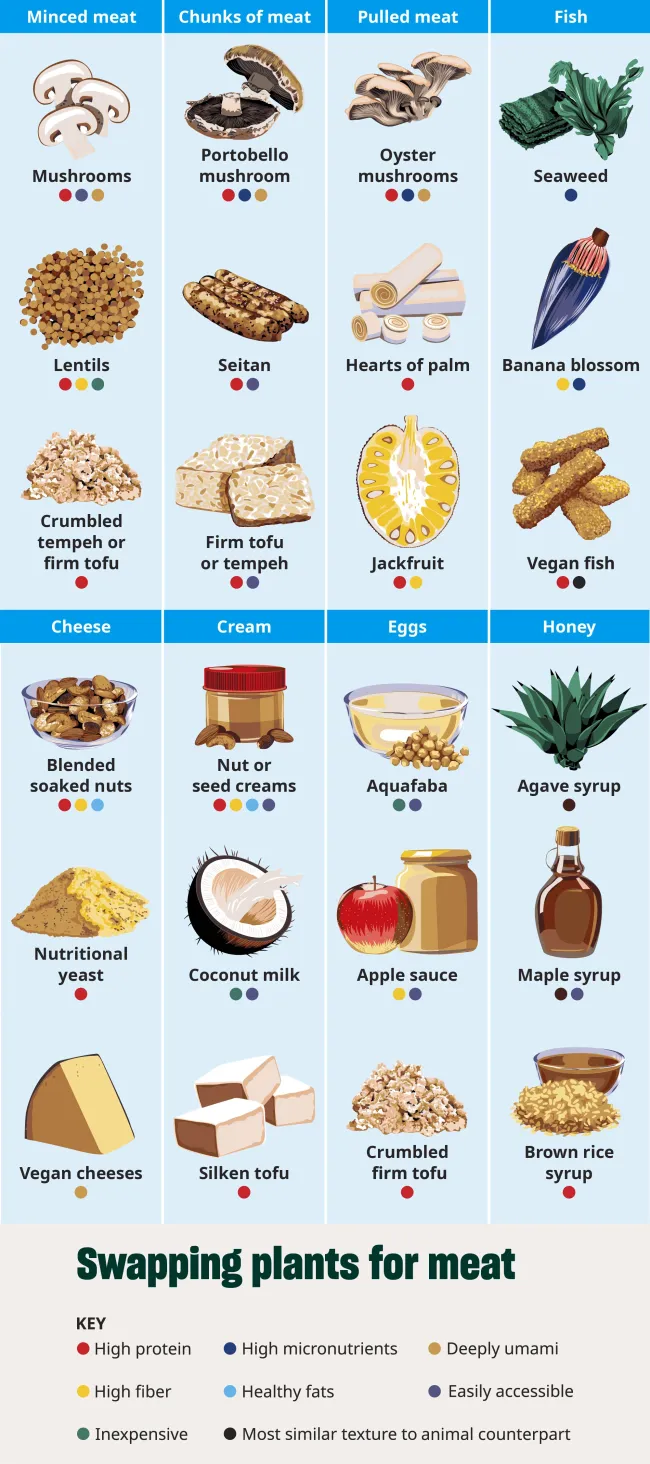
Wherever possible, the team’s recipes use whole foods, such as beans, chickpeas and lentils, which are among the cheapest, healthiest and most environmentally friendly choices, says Kate Jarvis, a manager on the Food Service Innovation team. Sometimes, for reasons of scale, location and supply, chefs swap in other products, such as plant-based nuggets.

Rachel Stern/Humane World for Animals
“Our goal is not necessarily making everyone vegan, it’s to create options that your entire student base will like,” she tells food service providers for schools and colleges. “The food has to taste good, period.”
At the University of California, Humane World finally found success getting schools to serve more plant-based meals by presenting them as a way to meet the university system’s sustainability goals.
“Five years ago, they were completely unresponsive. They said, ‘For those four or five vegan students we have, we have salad bars,’” says Jarvis. “Then, instead of asking them to do something new, we led with, ‘This is aligned with what you’re already doing.’”
Now, four of the UC campuses—Berkeley, Los Angeles, San Diego and Riverside—have pledged to make 50% of their meals—around 67,000 daily meals—plant-based.
Rachel Stern/Humane World for Animals
Embracing tempeh and tofu
At the expo, Burgio meets up with dining staff she knows from Cornell University and Smith College. On day two, she provides a demonstration on a raised stage with a mirror overhead so the audience can watch as she cooks Thai tempeh fried rice. Tempeh is not one of the latest plant-based products; it’s been a staple in some parts of the world for centuries. But she assumes some in the audience have not cooked with the blocks of fermented soybeans. “It’s tofu’s sexier cousin,” she explains.

Rachel Stern/Humane World for Animals
Trenchard leads a workshop on winning over people to plant-based meals for representatives of a culinary group, a food operations chief at a West Virginia Veterans Affairs center and the CEO of a Philadelphia vegan food stand. Trenchard challenges those at the workshop to create a recipe using canned lentils, cauliflower, plant-based mayo and tempeh. Matthew Delaney, sustainability manager with Whitsons Culinary Group, a dining services company based in New York, says his company is looking for meals beyond plant-based nuggets. “K-12 is the world’s largest restaurant. We’re always asking, ‘What can we do that’s kid-friendly?’”
Whitsons is aiming for a third of the meals it serves to be plant-based by next year.
The Public Schools of Brookline, Massachusetts, spurred by a 2021 proposal from the student club Warriors for Animal Rights, is already at 45% and has signed a Forward Food pledge for 50% by next year. Sasha Palmer, Brookline director of food services, says she asked the club’s founder, then-freshman Ezra Kleinbaum, and other students to research and develop a proposal for school system approval. Once they succeeded, she introduced Meatless Mondays without calling attention to the fact that the meals they were eating were plant-based.
Burgio provided the recipes and training. School cooks had been doing their best with a USDA recipe called “crispy teriyaki tofu.” But they didn’t really understand how to use tofu in dishes. Burgio shared her expertise with them and helped transform the menu item from one of the least popular to the most popular. The number of students choosing to buy school lunches rose by half.
Rachel Stern/Humane World for Animals
Beans over meat
Thousands of miles to the south, our Brazil food policy team is helping move some of the nation’s largest school systems to serve more plant-based meals—which is helping them achieve government sustainability goals, says country director Thayana Oliveira Soares. Since 2020, several school systems, working with Humane World and our partner Mercy For Animals, have shifted 20% of their meals to plant-based options, including the system serving Salvador, Brazil’s fifth-largest city, with more than 170,000 students. As a result, those school systems have served nearly 40 million plant-based meals beyond those they already offered.
By late 2025, new schools joining the program had committed to serving an additional 21 million plant-based meals per year. And Rio de Janeiro, Brazil’s second largest city, had worked with us, Mercy For Animals, and the Brazil Vegetarian Society to launch a pilot project in 15 schools. The project could expand to the entire school system of more than 1,500 schools and 600,000 students, potentially shifting 25 million meals a year to plant-based options.
The Salvador schools use plant-based meals to meet local, state and national sustainability objectives, as well as global commitments to resilient food systems (how food is grown, processed, distributed and eaten), says Juliana Garcia, a nutritionist responsible for the National School Feeding Program there. “It’s gratifying to know that we’re making a difference to children’s health and the future of the planet.”
Our goal is not necessarily making everyone vegan, it’s to create options that your entire student base will like.”
Kate Jarvis, Humane World for Animals
Students receive food and nutrition education to teach them how to eat healthy with a low environmental impact. There was resistance to the new meals at first, because students mistakenly thought meat was completely removed from the menu, Garcia says. Once they found out that plant-based offerings would complement animal proteins, rather than replace them, they were more receptive.
The new meals are introduced through their ingredients and taste, not the label “vegetarian.” The students’ favorite is a white bean moqueca, based on a traditional Bahian seafood stew recipe, with coconut milk and dendê oil. They also like beans with vegetables and noodles in soy sauce. Each month, the school system performs acceptability tests and revises recipes to suit students’ tastes.
We hope to scale up from the municipal level to the state level to the federal level and beyond. Stefanie McRaj, our senior director for food policy, says Humane World pursues this bottom-up approach at the same time as it participates in top-down efforts, especially at the annual U.N. climate Conference of the Parties that brings together governments from all over the globe to address climate change.
Rachel Stern/Humane World for Animals
Getting heard on the world stage
In the months after Trenchard and Burgio attended the 2024 Plant Based World Expo, some of the products promoted there were discontinued. In the U.S., a new president was elected who favors meat, particularly beef, and who chose a health secretary who encourages Americans to eat animal-based whole fat dairy. The U.S. pulled out of the 2015 Paris climate agreement to limit global warming for the second time. Icebergs calved from glaciers in Antarctica and Greenland. And meat consumption around the world continues to rise.
Still, expectations were high as delegates from most nations (the United States chose not to attend) gathered in November for COP30, held 30 years after the first such U.N. conference. It took place in Belém, Brazil, near the mouth of the Amazon River. Observers called this “the people’s COP.” The host country is a democracy, its president is a champion of sustainability and, unlike other recent hosts, Brazil is not a major oil and gas exporter. McRaj and Soares were hopeful that the conference would result in decisions encouraging nations to integrate the way they raise and consume food into their climate policies and plans.
We’re still a long way off from what we need to protect people, to protect animals, to protect our planet.”
Stefanie McRaj, Humane World for Animals
The city of Belém, which lies next to the Amazon rainforest, has many people living in extreme poverty. They used to subsist off the forest. Now they live in crowded neighborhoods built along polluted creeks that frequently flood. Brazil is a major exporter of beef and soybeans grown for animal feed. Ranchers and farmers have cut and burned the forest to graze cattle and grow soybeans. Midway through COP30, Indigenous people broke into the venue where 25,000 people were gathered, chanting, “Our forests are not for sale.”

Rachel Stern/Humane World for Animals
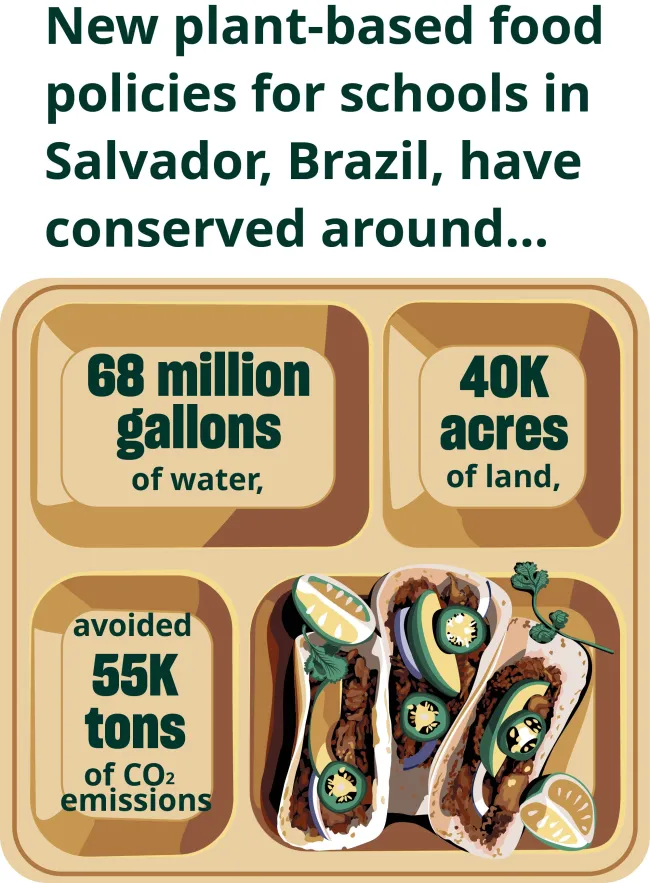
Humane World staffers were in attendance alongside other animal welfare and environmental advocates (and more than 300 lobbyists from industrial agriculture). Our partners in the cities of Salvador and Rio de Janeiro spoke on an official panel about their shift toward plant-based meals in schools. Ivan Euler, Salvador’s secretary of sustainability, resilience, well-being and animal protection, said new food policies for schools have already saved more than 40,000 acres of land, conserved around 68 million gallons of water and avoided 55,000 tons of CO2 emissions. At a separate side event, Humane World, Compassion in World Farming and World Animal Protection presented a newly launched set of guidelines for financial institutions to redirect capital to support more plant-based proteins.
Negotiations among the government delegates went late into the night, past the deadline. But the COP ended without a commitment to reduce fossil fuel emissions or even a mention of food systems. There was no acknowledgment of the need for healthy and sustainable diets. It was a disappointment for Soares and McRaj.
“We’re still a long way off from what we need to protect people, to protect animals, to protect our planet,” says McRaj. “That just means there’s more work to do.”
The power of persistence
During the meeting, McRaj left the huge conference center where delegates met to sample local food beyond. She was amazed by the meals cooked with plants she has never before tasted: maniçoba, prepared with a dark green plant from the Amazon rainforest that is cooked for days until it is safe to eat; farofa, or toasted cassava flour; one of five different varieties of plantain-like “earth bananas;” plant-based ice cream made with tapioca and acai; jambu, a leafy green that turns your lips and tip of your tongue numb. Like the students in Salvador, her favorite is moqueca. She ate it five times, sampling four different vegan versions of the stew. Once back home, she recreated the recipe using hearts of palm and plantains over rice.
It was not the meat or fish that dazzled her, it was the plants.
Meal by meal. That’s how McRaj and Soares and the rest of our team at Humane World are putting more plants on plates. That’s how we are saving animals and the planet. Our Food Service Innovation team has shown what’s possible working with institutions and schools, from Brookline to Brazil—no matter the ups and down of the plant-based alternatives industry. No matter the progress or lack of progress at the next COP. Whatever happens, we’ll be making change.
Related stories
MEDITERRANEAN/Getty Images
We don't need factory farming to feed the world. To ensure everyone has access to healthy and affordable food, we need to change how we think about our food and how we produce it.
Kseniya Ovchinnikova/Getty Images
Dorrie Nang with the Food Service Innovation team at Humane World champions change by teaching companies and institutions how to prepare and promote plant-based food.
Sharon Palmer
Discover how to meet your protein needs with plant-based foods. Experts and athletes share tips on fueling performance and improving health.