For over a decade, our Farm Animal Protection team has committed itself to not only improving the treatment of farmed animals currently entrenched in animal agriculture, but also reducing the consumption of meat, eggs and dairy in the U.S. and around the world. Back in 2013, we started expanding our work with the biggest food service companies to bring plant-based dishes to their menus. This has led to hundreds of schools and colleges, hospitals, military bases, prisons and stadiums offering more plant-based meals, with many now committed to shifting half of their menus to plant-based within the next few years. Such achievements decrease the number of animals killed for food while providing healthier, more sustainable meals. Much of this work involves building relationships and connections with people in the foodservice industry. Here, Dorrie Nang, manager of food service innovation for Humane World for Animals, shares a story about what this work has meant for her.
There is no question that food is personal. So often, what we eat reminds us of where we come from—our families and cultural traditions. And that’s why it can feel like such a monumental personal shift to change what we eat.
My father was born in the Philippines, where he learned to cook from his mother as his family lived and traveled in Hong Kong and throughout the Philippines. Although my father was an engineer by training, he had a special talent for cooking.
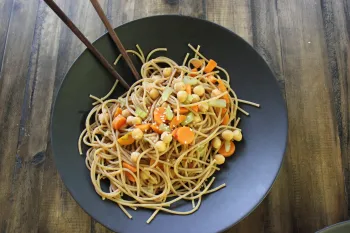
In 1993, when I decided to cut meat, dairy and eggs out of my diet, my dad supported me by making sure there were always plant-based versions of whatever he was cooking. Ever since then, he has tailored his traditional dishes so that I could still enjoy the flavors that meant so much to him, and to me. What my father taught me about connecting with other people over food has done more than shaped my choice of a career path; it has also shaped how I view and interact with the world.
In December 2022, just a few weeks before my father passed away, I happened to connect with Chef Herlan Manurung, the corporate executive chef and associate director of dining at Rochester Institute of Technology. We were discussing RIT’s remarkable pledge to serve 50% plant-based entrees by the end of 2025—a pledge that will not only dramatically reduce the amount of meat consumed on the campus but introduce delicious plant-based dishes to thousands of students, many for the first time. As we planned the training for RIT’s dining hall chefs, Chef Herlan and I shared our ideas about making plant-based meals more accessible to students, and we talked about how easily Asian cuisine lends itself to plant-based eating, as Asian dishes hardly use dairy, and tofu is a perfect protein stand-in for meat.
When our in-house chefs partner with food service companies, such as Aramark and Sodexo, we don’t just share recipes; we connect about the future of cuisine and how to make food healthier, more compassionate and better for the environment. And sometimes we even get to share with each other what brought us all into the food world in the first place.
When we realized that we both had roots in Asian cuisine, Chef Herlan told me that he grew up on Sumatra Island, Indonesia, and had been an executive chef on cruise ships.

Dorrie Nang
With Chef Herlan, there were so many commonalities between his view of cooking and my dad’s. When Chef Herlan said, “If a meal does not include rice, it’s just a snack!” I was reminded of my dad’s lifelong saying: “If you haven’t had rice with your meal, you haven’t eaten!”
When, a few weeks later, my dad passed at the age of 94, I tried to capture in words his beautiful soul and found myself writing about his love of cooking and sharing food: “He was an outstanding cook whose eggrolls, lo mein and fried rice could never truly be replicated, even after he shared the recipes with family. He cooked with love and from memory.”
Since my dad’s passing, whenever I’m in the kitchen preparing anything—from a brand-new recipe to a quick snack—I think of my dad and feel grateful for the love of cooking that he passed on to me.
My connection with Chef Herlan at RIT is just one example of the relationships that are central to our unique food service work at Humane World for Animals. It’s about connecting over food in deep and profound ways—that also make a difference for animals and the future of our planet. I know my dad would be proud that I’m advocating for animals while continuing to connect with people over a love of food, just the way he loved to do.
Dorrie Nang is one of the managers on the food service innovation team at Humane World for Animals.