
Since 2023, Humane World for Animals has been publishing The Pecking Order reports, evaluating the chicken welfare policies and progress of major fast-food brands in Poland and Romania. The report highlights an urgent need for Poland's and Romania’s fast-food industry to accelerate its efforts to adopt higher welfare standards for chickens raised for meat—especially given growing consumer demand for more humane food production. Additionally, the report outlines actionable steps for the industry, lawmakers and consumers to drive meaningful change.

Humane World for Animals
Addressing urgent welfare issues
The report relies on the science-based criteria of the European Chicken Commitment agreed to by 38 animal welfare organizations worldwide. These criteria set minimum standards for addressing the most urgent welfare issues in the production of chickens kept and killed for meat, such as overcrowding, unhealthy breeding, cramped cages, barren environments and inhumane slaughter methods.
Fast-food companies should do better
In the 2025 Pecking Order report in Poland, IKEA, Domino’s and Pizza Hut lead the rankings, while in Romania, IKEA, Pizza Hut and Subway top the list. These companies have publicly stated chicken welfare policies that align with ECC standards, except for Subway. However, they still need to improve their substantive reporting on progress, timeline and specific steps they will take to show customers that they are improving chicken welfare in their supply chains.
In contrast, Subway, KFC and McDonald’s in Poland, as well as KFC in Romania, lag behind with incomplete policies without deadlines or failing to address key welfare issues. Meanwhile, Burger King, Popeyes, Pasibus, Salad Story, Starbucks and Zahir Kebab in Poland, along with 5 to go, Burger King, Popeyes, Domino’s, McDonald's, Salad Box, Spartan, and Starbucks in Romania, received the lowest scores for not publishing an ECC commitment. Consequently, consumers may assume that these companies are not taking any action to address critical chicken welfare concern.
By the numbers
Intensive farming practices continue to cause significant welfare issues for billions of animals each year. Chickens raised for meat are selectively bred to grow so rapidly that they commonly suffer from leg disorders and difficulty walking. The ECC promotes the use of slower-growing breeds, breeds that have better walking ability, improved immunity, are more robust, and require fewer antibiotics. Giving each bird more space by requiring lower stocking densities further supports better animal welfare, helping to reduce antibiotic use and combat the rise of antibiotic-resistant bacteria.
are slaughtered annually in the EU—including 1.298 billion in Poland and 320.1 million in Romania
in Europe, including 28 in Poland and 16 in Romania, have committed to meeting ECC criteria
in Poland and Romania were assessed; 5 committed to meeting ECC standards
EU insights
Humane World for Animals Europe
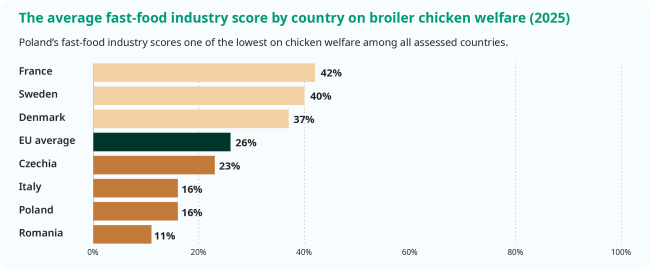
Poland’s and Romania’s performances are the weakest in the EU
Across the EU, 81 fast-food chains were evaluated in seven countries. Company scores within a country reflect the state of broiler chicken welfare in a country’s fast-food industry. All countries together reflect the state of affairs in the EU.
Romania has the lowest score among all countries, with an average industry score of 11% in 2025—down from 17% in 2023—highlighting both the urgency and the opportunity for action. Poland has the second-lowest score, with an average industry score of 16% in 2025—down from 18% in 2023—reinforcing the need for accelerated progress.

Lukas Vincour / Zvirata Nejime/We Animals
Ways forward
The Pecking Order report urges fast-food companies to take concrete steps to improve chicken welfare by adopting ECC standards and creating clear road maps to achieve their goals. It also highlights the need for stronger collaboration between fast-food chains and chicken producers to implement a transition to higher welfare farming models, which can also help reduce reliance on antibiotics. Producers need dedicated buyers to justify investments in higher welfare, while fast-food chains rely on these producers for a steady supply of higher-welfare chicken.
In addition to corporate action, lawmakers are critical to driving the transition to higher welfare for chickens, especially regarding stocking density and promoting slower-growing genetic lines. Legislators can protect animal welfare through policy development and enforcement while keeping the industry competitive in national and European markets.
The European 2025 edition of The Pecking Order is a project by World Animal Protection, together with Humane World for Animals, Essere Animali and Obranci Zvirat. A total of 81 companies were assessed in 2025 covering the markets of Czechia, Denmark, France, Italy, Poland, Romania and Sweden.
Dig deeper
Chicken welfare in the fast-food industry is important. Learn more about the topic and what we do to create awareness among corporates, lawmakers and the public.

Lukas Vincour / Zvirata Nejime/We Animals

Elise Allart/Humane World for Animals

Seb Alex/We Animals

Jo-Anne McArthur /Sibanye Trust/We Animals

Stefano Belacchi /Animal Welfare Observatory/We Animals

Humane World for Animals Europe
TPO Reports
2025
Full reports
Executive summaries
European report
Summaries for lawmakers
2024
Full reports
Executive summaries
European report
Summaries for lawmakers
2023
Polish reports
Romanian reports
European report
Get involved to make a change
Your voice matters because animals don’t have one. When you contact your representatives, sign a petition, attend an event or volunteer, you send the message that animal lovers everywhere want to end animal cruelty and create a more humane world. Find out ways you can take action for animals.
Laurent Prunier/Getty Images