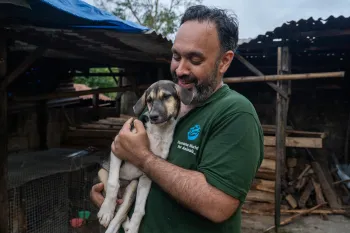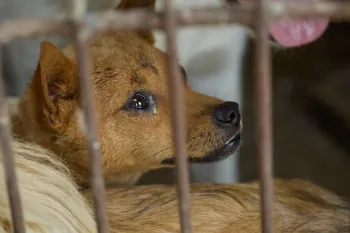
BEIJING―Days before the start of the infamous Yulin dog meat “festival” in China’s Guangxi province, animal activists have permanently closed a dog slaughterhouse in the city’s first ever alternative livelihood conversion program. Nine dogs found at the property were saved from slaughter, among them three still wearing their collars and clearly stolen pets―a Labrador the rescuers have named An An, a beagle now given the name Moli and a poodle they have called Lian.
Vshine Animal Protection Association, with funding and technical guidance from long-time partner Humane World for Animals (formerly called Humane Society International), secured a legally binding agreement with the dog slaughterhouse owner, to close the facility that has killed more than 15,000 dogs since being in operation. The slaughterhouse supplies dog carcasses to Yulin festival restaurants and markets. The owner was present for the closure, and is looking forward to giving up the brutal trade. He is considering starting afresh in a breakfast catering business serving rice porridge, fried dough and steamed buns. He is using a pseudonym for the purposes of this closure.
“I’m looking forward to a peaceful life,” said Mr. Huang in a statement translated by Humane World for Animals. “I have been killing dogs for almost 20 years. It’s a dirty business and I don’t feel good about it. Also, as fewer people are eating dog meat these days it’s hard for me to provide for my family. I am relieved to be leaving it behind me and having a more stable living. Without the support from this program, I would not have been able to make this life change but I think a lot more dog meat businesses in Yulin would choose to close if they had this kind of support.”
The slaughterhouse is about 30 kilometres to the south of Yulin city centre. Around 15 dogs each week have been slaughtered there since 2007. Dogs were bludgeoned over the head and their throats cut before being butchered. June has been the slaughterhouse’s busiest month, accounting for 70% of its annual income due to the Yulin festival.
This is the first ever livelihood conversion to take place in China’s dog meat hotspot of Yulin and is a tangible example of how Vshine and Humane World for Animals work together to advance practical solutions to end the trade in ways that benefit both people and animals. Across Asia, Humane World for Animals has run similar livelihood conversions as part of its Models for Change program. For more than a decade the charity has been supporting dog meat farmers in South Korea transition to alternative trades such as chilli and mushroom farming, and more recently Humane World for Animals has launched the Models for Change program in Viet Nam, India and Indonesia.
Julie Sanders, Humane World for Animals’ director of End Dog and Cat Meat campaign, said: “It’s incredibly exciting to see this livelihood conversion take place in Yulin, arguably China’s most infamous dog and cat meat hotspot. But even here, support for the dog meat trade is low and traders are keen to get out of the business due to family and financial pressure.
“The dog and cat meat trade in China is unpopular, often illegal, a danger to public health through the spread of rabies, of limited economic significance and outside of the mainstream food culture. We hope to demonstrate to the Yulin authorities that it’s possible and desirable to end this brutal and controversial trade by offering support for those in the trade to transition to new livelihoods. To do so would not only save thousands of dogs and cats but also offer people a safer, legal and sustainable livelihood away from the dangerous and illegal dog meat trade.”
The nine dogs rescued at the slaughterhouse are receiving essential veterinary care to recover from their ordeal before being transported to Vshine’s shelter. They will be quarantined, vaccinated and sterilized before being made available for local adoption into safe and loving homes.
Earlier this year, Vshine submitted a legislative proposal to the National People’s Congress to improve companion animal protection, including a nationwide dog and cat meat trade ban.
Chen Xiaolei from Vshine said: “It was very disturbing to step foot into this dog slaughterhouse where so many dogs have lost their lives so brutally over the years. This cruel and dirty trade has no place in modern China and the Yulin dog meat festival is a stain on China’s international reputation. By supporting policies that enable traders to transition to alternative livelihoods, the Yulin authorities could help close this cruel trade for good and lead the way in China to end the dog and cat meat trade.”
Facts about China’s dog and cat meat trade:
- An estimated 20 million dogs and 6 million cats are brutally killed and eaten each year across Asia in countries including Viet Nam, China, Cambodia, Indonesia and several states in Northeast India.
- China has the world’s largest dog and cat meat market, slaughtering an estimated 10 million dogs and 4 million cats annually. Despite this, most people across China don’t eat dogs and cats and the trade is banned in the major cities of Shenzhen and Zhuhai.
- Across Asia the slaughter and sale of dogs and cats for human consumption is explicitly banned in Taiwan, Hong Kong, the Philippines, Thailand and South Korea (coming into force 2027). In other countries such as Singapore and Malaysia, the trade is essentially prohibited under existing animal welfare, animal cruelty and animal or food hygiene laws. In addition, the trade is banned in the city of Siem Reap in Cambodia and across 121 regencies, cities and provinces in Indonesia.
- Most dogs and cats slaughtered for food are stolen pets, guard dogs or strays snatched from the streets or caught using poison bait and darts.
- Yulin’s so-called Lychee and Dog Meat Festival is not a traditional event. It was launched in 2010 by dog meat traders in an attempt to encourage dog meat eating and boost sales. Prior to 2010, Yulin had no history of commercial dog or cat meat sales.
- Over the years, the Yulin authorities have attempted several crack downs including roadblocks to stop dog and cat transport trucks entering the city. Despite this, the Yulin authorities have not implemented robust measures to ban the trade, even though the supply of dogs and cats relies primarily on criminal activity.
- China’s Food Safety Law (Article 34) prohibits processing food from non-food animals, and national and provincial slaughter regulations do not apply to dogs and cats, meaning the dog and cat meat trade violates the law.
Download photos and video from the Yulin closure HERE.