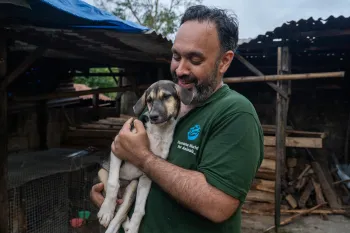
KUPANG, Indonesia (March 6, 2026)― A dog slaughterhouse owner and a dog meat restaurant owner in Nusa Tenggara Timur province, who between them have been slaughtering or serving up dogs for more than 45 years, have closed their businesses for good as part of a local drive to end the dog meat trade. The traders worked with Humane World for Animals as part of its Models for Change program which already helps dog and cat meat traders in South Korea, Viet Nam and India switch to more sustainable livelihoods that don’t jeopardize animal welfare and human health. Ten dogs found alive at the slaughterhouse were also rescued by Humane World for Animals and local partners Jakarta Animal Aid Network.
NTT province is a dog meat hotspot, with thousands of dogs a year snatched from streets and homes in NTT and neighboring provinces and trafficked in large numbers. As well as being incredibly cruel, this mass movement of dogs of unknown disease status facilitates the spread of deadly rabies across NTT, which is transmitted primarily through dog bites. NTT reports some of the highest rabies numbers in the country, with 78 confirmedhuman cases in 2025.
The Models for Change program is implemented in agreement with the NTT provincial government, representatives from which attended the closures. The program directly contributes to the government’s goal of making NTT a rabies-free province by 2030.
Julie Sanders, Ending Dog and Cat Meat campaign director for Humane World for Animals, who also attended the closure, said: “Every dog or cat meat business that shuts down as part of Models for Change represents a tangible step toward eliminating this cruel trade, safeguarding animal welfare and protecting communities nationwide from the risk of rabies transmission. Most people across Indonesia don’t eat dogs and cats and there is a growing national momentum to end the trade.
“Around 1 million dogs a year suffer appalling brutality for Indonesia’s meat trade. The 10 dogs who we rescued here came very close to being a part of that horrifying statistic but thankfully they will now get the love and veterinary care they need to recover before starting their search for loving families.”
Humane World for Animals and JAAN supported the two traders in Kupang City with a one-off grant to get them established in a new trade. Mr. Petrus Boly, who ran a dog slaughterhouse for more than 15 years, plans to open a convenience store or warung selling daily necessities such as rice, soap and household items. Dog meat restaurant owner Mr. Akim, who purchased dog meat from Mr. Boly to sell to diners, is planning on selling building materials. Both men were able to realize their goal of leaving the dog meat trade behind them thanks to financial and business planning support from Humane World for Animals and JAAN.
Mr. Boly said: “When I think about the thousands of dogs I have killed in the last 15 years or more, it makes me very sad and I’m very happy to be moving out of the trade. I know that dog slaughter is also dangerous due to the risk of contracting rabies so this opportunity came at just the right time in my life. I am now looking forward to opening my general store supplying all the things our community needs, but no more dog meat! I really hope the 10 rescued dogs will go on to have happy lives in families that look after them.”
Mr. Akim said: “At one time I used to slaughter around five dogs every day to cook at my restaurant, but after a big rabies outbreak in Kupang city in 2023, customer demand dropped sharply. My family has been keen for me to stop doing this trade for some time, and I have been increasingly worried about the link between the dog meat trade and the spread of rabies which is a big problem here. But I couldn’t have made the switch without the Models for Change program, so I am very grateful for that. I now feel I have a brighter future for me and my family.”
Humane World for Animals and JAAN hope the closures and the rescue of dogs will help foster greater compassion for animals within the wider community as well as raise awareness about the public-health risks associated with the dog meat trade. By increasing public demand for an end to the trade, the local government in turn will be in a stronger position to introduce a ban across NTT.
Dr. Melky Angsar, who is in charge of animal health and veterinary public health at the Animal Husbandry Office in Nusa Tenggara Timur, attended the closures and said: “The dog meat trade poses a significant and serious public health threat to our communities here in NTT due to the spread of rabies. Our communities will be safer and healthier without the dog meat trade. Projects like Models for Change are turning that into a reality by providing a practical way to move people out of the trade and into sustainable futures for them and their families.”
Following the closures, the 10 dogs rescued were taken to Kupang Animal Clinic for vaccinations and veterinary care. After a quarantine period, they will be flown to JAAN’s shelter in Jakarta to fully recover physically and emotionally before they are found local adoptive homes.
Kerin Franken, director of JAAN said: “These closures demonstrate that if financial and business support is provided, people are willing and keen to move out of the cruel and dangerous dog meat trade. With these closures, not only have we rescued 10 vulnerable dogs out of harm’s way but we have ensured that thousands more will no longer suffer and die at these premises. It’s programs like this, combined with legislation and enforcement, that will end Indonesia’s dog and cat meat trade for good.”
Humane World for Animals (formerly called Humane Society International) has been campaigning for years for an end to Indonesia’s dog and cat meat trade, as founding members of the Dog Meat Free Indonesia coalition. The organization works across Asia to end the dog and cat meat trade. In South Korea, Viet Nam, Indonesia, China and India, we pursue change through legislation, public awareness, community engagement, animal rescue, rabies vaccination and livelihood transition programs, working both directly and with local partners.
Facts
- Kupang is in the western part of Nusa Tenggara Timur province. It sits on the north-western coast of Timor Island and serves as the capital city of East Nusa Tenggara. Kupang is the main administrative, economic, and transport hub of the province, with an airport and seaport connecting it to other parts of Indonesia.
- The mass movement of unvaccinated dogs for human consumption facilitates the spread of rabies, undermining disease surveillance and bringing infected dogs into previously rabies-free areas. Dog thieves also remove vaccinated dogs from communities, breaking down ‘herd’ immunity achieved when at least 70% of dogs are vaccinated in a given area. Herd immunity helps stop the spread of rabies.
- The Animal Welfare and Protection Bill, introduced in September 2025, has received cross-party support including from the Golkar Party Faction, National Democratic Party Faction, National Mandate Party Faction and Indonesian Democratic Party of Struggle Faction.
- A Nielsen opinion poll in January 2021, commissioned by DMFI, revealed that 93% of Indonesians support a national dog meat ban, and just 5% have ever consumed dog meat
Download photo and video of the closures and rescue HERE.
#