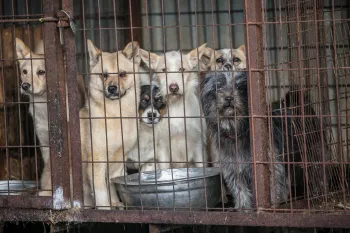
BEIJING— Humane World for Animals joined with Chinese animal campaigners, legal scholars, academics and lawyers in Beijing to support their call for a national law to protect companion animals and end the dog and cat meat trade. The Animal Law Forum event convened by Capital Animal Welfare Association, titled Time to Legislate Companion Animal Protection, highlighted the urgent need to modernize China’s legal framework to reflect the country’s evolving relationship with companion animals, particularly dogs and cats, who hold deep emotional significance for millions of families.
Speakers from across China outlined the absence of explicit legal provisions recognizing the special status of companion animals in China’s current legal system, as well as potential pathways for legislative reform with clear penalties for cruelty, violence and neglect.
Professor Amanda Whitfort from the University of Hong Kong’s Faculty of Law discussed Hong Kong’s Dogs and Cats Ordinance, explaining how long‑standing dietary practices posed no barrier to enacting a ban on the sale and consumption of dog and cat meat. The ordinance’s successful implementation was presented as evidence that legislative reform is both feasible and socially beneficial.
Professor Li Bo of Northern Anhui Normal University Law School reviewed civil judgments in mainland China that increasingly recognize the emotional value of companion animals, indicating that China’s judiciary is prepared to implement laws that formally acknowledge the special status of dogs and cats.
The forum’s program emphasized that China is not alone in confronting the issue. Speakers from Humane World for Animals were invited to present to delegates perspectives on the global trend toward ending the dog and cat meat trade, particularly in Asia.
Julie Sanders, Humane World for Animals’ ending dog meat principal, offered an overview of growing public opposition and legislative reform efforts across the region targeting the dog and cat meat trade. Sangkyung Lee, campaign manager at the organization’s South Korea office, described the policy and social momentum leading to South Korea’s Special Act on the Prohibition of the Breeding, Slaughter and Processing of Dogs for Human Consumption, including the decline of long‑standing cultural justifications for dog meat consumption. Lastly, Karan Kukreja, Humane World for Animals’ dog and cat meat campaign consultant, discussed the prospects for a national ban in Indonesia, where similar debates are underway.
Two research teams working with Professor Guo Peng of Shandong University and Sun Jiang of Northwest China University of Law and Politics presented findings from field studies conducted in different regions of China. Their work concluded that dog or cat meat consumption does not meet the criteria of a genuine traditional food, noting that is not practiced by the majority of local residents, is not passed down generationally as a cultural practice, does not have broad social acceptance. Ultimately, they contend, its persistence is heavily influenced by commercial promotion, not cultural heritage.
Chinese participants at the forum adopted a formal letter of appeal to be submitted to the National People’s Congress urging lawmakers to consider comprehensive legislation that would elevate the legal status of companion animals; regulate pet‑owner responsibilities to reduce abandonment; penalize cruelty, neglect, and violence toward dogs and cats and prohibit the sale and consumption of dog and cat meat nationwide.
Professor Peter Li, Humane World for Animal’s China policy expert, said: “China stands at a critical crossroads. Advancing companion animal protection would not only safeguard public health, animal welfare and social well‑being but also enhance China’s global image at a time when the country is demonstrating leadership in science, technology and cultural influence.”
Facts about China’s dog and cat meat trade:
- China has the world’s largest dog and cat meat market, slaughtering an estimated 10 million dogs annually.
- Most dogs and cats slaughtered for food are sourced by pet or street theft, poisoning or other illicit sources.
- Dogs and cats are not classified as food animals in China; in 2020, the last two dog breeds were removed from the National Catalogue of Genetic Livestock and Poultry Resources.
- China’s Food Safety Law (Article 34) prohibits processing food from non‑food animals, and national and provincial slaughter regulations do not apply to dogs and cats, meaning that the dog and cat meat trade violates the law.
- The Animal Epidemic Prevention Law requires strict quarantine for live animal transport across provinces, requirements routinely violated by trucks carrying hundreds of dogs or cats across provincial lines for the meat trade.