Target has renewed its commitment to sell only eggs from cage-free hens by 2030. The company has released a comprehensive plan to do so at its 2,000 stores across the United States, with benchmarks for each of the next five years until it reaches 100 percent cage-free.
More than 600 of Target’s stores already sell exclusively cage-free eggs, largely because of state laws prohibiting the sale of cage eggs, laws whose passage we led. With our supporters and the other organizations that helped to secure this outcome, we’ll be working hard to make sure that Target fulfills its promise.
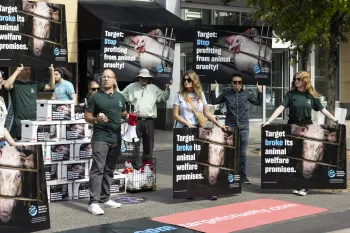
Last summer, members of our Humane World for Animals team and volunteers arrived at Target’s headquarters in downtown Minneapolis to deliver 15 large boxes containing signed petitions; more than 195,000 signatures called on the company to fulfill its long-overdue commitments to do better by farmed animals. We showed up at Target’s annual team retreat and communicated our position to thousands of staff members, urging them to pressure their leadership to do the right thing. Both times, our efforts were covered in Minnesota’s largest newspaper. We also invested significant resources in online advertising and mobile billboards.
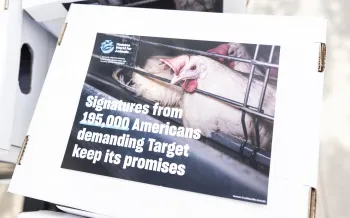
Tim Gruber/AP Images for Humane World for Animals
Hundreds of other companies have adopted cage-free policies within their U.S. operations. Just last month, Ahold Delhaize (which owns Food Lion, Giant, Stop & Shop and Hannaford), the subject of a similar campaign, strengthened its plan to eliminate battery cages in its supply chains. Many household brands and known companies operating in the U.S., such as Costco, Amazon, McDonald's, IHOP, Cheesecake Factory and Nestlé have made good on their cage-free commitments, with some even reaching their goals ahead of schedule.
Fewer than 15 years ago, cage-free production accounted for only single-digit percentages in the U.S. egg industry. Now, more than 46% of the egg market in the U.S. is from cage-free hens. This sea change in the egg industry is due in no small part to people who continue to speak up for animals. Our supporters have joined us in pressing some of the world’s largest corporations to do better. The steady rise of eggs from cage-free hens in the marketplace reflects how much people care about achieving a more humane future for animals in our food systems.
Even after companies make promises to better their treatment of animals, there’s more to be done to ensure that things actually do change. That’s why we track companies that have made animal welfare commitments to ensure that they follow through.
Our campaign for a cage-free future involves other actions, too. We support suppliers willing to transition to higher welfare systems with scientific evidence and expert guidance to ensure the smooth implementation of cage-free systems. This is how we make sure promises don’t turn up empty.
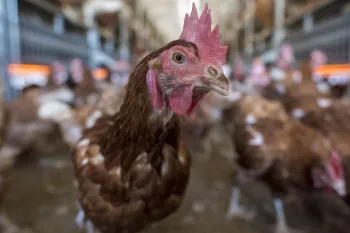
The magnitude of animal suffering in this sector is staggering. Hens on a typical egg factory farm are crowded into barren wire cages where each hen endures a lifetime of extreme confinement. There’s no room for complacency about their plight, and the reforms we’re seeking cannot happen fast enough.
We’ll closely monitor Target’s performance to ensure its continuing progress toward its cage-free goal, and we’ll continue pressing other companies to step up and do right by animals and the millions of people worldwide who care about how they are treated.
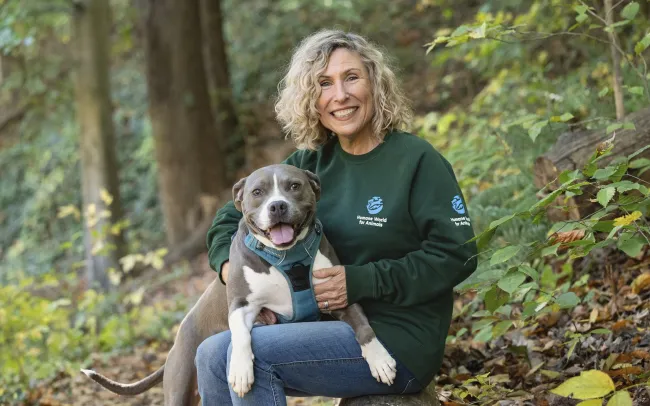
Kitty Block is president and CEO of Humane World for Animals. Follow Kitty Block.