Ahold Delhaize USA, the parent company of well-known grocery store chains, including Food Lion, Giant, Hannaford and Stop & Shop, has strengthened its cage-free egg policy by formally introducing steps toward reaching its goals, including a concrete action plan with public reporting. This dramatically improved accountability clearly shows a much stronger commitment toward 100% cage-free eggs, a goal the company says it will fully achieve by 2032 at the latest. Ahold has already begun rolling out improvements in its egg supply chain as a result, which should continue until full compliance is met.
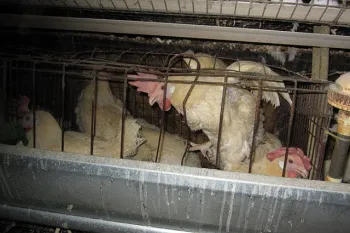
On an egg factory farm that still uses cages, it is the status quo for a hen to be crammed into a wire cage roughly the size of a microwave with as many as nine other birds, all of them unable to spread their wings for their entire lives. Each hen is forced to eat, sleep and defecate in a space with dimensions the size of a letter-sized sheet of paper.
This corporate commitment would not have happened without you and your steadfast dedication to speaking up for animals. We also acknowledge the work of the many other organizations across the U.S. and abroad that helped make this possible.
Once fully implemented throughout Ahold Delhaize’s U.S. grocery retailer networks, the commitment is estimated to impact more than 5 million hens in the egg industry per year. The company has stated, too, that it has set benchmarks to show the decreased use of cage systems leading up to the 2032 deadline. The company aims for a 75% cage-free goal for 2026 and 85% goal in 2028.
This announcement comes at a particularly significant moment for hens kept for eggs in the U.S. The cage-free egg industry has reached an all-time high in market share; 47.7% of hens used for eggs are now housed in cage-free systems nationwide, according to the U.S. Department of Agriculture. The USDA itself acknowledges the value of these systems, as it has mandated the use of cage- and crate-free systems for its official organics program through binding regulations.
Fewer than 15 years ago, cage-free production accounted for only single-digit percentages. The steady rise to today’s record level reflects the cumulative impact of legislative advances, consumer awareness and demand and corporate commitments.
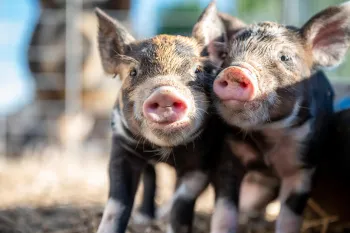
For pregnant pigs who suffer immensely in gestation crates, Ahold Delhaize USA has also reinforced its commitment toward its stated goal to reduce the time that pigs in its supply chain will spend in intensive confinement. The company aims to source pig meat from suppliers that reduce their use of gestation crates by 2028. Three of the company’s five supermarket chains have already met this goal.
Ahold Delhaize USA joins a growing group of retailers, restaurants and foodservice companies that have already transitioned to purchasing cage-free eggs within supply chains, including some big players. The U.S. branches of major brands including McDonald’s, Subway, Amazon and nearly all stateside Costco divisions are now 100% cage‑free, alongside many of the nation’s largest packaged food manufacturers such as Nestlé, PepsiCo, Unilever and Mondelez.
However, while many companies have made important strides, others, including Target, still refuse to fulfill publicly made promises to go cage‑free. Join us in pushing Target to follow through by signing our petition to Target’s CEO, Michael Fiddelke, at TargetCruelty.com.
Konrad Lozinski/We Animals Media
Target is profiting from animal cruelty
Sign this petition to Michael Fiddelke, CEO of Target Corporation, urging the company to keep its animal welfare promises and stop using cruel cages and crates.
We are devoted to seeing a better, more humane future for farmed animals. Not only do we track companies who have made promises to ensure that they follow through, we also work hands-on in our campaign to bring on the cage-free future for farmed animals. We meet with suppliers who are willing to transition to higher welfare systems and offer scientific research and expertise to show why improving animal welfare is crucial for everyone. At times, we even set up farm visits to facilitate company introductions to farmers and producers who have gone cage-free, and we provide companies with strategies and insights to help with implementation plans. This is how we work on-the-ground to ensure promises are fulfilled, not empty.
While we work on ending the cage age for farmed animals, one of the most important things you can do to help farmed animals is by choosing more plant-based meals in place of animal products. Many of the companies with the strongest animal welfare policies are also intentionally diversifying their menus to increase plant-based meal selections. You can see how these companies rank in the Food Service Industry Protein Sustainability Scorecard.
In this way, everyone can make a difference for farmed animals each day by choosing to eat more plant-based meals, even as we all do our best to support the corporate campaigns that produce animal welfare gains at scale.
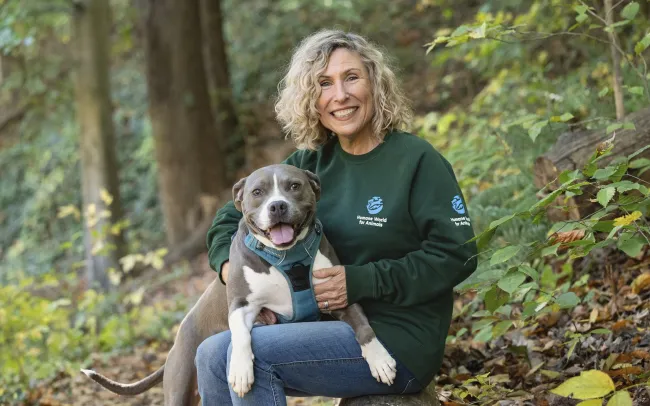
Kitty Block is president and CEO of Humane World for Animals. Follow Kitty Block. Sara Amundson is president of Humane World Action Fund.