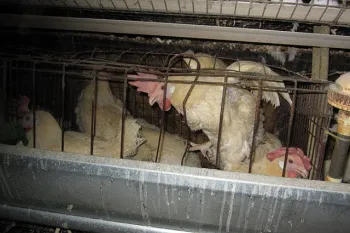
Last month, the U.S. Department of Justice sued the state of Michigan over cage-free eggs. The lawsuit is an attempt to gut a 2019 law requiring that eggs produced and sold in the state come from hens kept in cage-free environments. The move tries to reverse a trend that goes well beyond Michigan, the broad public rejection of the obvious cruelty of intensively confining farmed animals in cages so small they can hardly move.
The Michigan lawsuit is essentially a copycat version of one the DOJ filed in California in July 2025, and at this point there is no doubt: The hot war Big Pork, the U.S. Department of Agriculture and the DOJ are waging against California’s Proposition 12, the Michigan statute and other state-level farmed animal welfare laws is about politics, not constitutional law.
Michigan’s cage-free law passed with bipartisan support in the Michigan Legislature in 2019. It is one of 15 laws pertaining to the extreme confinement of farmed animals approved in red, blue and purple states across the nation. But this doesn’t seem to matter to the DOJ, nor does the fact that outcomes in the marketplace do not substantiate the lawsuit’s claim, with no support offered, that the Michigan law is partly responsible for higher egg prices. The price of eggs is lower now than it was a year ago.
All that said, the surest sign of the federal government’s bad faith in relation to farmed animal welfare laws is that the DOJ lawsuit takes a position diametrically opposite that of egg farmers in Michigan, the tenth-largest egg producing state in the nation. Indeed, Michigan egg farmers lost no time in asking the administration to stay out of their business. They observed that it would do more good for them and other producers around the country were federal agencies to turn their attention to developing a vaccine for highly pathogenic avian influenza, a genuine threat to hens kept for egg production, and implicitly, to producers and consumers.
Moreover, egg industry experts agree that it’s avian flu driving egg prices, not cage-free legislation. Nancy Barr, executive director for the Michigan Allied Poultry Industries, noted that cage-free legislation won’t significantly impact prices. “Will the egg prices go up because of our cage-free law? I don't think so,” she said. “We already have enough cage-free supply for the state of Michigan.” Bernt Nelson, an economist at the American Farm Bureau Federation, said: “Bird flu infections are by far the biggest factor impacting egg prices.”
At a certain level, it’s just plain bizarre that the government has chosen a path that would create absolute chaos in the egg industry, which is trending inexorably toward cage-free. Cage-free conversion nationwide has recently been estimated to be higher than 45%, by the USDA, and is on course to account for more than half of production in a few short years. An Egg Magazine survey of producers, published in early 2025, suggested that by 2030 the cage-free share of the U.S. market would top 57%.
The cage-free eggs landscape has reached an inflection point through shifting consumer values and preferences, retailer commitments, and supply-chain reconfiguration. The egg industry has embraced this transformation, and it’s time for the federal government to acknowledge and respect the market-driven outcomes that have resulted.
It’s pretty clear that the fight over state laws is no longer about eggs. At this point, the true source of opposition to higher welfare standards for farmed animals in Michigan and across the country is a backward-facing segment of the pork industry led by the National Pork Producers Council. When the NPPC challenged California’s Proposition 12, considered the nation’s strongest law for the protection of farmed animals, it landed in the Supreme Court of the United States. And the court upheld Proposition 12. In its May 2023 ruling, the Supreme Court rejected the trade association’s claim (supported by the DOJ in its brief) that the farmed animal welfare and public health law in question impermissibly burdened interstate commerce, violating the dormant Commerce Clause of the U.S. Constitution.
Now the tactic against state laws for the protection of farmed animals and public health has shifted slightly. The lawsuits currently targeting Michigan and California rely on federal preemption arguments, challenging the authority of the two states to impose prohibitions on sales of eggs if they do not comply with humane standards approved by voters and/or legislatures.
The tactics fluctuate—but the motivation remains the same: to feed the American people on a cheap diet of animal cruelty without any regard for what the public wants or the minimal standards of more humane treatment animals clearly deserve.
While not parties to the DOJ lawsuits in California or Michigan, Big Pork and its allies in Congress are thoroughly invested in destroying the progress we’ve helped achieve for animals. For example, after losing its challenge to Question 3 in Massachusetts, pork giant Triumph Foods is trying to take down Proposition 12 in a separate case.
Indeed, these forces are doing all they can to undo the tremendous market-driven reforms fueled by public support for the more humane treatment of animals kept and killed for food. It’s a strange course to adopt, given the run of events in recent years. Throughout the production and supply chains, both in the United States and abroad, key players are embracing higher welfare standards. The public is making its values clear in the supermarket, in restaurants and at the ballot box, rejecting intensive animal confinement for its unvarnished cruelty. This confirms, as we’ve suggested for some time now, that a laggard faction of the pork industry is trying to stack the deck against animals in Washington, D.C.’s corridors of power, while losing the battle nearly everywhere else.
The defenders of intensive confinement cruelties, for all their talk of states’ rights, are so swift to trample on the autonomy of states when it comes to this issue. For all their praise for the power of the marketplace, they’re conspicuously hostile to the remarkable economic transformation that has seen nearly half of the egg industry embrace cage-free systems and a swelling number of pork producers abandon the gestation crate—in just a few short years.
Certainly, whether it’s the NPPC or a few key members of the House and Senate Agriculture Committees, they’re quick to claim they know what animals need better than the rest of us do. Which is no assurance at all, because the cruelties of cage and crate confinement are evident to tens of millions of Americans, and increasingly familiar.
To us, this means that, while we’ve got a hard fight ahead in Congress this year, and in several of the nation’s federal courts, the wind is at our backs. And we are also standing up for farmed animal welfare in the courts. And the public is with us, as the more people learn about the unrelenting misery and suffering that intensive confinement of animals causes, the more they make it clear: they want no part of it.
Kitty Block is president and CEO of Humane World for Animals. Follow Kitty Block on X. Sara Amundson is president of Humane World Action Fund