New Year’s resolution season is a great opportunity to commit to improving ourselves and our world for the present and the future. Many people participate in challenges like Veganuary to feel healthier and to reduce demand for animal products, which can have profound effects on animals as well as the health of our planet.
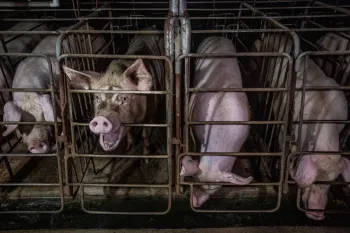
Ending animal cruelty in our food systems will need to be met by both individual commitments like New Year’s resolutions as well as systemic changes in global food production and consumption. All that starts with the profound acknowledgment that we can do better. In the humane world we envision, no animal is locked in a cage or crate where they can hardly move for months on end. Instead, farmed animals are treated with respect and care they rarely experience in our current industrial factory farming systems. It’s a world in which more plants and fewer animals are used to feed the world.
For too long, the role of animal agriculture in climate change was sidelined from climate discussions. That’s changing now: Today, more people recognize the fact that animal agriculture is responsible for about 16.5% of human-induced greenhouse gas emissions globally. Beyond emissions, the farmed animal sector is the single largest human-driven user of land, consuming approximately 83% of the world’s farmland while providing only 37% of global protein and 18% of calories.
As 2025 came to a close, our team attended the United Nations’ 30th conference of parties on climate change, COP30, in Belém, Brazil, to underscore why tackling climate change will require transforming both food systems and the consumption habits that drive demand for products that come from industrial animal agriculture.
We co-organized an event at the conference “Nourishing Climate Action: Policy Tools for Climate-Aligned and Resilient Food Systems” alongside partners including ProVeg International, Mercy For Animals, Compassion in World Farming, Good Food Institute, Foodrise and Food Tank. Together, we showcased a case study involving Brazilian municipalities that are leading the way—implementing climate-aligned food policies, shifting procurement to serve more plant-based meals in schools and educating nutritionists, school directors, and teachers on the sustainability and health benefits of plant-forward eating.
COP30 in Belém also witnessed the launch of a framework that guides financial institutions to acknowledge the climate impacts of animal agriculture, set measurable targets and redirect capital toward more sustainable, humane plant-protein systems.
Food systems transformation requires collaboration from a host of interested parties, from municipal kitchens to global finance institutions. We are aligning local action with advocating for international policy to expand understanding and support for plant-forward solutions among educators, civil society groups, chefs, financial institutions and policymakers.
While we continue our hands-on work with procurement officials and chefs to bring more plant-based meals to institutions worldwide, we’re also advocating for systemic public policy change in other channels—urging policymakers at the UN Framework Convention on Climate Change to recognize that a plant-forward global food system is key to both mitigating and adapting to climate change.
By scaling up plant-forward programs within key institutions and embedding food systems into climate policy, we can nourish both people and the planet. Creating a more humane world means creating a sustainable future—one where we can all thrive in a healthier environment while sparing millions of animals from suffering.
Kitty Block is president and CEO of Humane World for Animals. Follow Kitty Block.