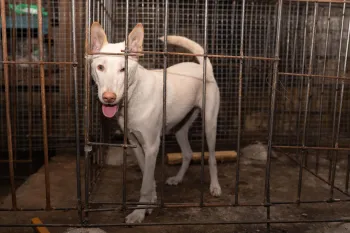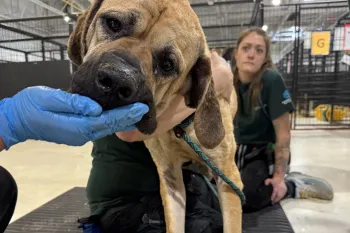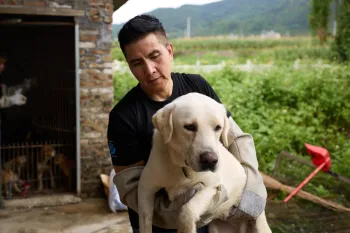
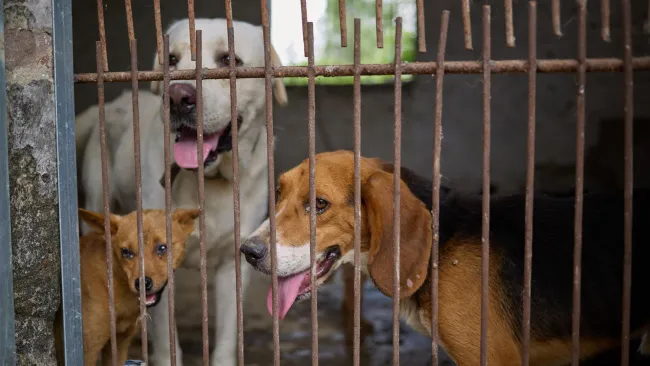
Some dogs were still wearing their collars when they were rescued by our local partner from a dog slaughterhouse just outside Yulin.
Doubtless, you know the name Yulin; it has become a city synonymous with dog meat, due to its so-called Lychee and Dog Meat Festival. And, as those collars attest, the gut-wrenching truth is that dogs and cats slaughtered to feed the dog and cat meat trade are often stolen pets.
The Yulin event was launched in 2010 by dog meat traders to encourage dog meat eating and boost sales. Due to mounting opposition from voices inside and outside China, the “festival” was stopped a few years later. However, dog slaughter and dog meat sales have continued, though in a more subdued fashion, in the days leading up to and around the summer solstice.
For years, activists have spoken out against the event and done what they could to rescue animals before they meet cruel and brutal ends. But this is the first time a dog slaughterhouse in the Yulin region has worked with rescuers to close up shop and start a different kind of business.
Confidential for Humane World for Animals
This approach to dismantling this cruel trade is at the heart of our Models for Change program, which has already helped dog meat traders in South Korea, Viet Nam, India and Indonesia switch to livelihoods that are more humane and financially sustainable. It has also provided a template by which South Korea’s dog meat farming industry is coming to an end.
Now, through our Chinese partner Vshine, this same approach has debuted in Yulin.
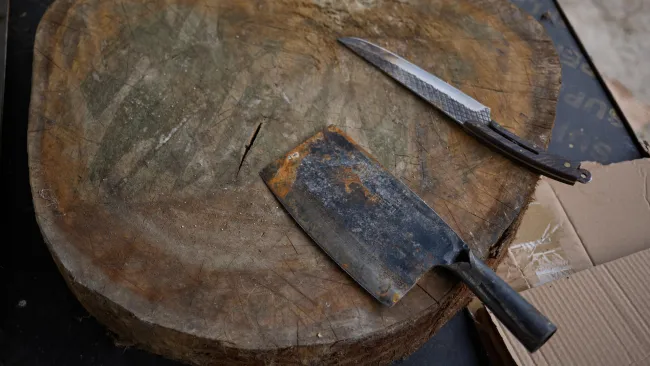
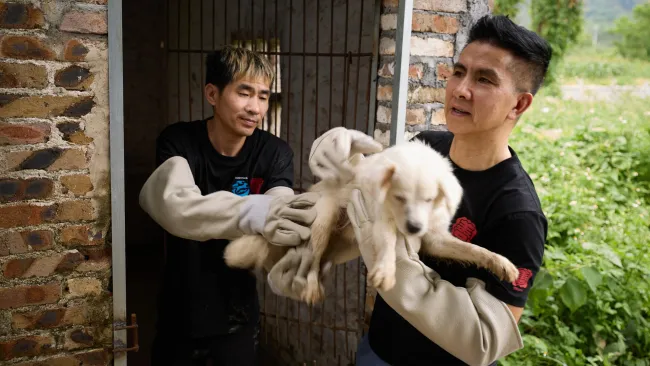
Days before the start of the infamous event, animal activists from Vshine Animal Protection Association secured a legally binding agreement with the dog slaughterhouse owner to close the facility that has killed more than 15,000 dogs since it began operating.
Confidential for Humane World for Animals
The slaughterhouse owner, who has been killing dogs for nearly 20 years, was present for the closure and said it brought him a sense of relief. “I’m looking forward to a peaceful life,” he said. “Without the support from this program, I would not have been able to make this life change but I think a lot more dog meat businesses in Yulin would choose to close if they had this kind of support.”
He is considering starting a breakfast catering business, serving rice porridge, fried dough and steamed buns.
Meanwhile, the dogs rescued from the slaughterhouse are recovering and receiving veterinary care. At our partner’s shelter, they will be quarantined, vaccinated and sterilized before being made available for local adoption into safe and loving homes.
This first-ever permanent closure of a slaughterhouse that has supplied Yulin’s dog meat is a monumental achievement, and we are honored to have been able to provide funding and technical guidance to Vshine for this closure. Our hope is that the Yulin authorities will see what policy makers in South Korea have seen, that it’s possible to dismantle the trade in cooperation with traders rather than in conflict, as long as they are supported in transitioning to something new. This could be just the first of more to come.
But we also know that permanent change depends on strong laws against animal cruelty. Earlier this year, our partner submitted a legislative proposal to the National People’s Congress to improve companion animal protection across China, including a nationwide dog and cat meat trade ban.
Confidential for Humane World for Animals
More dogs and cats are killed for meat in China than anywhere else; an estimated 10 million dogs and 4 million cats are slaughtered each year. Still, most people in China don’t eat dogs and cats. The trade is even banned in the major cities of Shenzhen and Zhuhai.
Across Asia—in Viet Nam, China, Cambodia, Indonesia and several states in Northeast India—an estimated 20 million dogs and 6 million cats are killed for the meat trade.
I know these numbers can sound unbearable and daunting—and the scale of suffering unfathomable. But keep in mind that when we started our Models for Change program over a decade ago, and began closing dog meat farms in South Korea, we were told that achieving a ban on the dog meat industry in the country would be impossible. Now the last dog meat farms in South Korea are shuttering in preparation for next year, when the full ban on the industry in the country will take full effect.
We have demonstrated that through hard work, determination and dedication we can make the impossible possible, and we will persevere in that effort until the dog and cat meat trade is consigned to history across Asia.
Humane World for Animals/
End the dog and cat meat trade
Dogs and cats who are victims of the meat trade are mostly stolen pets or street animals that endure immense suffering before being slaughtered. Take action to speak out about this cruel and dangerous practice.
Kitty Block is president and CEO of Humane World for Animals. Follow Kitty Block.