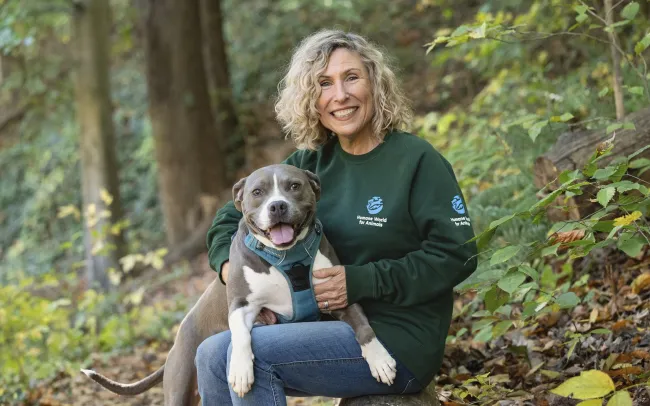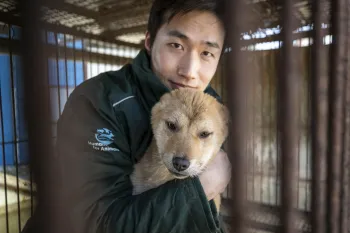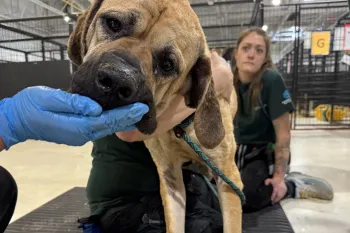
In May, seven dogs arrived at our care and rehabilitation center in Maryland. These pups had just flown from South Korea—they had burns on their skin and were extremely timid. They had seen and experienced things that would leave a terrible mark on anyone.
While dog meat farming is being phased out in South Korea, some dog meat farms continue to operate for now. So, when a deadly wildfire broke out in Andong and people fled the region, the dogs at the meat farm there had nowhere to run. Hundreds of them perished.
But these seven dogs survived.
Discovered by Korean K9 Rescue, they suffered from burns and smoke inhalation, as well as trauma. As our experts worked with them, they slowly began to trust people again.
Years ago, we understood we couldn’t rescue our way out of the cruel dog meat industry in South Korea. Instead, we launched our Models for Change program which not only rescued animals, but also showed farmers how to transition to other, more humane ways of making a living. When the ban is implemented, we estimate it’ll save as many as one million animals a year from the industry.
The progress we’ve helped to achieve in South Korea exemplifies our approach to the most entrenched animal cruelties all over the globe—we respond to the needs of individual animals in crisis, like those seven dogs, but we also work to achieve our vision: The end of animal cruelty, and a more humane world.
Across Asia, our teams are working to end the dog and cat meat trade through raising public awareness, advocating for laws, training law enforcement officials and transitioning owners of dog and cat meat farms, restaurants and slaughterhouses to new humane and sustainable livelihoods. Here is a look at some of our 2025 highlights.
South Korea
During the phase-out period of the dog meat industry in South Korea, Humane World for Animals Korea has worked closely with the government to raise public awareness of and support for the Dog Meat Ban Special Act to ensure that it is fully implemented and enforced.
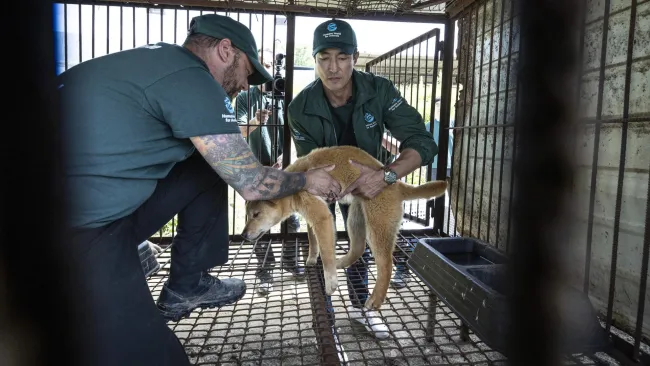
In February 2025, we uncovered an illegal dog meat farm that had violated the Animal Protection Act by killing a dog in the presence of other dogs. Local authorities closed the farm and requested our team’s help in rescuing and rehoming the surviving dogs. In total, 67 dogs were saved from the farm. To maximize the impact on public awareness, Korean American actor Daniel Henney joined our rescue team and helped prepare the dogs for international transport to our care and rehabilitation center in the U.S., where they recovered before adoption.
Jean Chung
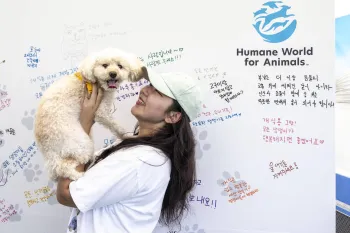
During the summer, we launched a campaign inviting the public to participate in a run during Bok Nal, the period when dog meat consumption has historically peaked. The campaign reimagined Bok Nal as a celebration of health and vitality, encouraging people and their companion animals to take part in physical activity together rather than defaulting to the belief that eating dog meat during warmer months enhances well-being. Participants ran or walked 4.6 km or 4,600 steps, a number symbolizing the estimated 460,000 dogs still trapped in South Korea’s dog meat industry.
Indonesia
Momentum to end the dog and cat meat trade in Indonesia has never been stronger. This year, the Dog Meat Free Indonesia coalition, of which Humane World for Animals is a founding member, achieved a historic milestone: three legislative proposals were submitted and accepted onto the national agenda for consideration, including a bill that proposes an explicit ban on the dog and cat meat trade. The bill is now part of the 2026 Priority Legislative Program which means it will be debated in parliament in Jakarta next year, with four major political parties, including the ruling party, backing the ban.
On the local level, change is quickly accelerating with 114 jurisdictions already issuing directives or regulations restricting the trade. Just recently, the capital of Indonesia, Jakarta, enacted a regulation that prohibits the commercial trade and slaughter of dogs and cats for human consumption. This historic milestone marks the first time a provincial government in Indonesia has enacted binding legislation explicitly banning the dog and cat meat trade, aligning with international efforts to protect public health, uphold animal welfare standards and reduce the risk of zoonotic disease outbreaks. In East Nusa Tenggara province, our project with Jakarta Animal Aid Network cast light on the link between rabies and the dog meat trade, making the case that ending this trade should be an integral part of rabies elimination strategies. This initiative includes mass rabies vaccination efforts, community outreach and lobbying for provincial regulations to end the trade. It is a model for how animal welfare and public health can advance together.
India
While the dog meat trade in India is illegal and the majority of the country does not eat dog meat at all, it has a complex history, as it has been associated with traditional tribal practices in remote northeastern states involving vulnerable women and youth in some communities. But over the years, the trade has become a truly ruthless pursuit, costing the lives of countless street dogs and stolen pets. In 2025, we began implementing a cohesive strategy to address the trade through an approach of cultural sensitivity, local partnerships and respect for the law. Our primary focus in 2025 has been stopping the smuggling of dogs from the state of Assam to neighboring states for the dog meat trade, while launching a livelihood conversion program for women vendors so that they can transition to humane and sustainable businesses.
Our work in Assam this year began with a convening of over 70 animal advocates, animal welfare organizations, government and law enforcement representatives from five northeastern states. The group collaborated on mapping existing intelligence on the trade, building capacity on legal procedures and creating new opportunities for collaborative efforts to strengthen their overall impact.
In Nagaland, our pilot program with a local partner helped 25 women receive training on livelihoods such as pickle making, baking and plans to expand to vegetable farming. The women also learned about financial literacy, marketing and business skills, as well as support for getting loans from a bank along with a small seed fund to help them get started in new and more humane lines of business.
As part of capacity-building efforts, 104 police officers in Assam received training on how to enforce the laws related to the dog meat trade. Over 20 officers of the Railways Police Force learned how to enhance surveillance and prevent the illegal transport of dogs via trains to neighboring states.
We are also supporting local organizations who have rescued dogs from the dog meat trade, take care of these animals till they are ready for adoption.
Viet Nam
In Dong Nai Province we worked on a study on cross-border transportation of dogs and cats for the meat trade. This has included conducting a survey at border points and quarantine stations to collect data for our 2026 campaign strategy to significantly reduce and disrupt these transportations in the future.
We are also working with the city of Thai Nguyen on a mass vaccination project in six communes including public awareness outreach at a local level on the link between rabies and the dog meat trade.
China
In 2025, with our support, our China partner group, Vshine, produced a comprehensive report on recent dog meat market sales and public attitudes toward dog meat consumption in Yulin, a hub of the dog meat trade. The report based on a three-week field survey encompassed eight markets, 50 dog meat restaurants, 60 dog meat stalls, and four slaughterhouses, as well as interviews with 160 urban and rural residents of Yulin. The findings provide important data for Humane World for Animals’ 2026 campaign against the Yulin Dog Meat “festival” and showed that most residents in Yulin are not supportive of this now notorious event. On June 17, Vshine submitted a formal letter to the Yulin Party Secretary presenting the survey results and urging immediate action to end the sale of dog and cat meat within the city. On the same day, Vshine submitted petitions to both the Standing Committee of the National People's Congress and the Minister of Agriculture, advocating for legislative and administrative measures to terminate the dog meat trade across the country. Vshine also delivered a global petition to the Beijing representative office of the Guangxi Autonomous Region government. This petition, endorsed and signed by over 180,000 animal welfare advocates worldwide, called upon the Guangxi and Yulin authorities to shut down the dog meat trade within the province and the city of Yulin.
As part of the broader anti-dog meat campaign, Vshine conducted the “Dalian Animal Friendly City Public Opinion Survey,” which revealed strong public support in Dalian for companion animal protection and for outlawing the dog and cat meat trade in this major city in northeastern China. The resulting report was presented to national and local media outlets. Coverage of the findings by more than 20 Chinese media organizations is helping galvanize efforts to persuade the Dalian local legislature to enact a companion animal protection law, which would include provisions prohibiting the sale and consumption of dog meat. If successful, Dalian will become the third city in mainland China to ban the dog and cat meat trade, marking a historic milestone for animal protection in the country.
—
Throughout 2025, we were steadfast in our determination to change the world for the dogs and cats who are stolen or farmed for slaughter. In the coming years, we will continue this work relentlessly until the dog and cat meat trade is nothing more than a distant bad memory.
Kitty Block is president and CEO of Humane World for Animals. Follow Kitty Block.