Today marks two years since the ban on dog meat officially passed in South Korea. Since enforcement began, 1,204 dog farms—or about 78% of all dog farms in the country—have closed. When we started advocating for an end to the industry, about a decade ago, government estimates indicated that there were more than 17,000 dog meat farms.
The phase-out of this industry—from 17,000 dog meat farms to now just over 330—represents a huge achievement. For decades, these facilities had been sites of suffering and death for millions of dogs and would have gone on to torment and kill countless more had the ban not been passed. And this progress is possible because of continued efforts from Humane World for Animals Korea and other Korean animal welfare groups during the phase-out period of the dog meat industry. We’re working to ensure that awareness of and support for the ban remains high so full implementation can be smoothly achieved.
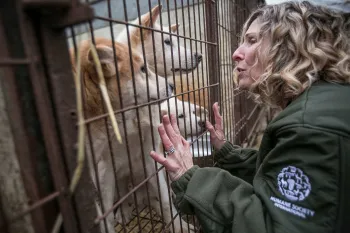
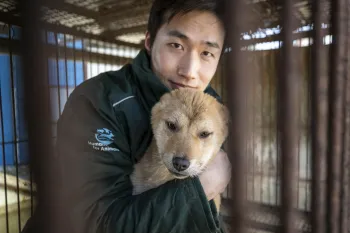
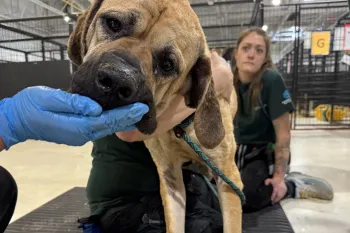
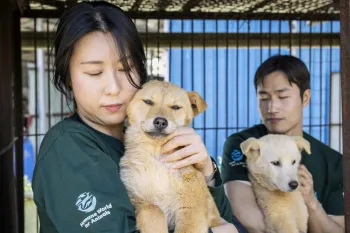
We are also continuing our efforts to rescue dogs from dog meat farms, giving them the chance to live full, loving lives. Later this month, we will be flying 16 dogs we rescued last year from meat farms to Canada for adoption. Additionally, in the spring, we plan to conduct another rescue as part of a farm closure operation.
Because the dog meat ban has no specific directive related to rescuing dogs, our rescues have become even more meaningful. With heavy hearts, we know we cannot save them all, but every life matters. In total, we have rescued nearly 2,800 dogs from dog meat farms in South Korea since our Models for Change program began over a decade ago.
Meanwhile, our teams are working across Asia to end the dog and cat meat trade:
In China, we’ve been partnering and supporting Vshine in its efforts to end the dog and cat meat trade. A survey in Dalian, a major city in Northeastern China, found that 95% of citizens support legislation to protect companion animals and 99% support Dalian banning dog and cat meat; these results boost support for a companion animal protection law, which would include provisions prohibiting the sale and consumption of dog and cat meat in this city. A legislative proposal has been submitted by Vshine and if approved this would make Dalian the third city in China to ban the dog and cat meat trade. And in Yulin, infamous for the dog meat “festival,” which is held each summer, Vshine produced a comprehensive report showing that most residents in Yulin don’t support this notorious event. A petition, endorsed and signed by over 180,000 animal welfare advocates worldwide, called upon the Guangxi and Yulin authorities to shut down the dog and cat meat trade within the province and the city of Yulin.
In India, we are working closely with authorities in the northeast of the country to address the illegal cross-border dog meat trade, in which thousands of dogs are sourced from the state of Assam and transported to neighboring states. We have also launched a livelihood conversion program—this program supports vulnerable women who work in the dog meat markets in transitioning out of the trade and into humane, sustainable livelihoods—and are engaging with authorities to stop the dog meat trade.
In Indonesia, a bill that proposes an explicit ban on the dog and cat meat trade, which is backed by four major political parties, including the ruling party, will be debated this year. This milestone was possible because of continued advocacy by the Dog Meat Free Indonesia coalition, of which Humane World for Animals is a founding member.
In Viet Nam’s Dong Nai province, we’re working on disrupting cross-border transportation of dogs and cats for the meat trade. In Thai Nguyen we are advancing public awareness raising programs to alert people to the dangers of rabies linked to the dog and cat meat trade and deter consumers, and in Ho Chi Minh City—the country’s second largest metropolis—we are in discussion regarding a potential three-year partnership to address the dog and cat meat trade in this city.
It is thanks to advocates all over the world that public perceptions of animals are changing. More people are welcoming companion animals into their lives, and there seems to be a wider acknowledgment that animals deserve to be treated with care and respect. In Asia, the younger generation has been at the forefront of the paradigm shift, demanding action to end the dog and cat meat trade.
When we first began our efforts to close dog meat farms in South Korea, we were told that achieving a ban on the dog meat industry in the country would be impossible. But we put our idealism into action: As our program shut down dog meat farms and transitioned farmers to more humane ways of earning a living, this work ultimately served as a model for the implementation of the nationwide ban. Now, the dog meat ban in South Korea will come into full effect next year, in February 2027.
As part of our mission to end the trade across Asia, we issued a report last year, Ending the Dog Meat Industry in South Korea: Building a more compassionate society toward dogs, which captures how animal advocates, policymakers and citizens came together to end dog meat cruelty. This is a story of how political will, shifting cultural values and strong partnerships can create lasting change for animals. And we will continue to work toward the kinder, more compassionate world at the center of our vision by advocating for a permanent end of the dog and cat meat trade wherever it exists.
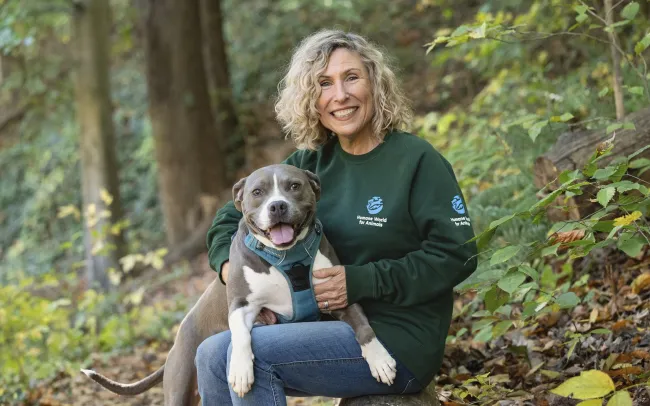
Kitty Block is president and CEO of Humane World for Animals. Follow Kitty Block.