The World Health Organization recently announced that Chile has become the first country in South America to eliminate dog-transmitted rabies. For the past few years, the team has been operating a mobile veterinary clinic in remote parts of Chile where services have been limited. Here, Daniela Benavides Sanchez, country director for Humane World for Animals Chile, tells the story of this achievement and what it will take to maintain it.
Chile’s historic recognition as the first country in South America validated by the World Health Organization for eliminating dog-transmitted rabies as a public health problem is both a milestone to celebrate and a responsibility to uphold.
For Humane World for Animals Chile, this recognition reinforces the importance of our work in the access to care space.
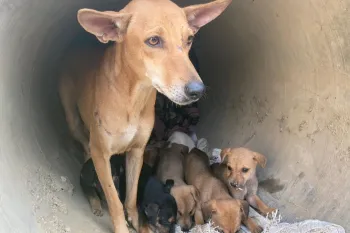
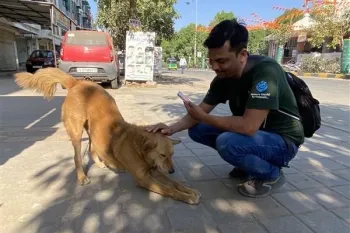
Chile is home to an estimated 4 million free-roaming dogs and cats. Many of these animals are much beloved in the communities, but without single dedicated caregivers responsible for their wellbeing, there is no guarantee that they receive basic veterinary care, including vaccinations against rabies.

Claudio Ramírez/For Humane World for Animals
Bringing veterinary care to remote communities
Access to care is especially important in underserved areas, where transport, distance, cost and limited infrastructure can prevent families from obtaining even basic care for their companion animals.
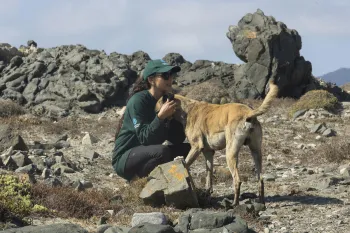
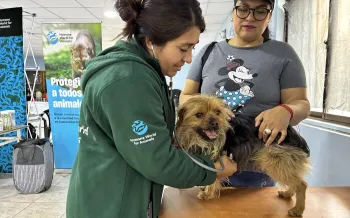
We bring free veterinary care directly to Chile’s dogs and cats in remote areas. Since 2024, we have:
- performed 2,482 sterilizations,
- administered 5,267 rabies vaccinations,
- provided 6,195 other treatments, including parasite control, microchipping and more.
Overall, we helped nearly 8,000 companion animals in just a couple of years. Activity has grown each year, with 2026 already showing strong numbers.
Elimination is not the end of the work
Eliminating dog-transmitted rabies does not mean that every risk has disappeared. Rabies continues to circulate in bats in Chile, and the movement of animals across borders creates a continuing possibility of reintroduction. Maintaining the country’s achievement therefore requires vigilance, high vaccination coverage, rapid response capacity and trusted local networks that can connect communities with public-health and veterinary services.
The greatest epidemiological risks are often concentrated where access to care is weakest, in isolated rural communities. Animals can remain unvaccinated, untreated and outside formal systems of care, while unwanted litters contribute to a growing population of free-roaming dogs and cats. That’s why we emphasize vaccination and sterilization in our mobile veterinary work.
No less important is education. During each intervention, teams speak with children and adults about animal care, vaccination, dog bite prevention, dog behavior, responsible guardianship and what to do following a potentially risky exposure. This educational component strengthens the ability of communities to care for animals over time.
Building networks that make care sustainable
Our model in remote areas begins before a clinic opens. Community assessments help us understand local knowledge, attitudes and practices, map the population of owned and free-roaming dogs and cats, identify barriers to care, and establish a baseline for measuring long-term change. This evidence guides program design so that interventions respond to the priorities identified with residents rather than imposing a one-size-fits-all solution.
Just as importantly, we build networks, working alongside municipalities, regional authorities, grassroots animal protection organizations, community leaders, veterinary professionals, universities, students and volunteers. These relationships are essential.
Diana Rodriguez/Humane World for Animals
In the Coquimbo region, for example, our teams have worked in rural communities such as Barraza, Salala and Oruro, where veterinary services have historically been limited. Local and regional government representatives have observed field activities, while veterinary faculty, students and volunteers have supported service delivery, training and community capacity-building. Grassroots organizations and local leaders remain essential partners because they understand the territory and identify families and animals most in need.
Cultivating the next generation of veterinarians
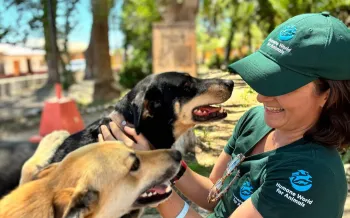
Helping animals who need care in the present also helps build a kinder, safer future by giving veterinary students supervised field experience. Students learn to practice veterinary medicine with an understanding that animal health is inseparable from the social conditions in which animals and their caregivers live. This training encourages them to consider poverty, geographic isolation, limited transportation, cultural context and other barriers that shape access to care. By integrating clinical skills with a social and vulnerability-aware perspective, students are better equipped to contribute to more equitable animal-health systems throughout their careers.
This coordinated approach turns a vaccination or sterilization campaign into something larger: a durable access-to-care network. It strengthens links among residents, civil society and government; builds local veterinary capacity; and embeds animal welfare within broader community-health systems. In practice, this is One Health/One Welfare—protecting animals and people through shared responsibility and coordinated action.
Diana Rodriguez/Humane World for Animals
The importance of placing equity at the center of this work
Chile’s rabies milestone depends on a continued commitment to equitable access to animal care. People in remote and underserved communities care deeply about their animals, but access to services should not be limited by geography, income or transportation barriers. Ensuring these communities are reached remains essential to protecting this important public health achievement.
When veterinary medicine reaches these communities, its impact extends beyond the consultation table. A vaccinated dog helps protect a family and a neighborhood. A sterilization surgery helps prevent unwanted births and supports more stable free-roaming animal populations. A conversation about animal behavior can prevent a bite. A trusted local partnership can ensure that a health concern is reported and addressed quickly.
Looking ahead
While we celebrate Chile reaching this impressive milestone of eliminating dog-borne rabies, we also acknowledge that doing so is based on a patchwork of services largely delivered by us and organizations like ours. In the long run, this is not sustainable, and we need far more state support for such services.
Chile’s achievement belongs to decades of public-health leadership and collective action. Its future will depend on continuing to work together—especially in the places that are hardest to reach. By ensuring that no community and no animal is left outside the network of care, we can protect this historic progress and build healthier, safer and more humane communities for generations to come.
Daniela Benavides Sanchez is country director for Humane World for Animals Chile.