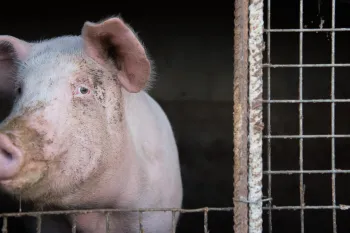
It’s been two years since the full implementation of California’s pioneering Proposition 12, one of more than a dozen state statutes responsive to citizens’ desire to reduce animal cruelty in our food production systems. Of course, the National Pork Producers Council and its allies, having failed over and over in their attempts to scuttle Proposition 12 and like measures in the courts, continue to push for congressional action to overturn the will of the people and get the handout they want: the ability to force their low-welfare pork into the markets of every state, even the ones that have explicitly and legally rejected it.
The most likely threat could emerge in a few weeks in the form of a “skinny Farm Bill”—a pared-down legislative package of agricultural measures excluded from the One Big Beautiful Bill Act last year. We’ll be ready to fight off the threat again.
We’ll do so with the wind at our backs, because a number of key suppliers have peeled away from the NPPC, shunning its belligerent litigation and lobbying efforts. Instead, they’re moving to supply California and a number of other states whose legislatures and citizens have made clear their support for higher-welfare products.
Among the hundreds of out-of-state companies already distributing Proposition 12-compliant products in California, either directly or through established distribution networks, are big players including Cargill, Hormel, JBS, Perdue, Premium Iowa Pork, Seaboard and Tyson. Even Smithfield, the Chinese-owned pork conglomerate that has strongly supported congressional action to destroy the law, is supplying California with Proposition 12-compliant products.
The congressional threat is real. Still, in key respects, the pork industry’s effort to negate animal welfare and public health laws like Proposition 12 has become more of a symbolic fight. The performative character of opposition to Proposition 12 was evident at the recent annual meeting of the American Farm Bureau Federation. There, in a closing speech, Secretary of Agriculture Brooke Rollins fed her audience the same trough of claims concerning federal jurisdiction and regulation and the United States Constitution that the U.S. Supreme Court soundly rejected in National Pork Producers Council v. Ross, the May 2023 decision that upheld Proposition 12.
One thing Rollins could not do was blame the Biden administration for Proposition 12, because her predecessor at the U.S. Department of Agriculture, Tom Vilsack, was just as woeful and misguided a critic of the measure as she is, and Merrick Garland’s Department of Justice just as wrong in its legal filings on the California law as Pam Bondi’s Department of Justice is today.
Konrad Lozinski/We Animals Media
Your voice is critical
The "Save Our Bacon Act" is bad for animals, consumers, and farmers. If it is enacted, hundreds of state laws protecting animals and addressing disease control, toxic materials, food labeling and more could be destroyed.
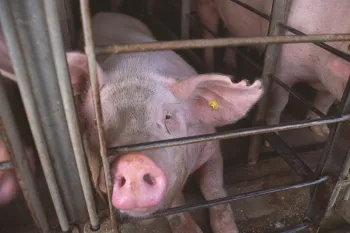
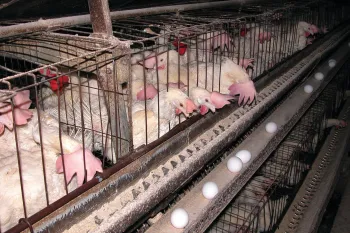
Rollins, Vilsack and those in Congress doing the bidding of the NPPC miss the point. The tipping point. Even without the passage of measures like Proposition 12, the national market, as well as the global market, are shifting in response to consumer demand that animals raised for meat and eggs are treated more humanely. The state laws now in place in states red, blue and purple have codified public values on giving animals room to stand up, turn around and lie down. Laws that address extreme confinement have strong, bipartisan support underscored by a study published at the end of 2025 that found 84% of U.S. adults believe confining mother pigs in gestation crates is unacceptable.
In their call for federal legislation to obliterate Proposition 12 and the other state laws, one still hears such critics complain of higher grocery prices and the difficulty farmers face in making long-term investment decisions without regulatory clarity. In fact, regulatory clarity is what they’re getting, state by state, law by law, and market by market, a clear resounding signal that Americans want higher animal welfare standards. Congress overturning these laws would only create regulatory chaos and pull the rug out from under those who have made investments to meet consumer demand. Recent federal data indicate jumps in prices of cereal, beverages and produce that outpace inflation, all of which have no connection to Proposition 12. Pork prices have remained fairly steady over the past year. Blaming Proposition 12 seems to be an ongoing ham-handed attempt to divert attention away from the real problems that could be caused by federal intervention.
Moreover, a swelling number of farmers and producers have already made substantial investments in higher-welfare systems not because they feel forced to do so but because they recognize the ethical and public health arguments against intensive confinement and the market opportunities that consumer demand and the new laws have created. They’re not complaining about Proposition 12 or any similar measure. They’re asking the trade associations and Congress to stay out of their way. A Missouri pig farmer named Russ Kremer put it well: “Prop 12 gives small farms like ours the opportunity to survive during a time when agriculture is heavily consolidated and independent farmers are being pushed out. If Congress rolls back Prop 12, that's a move against family farmers.”
Interestingly, a letter from Rollins introduced at a congressional hearing in July reported that USDA data shows 27% of pork producers were already Proposition 12-compliant as of April 2025. The market is shifting. Attitudes are changing. And so are our laws. This is how things work. The stodgy, hidebound doomsayers—in the trade associations, in Congress, and in the administrative branch of government—don’t just have it wrong. They’re doing wrong.
The incessant talk of a “fix” by the sponsors of the Save Our Bacon Act and similar measures is not merely a diversion. It’s a disservice. There’s no problem here, and there’s no fix required. What we have is a swell of opinion and movement in a direction that’s better for animal welfare. It’s also better aligned with the ethical convictions of millions of ordinary Americans who don’t want to see special interests destroy a legal framework that embodies the best of human values—compassionate regard for billions of animals who are entirely at our mercy, their fates hanging on the triumph of those values.
Kitty Block is president and CEO of Humane World for Animals. Follow Kitty Block on X. Sara Amundson is president of Humane World Action Fund.